
Religion · –
1009: The Destruction of Jerusalem’s Holy Sepulchre
The church was destroyed in 1009. The surviving evidence attributes the destruction to Fatimid caliph al-Hakim, while preserving uncertainty about motive, scope, and responsibility for every aspect of the event.
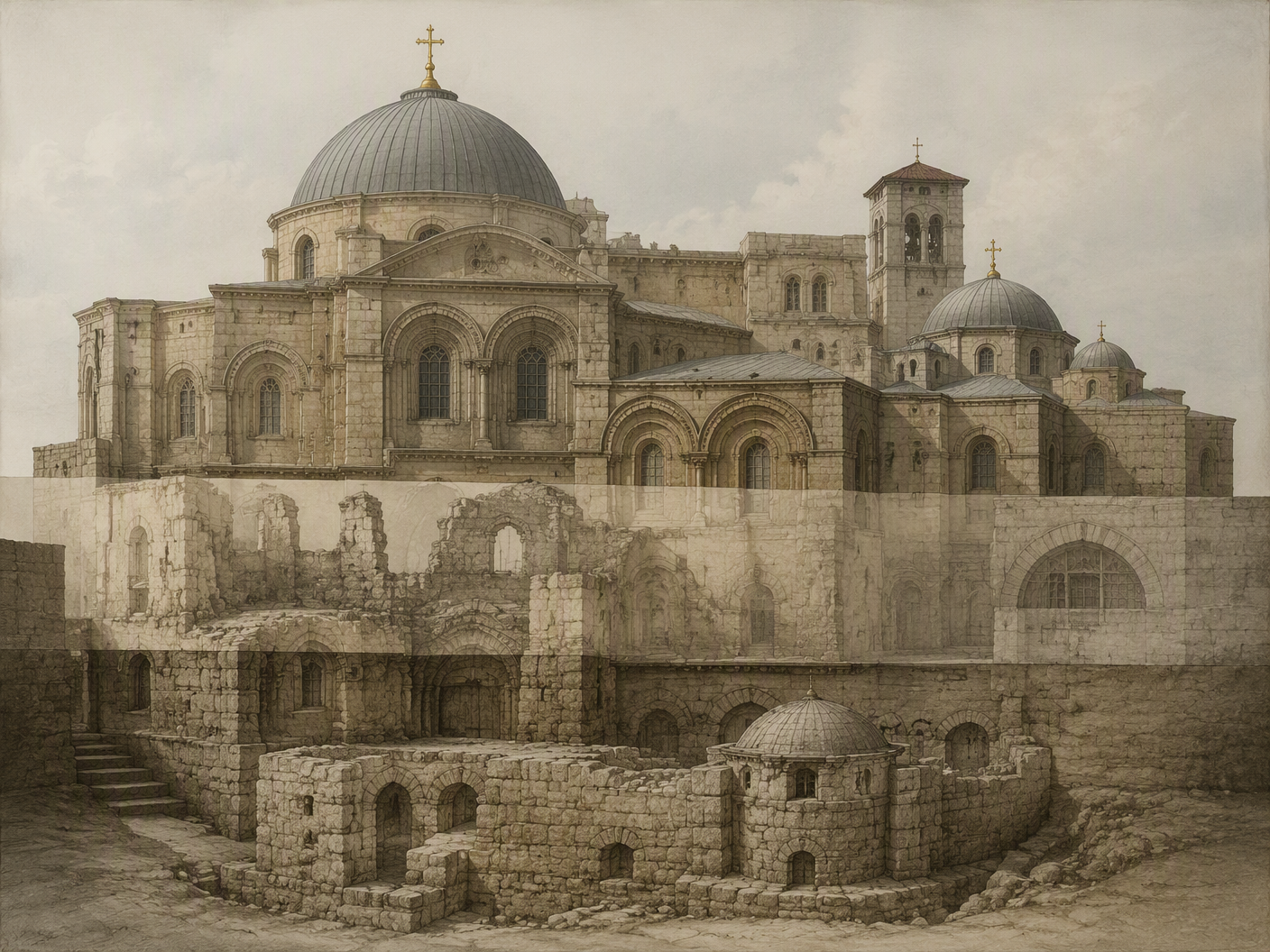
In 1009, Jerusalem’s Church of the Holy Sepulchre was destroyed. The building was also known as the Church of the Resurrection, a designation used in the chronology of the Jerusalem Patriarchate and listed among the established names recorded by the Getty. These points are independently supported by a scholarly study and two institutional records. The event itself is therefore more securely established than explanations of its motive, scope, or responsibility for every aspect of the destruction.
The destruction is attributed in the surviving institutional records to al-Hakim, the Fatimid caliph. The Jerusalem Patriarchate chronology associates the event with Hakem, while the Getty identifies Al-Hakim bi-Amr Allah as the Fatimid ruler connected with the destruction. A scholarly study also places the event within the policies associated with his reign. That attribution is supported, but it does not by itself establish every detail of what happened at the site.
The available evidence describes the destruction in the context of anti-Christian religious policies associated with al-Hakim’s reign. That formulation comes from the scholarly study and should remain bounded by what it establishes. It does not supply a more specific motive, prove a broader coordinated program, or resolve responsibility for every part of the event. The distinction matters because contextual interpretation can explain how historians situate an episode without answering every question about its causes.
One account requires especially careful attribution. The scholarly study reports that Adémar of Chabannes attributed the destruction to Jews and Muslims from al-Andalus. This is Adémar’s account and explanation, not an independently established finding about who caused the destruction. The evidence therefore permits reporting what Adémar said, while prohibiting its presentation as settled fact. No stronger conclusion about communal responsibility is established by the independently verified material.
The Jerusalem church’s name also carries historical importance. The Jerusalem Patriarchate uses Church of the Resurrection as its primary designation for the site, and the Getty record lists that name among the building’s established titles. Thus, references to the Holy Sepulchre and the Resurrection church concern the same destroyed building in this account. The naming evidence clarifies the subject without adding claims about the event’s causes or wider consequences.
What can be said with confidence is narrower than a complete narrative of the destruction. The church in Jerusalem was destroyed in 1009, and the captured institutional records associate that destruction with al-Hakim. The scholarly source independently reports the event and supplies its policy context. Together, these sources support the date, place, building, and attribution while leaving motive and the full distribution of responsibility less securely established.
The site did not remain permanently in the condition produced by the destruction. The Jerusalem Patriarchate records reconstruction in 1027–1048 by the emperors of Byzantium. The Getty describes rebuilding by Constantine IX Monomachos, the Byzantine emperor, without specifying the same date range. These records establish later Byzantine rebuilding or reconstruction, but they do not turn the later structure into the intact church that stood before 1009.
The rebuilding record also places a boundary around what later architectural history can prove. Byzantine sponsorship or authority is documented in the institutional accounts, yet the sources do not provide a continuous reconstruction history in the material reviewed here. The verified claim is that the church was later rebuilt or reconstructed under Byzantine authority. It is not that every later phase, surviving wall, or architectural element belongs to that rebuilding.
The Getty’s architectural record adds another qualification: the present-day church is largely a later structure, with much of it dating from 1810. That statement provides architectural context rather than a continuous account of rebuilding from the eleventh century to the present. It supports the conclusion that today’s building is not the intact church destroyed in 1009, while avoiding claims about which specific portions derive from particular earlier phases.
The distinction between historical site and present structure is essential. The church destroyed in 1009 was later rebuilt under Byzantine sponsorship or authority, and the present-day church is largely from 1810 according to the Getty record. Those facts describe change over time without implying that the sources establish an uninterrupted architectural sequence. They also prevent the modern building from being treated as the untouched survivor of the medieval destruction.
The evidence consequently supports a restrained account. Jerusalem’s Church of the Holy Sepulchre, also called the Church of the Resurrection, was destroyed in 1009. The destruction is attributed to Fatimid caliph al-Hakim, and a scholarly study places it in the context of anti-Christian policies associated with his reign. Adémar’s allegation about Jews and Muslims from al-Andalus remains explicitly his account, not an independently verified conclusion about responsibility.
Later history is established in similarly limited terms. Institutional records describe rebuilding under Byzantine sponsorship or authority, including reconstruction recorded for 1027–1048 and rebuilding associated with Constantine IX Monomachos. The Getty states that the present-day church is largely from 1810. The verified record therefore distinguishes the 1009 destruction, later Byzantine reconstruction, and modern architectural form, without inventing motives, a broader program, or outcomes beyond those documented.
Companion notes
What the Evidence Establishes
Dek: Three independent records support the destruction, its attribution, and the later history, but they do not resolve every question about motive or responsibility.
The Event and the Building
The scholarly study and both institutional records identify the destruction of Jerusalem’s Church of the Holy Sepulchre in 1009. The Jerusalem Patriarchate chronology uses Church of the Resurrection as the site’s primary designation, while the Getty lists that name among its established titles. The event and the building’s identity are therefore supported across the reviewed evidence. A1, A2, A3
The agreement on the date does not eliminate the need for limits. The records establish that the church was destroyed in 1009, but they do not, in the material reviewed, establish every physical detail of the destruction or a complete account of what occurred at the site. A responsible narrative should separate that verified event from unsupported elaboration. A1, A2, A3
Attribution and Context
The institutional records associate the destruction with Hakem or Al-Hakim, and the Getty identifies Al-Hakim bi-Amr Allah as the Fatimid caliph. The scholarly study likewise connects the event with anti-Christian religious policies associated with his reign. This supports attribution and context, but the evidence does not establish a more specific motive or a broader coordinated program. A1, A2, A3
The scholarly study reports Adémar of Chabannes’ attribution to Jews and Muslims from al-Andalus. Its presentation is an account by Adémar, not an independent finding that those groups caused the destruction. That distinction is central: the report can be described as part of the historical evidence, while responsibility remains more limited than the allegation itself. A1
Rebuilding Under Byzantine Authority
The Jerusalem Patriarchate records reconstruction in 1027–1048 by the emperors of Byzantium. The Getty separately describes rebuilding by Constantine IX Monomachos, the Byzantine emperor, without specifying a date. Taken together, these institutional records support later rebuilding or reconstruction under Byzantine sponsorship or authority, while avoiding claims about an uninterrupted sequence of construction phases. A2, A3
The rebuilding evidence concerns what followed the destruction, not a recovery of every detail about the original church. It establishes that the site was reconstructed under Byzantine authority or sponsorship. It does not establish that the later building preserved all earlier fabric, nor does it provide a complete architectural history between the recorded rebuilding and the modern structure. A2, A3
The Modern Structure
The Getty record states that the present-day church is largely from 1810. That description supplies architectural context and supports the conclusion that the modern church is not the intact building destroyed in 1009. It should not be expanded into a claim that every part of the present structure dates from 1810, because the record’s wording is expressly qualified. A3
The reviewed evidence thus separates three points in time: destruction in 1009, later rebuilding associated with Byzantine authority, and a present-day church largely dating from 1810. The records support that broad sequence, but not every intermediate stage or cause. The strongest account remains one that preserves those qualifications and treats disputed responsibility with explicit attribution. A2, A3
Source key
The associated evidence page provides source roles, links, and the claim ledger.