
Apocalyptic violence · 1995–2000
Five Subway Cars, One Chemical Agent, and the Record of Aum’s 1995 Attack
On March 20, 1995, Aum Shinrikyo members released sarin in Tokyo subway trains during the morning rush. Official and technical records document the attack’s reach, its human toll, the forensic work that followed, and the formal prosecutions that were under way by 2000.
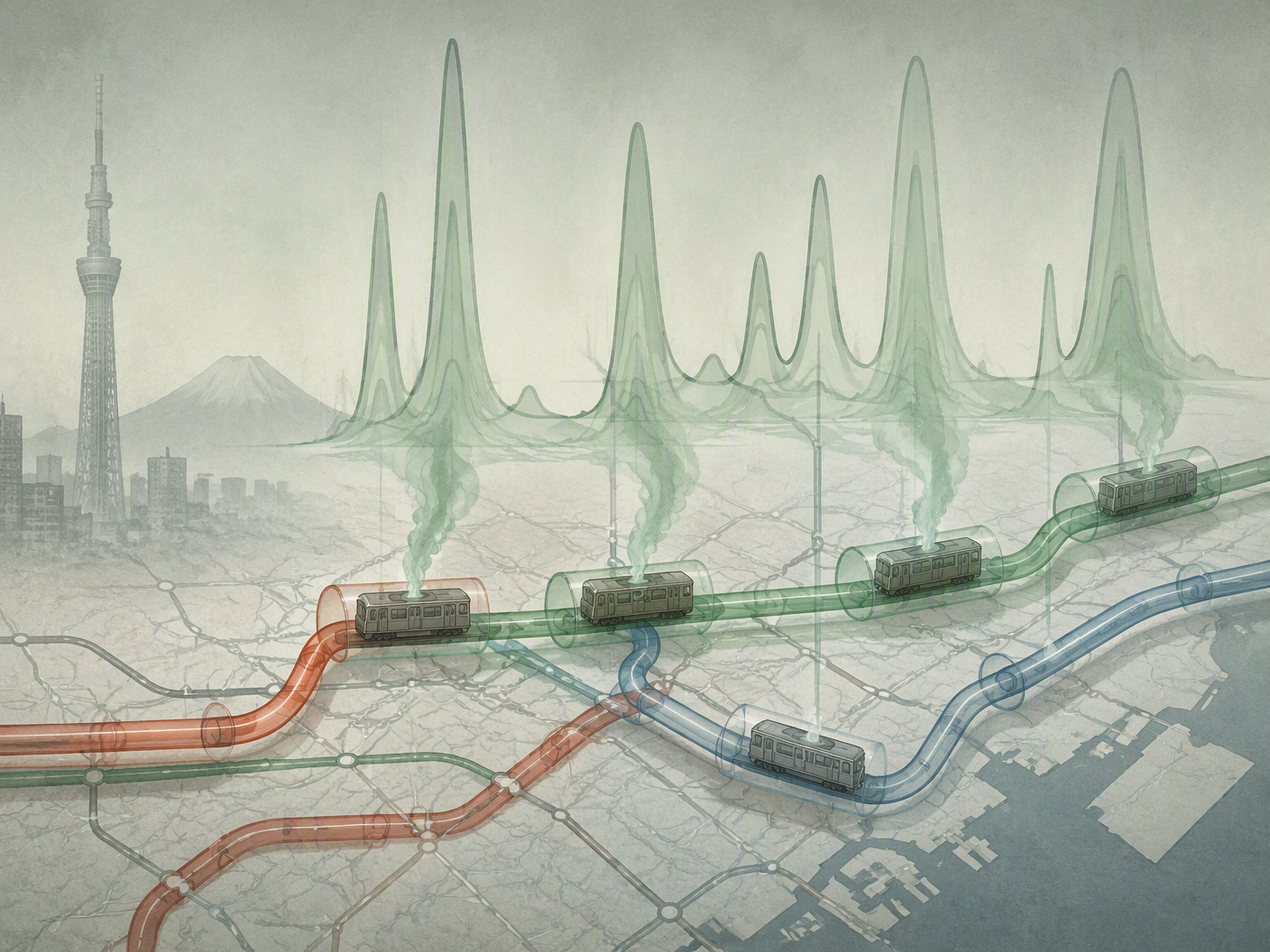
At 8 a.m., according to an OPCW-hosted technical account, sarin was released separately in five Tokyo subway cars. The trains ran on three subway lines during the peak morning rush. That operational detail is the first measure of the attack’s mechanism: a chemical agent was placed inside ordinary transit vehicles, where passengers and station personnel encountered its effects within a public transportation system. The record does not require an imagined command room or a reconstructed scene. It identifies the cars, the lines, the timing, and the substance.
The event took place on March 20, 1995. Aum Shinrikyo members released sarin in the Tokyo subway system, an act attributed to the organization in the official accounts used here. Aum Shinrikyo had been established by Shoko Asahara, also known as Chizuo Matsumoto. Those facts establish an organization, a founder, a date, a place, and a chemical agent. They do not, by themselves, establish every claim about Asahara’s leadership or doctrine.
The documented arrangement placed the release inside a working transit system. Five cars were involved, and the trains operated across three lines during the morning rush. Those details establish where and when passengers and station personnel encountered the chemical agent. They describe the attack’s physical arrangement without supplying a complete account of motive, planning or the intentions behind the choice of the subway.
The recorded human toll was twelve deaths and approximately 5,000 injuries. The dead included passengers and station personnel. The wording matters: the source gives a precise number for those killed and an approximate figure for those injured. It does not offer, within this record, a more detailed breakdown of the injured, their symptoms, or the circumstances of each death. What it does establish is the scale of harm linked to the Tokyo subway incident.
The technical account also keeps two incidents from being collapsed into one. It separately reports that the 1994 Matsumoto incident and the 1995 Tokyo incident together caused 19 deaths. That combined figure is not the Tokyo subway total. For the subway attack itself, the stated count is twelve people killed and approximately 5,000 injured. Preserving that distinction is part of preserving the evidence: a combined number cannot silently replace an event-specific one.
The investigation turned the attack’s invisible agent into a matter for chemical analysis. Japanese forensic laboratories identified sarin in evidence from the Tokyo subway incident using gas chromatography/mass spectrometry, or GC/MS. The same technical account reports detection of sarin-related compounds in victims’ blood. Those findings supplied a forensic basis for identifying the substance and contributed to the criminal investigation and court trials.
That laboratory record is powerful but bounded. The available account describes the analyses and their role in the investigation; it does not reproduce the underlying laboratory records in this evidence set. The distinction separates a reported forensic finding from a direct review of every test, sample, and result. It also explains why the technical history is central: the account documents chemical identification without claiming to provide a complete reconstruction of every investigative step.
The legal response can be measured in a different kind of record. The Japanese Ministry of Justice reported that, as of June 20, 2000, formal-trial prosecutions had been instituted against 189 people in cases alleged to involve Aum Shinrikyo members. The ministry said those cases began with the March 20, 1995 subway sarin attack. This was a statement about the status of proceedings at a particular date, not a final accounting of convictions.
That qualification changes how the number 189 should be read. It describes people against whom formal-trial prosecution had been instituted in cases alleged to involve Aum members. It does not establish that every defendant was convicted. The number therefore documents the breadth of the state’s prosecutorial response by June 20, 2000, while preserving the difference between being prosecuted and being found guilty.
The records divide the story into distinct kinds of authority. The Public Security Intelligence Agency provides an institutional account of Aum’s establishment and the attack’s attribution. The OPCW-hosted technical account supplies the operational details, casualty figures, and forensic description. The Ministry of Justice supplies a dated account of formal prosecutions. None of those perspectives should be made to prove more than it says; together, they document the attack, its effects, its chemical investigation, and the proceedings that followed.
A later institutional record extends the chronology, but not the 1995 event itself. In a webpage updated September 29, 2022, the Public Security Intelligence Agency stated that Aum Shinrikyo remained divided into successor groups and subject to statutory surveillance. The account described a renewed surveillance disposition under the Organization Control Act and presented these as claims by the agency and the Public Security Examination Commission. It belongs to the history of later state oversight, not to independent proof of current danger.
The established record is therefore both stark and limited. Aum Shinrikyo, founded by Shoko Asahara, is identified in these sources with the March 20, 1995 release of sarin in five subway cars across three lines. Twelve passengers and station personnel were killed and approximately 5,000 people were injured, according to the technical account. Forensic laboratories identified sarin or related compounds, and formal prosecutions had reached 189 people by June 20, 2000. The later surveillance account remains an institutional statement about successor groups, outside the event boundary.
Companion notes
How the Evidence Fixes the Attack’s Scale
The available records come from Japanese government institutions and an OPCW-hosted technical account. Their value lies in the distinctions they preserve: operational detail versus institutional attribution, event-specific casualties versus combined totals, and prosecution figures versus convictions.
Organization and attribution
The Public Security Intelligence Agency identifies Shoko Asahara, also known as Chizuo Matsumoto, as the founder of Aum Shinrikyo. Its account attributes sarin attacks on the Tokyo subway system to the organization under Asahara’s direction. The narrower verified conclusion is that Aum members released sarin in the Tokyo subway attack. The source supports the organizational attribution but does not independently establish every claim about Asahara’s leadership or doctrine. A1
A separate institutional source, the OPCW-hosted account The Sarin Gas Attack in Japan and the Related Forensic Investigation, supplies the date: March 20, 1995. Read together, the records establish the organization, founder, substance, location, and date. They do not provide a complete account of motive, internal structure, or doctrine within the verified claims. A1, A7
Operational facts and human effects
The OPCW-hosted technical account reports that sarin was released separately in five subway cars at 8 a.m. The trains operated on three subway lines during the peak morning rush. These details describe the physical reach of the release without requiring additional assumptions about planning or intent. The exact number of cars and lines is reported in this account and is not independently corroborated by the other cited sources. A7
The same account reports twelve passengers and station personnel killed and approximately 5,000 people injured. It separately gives a combined figure of 19 deaths for the 1994 Matsumoto and 1995 Tokyo incidents. That figure must not be substituted for the Tokyo event’s stated toll. The available record does not supply a fuller injury breakdown. A7
Forensic bridge
According to The Sarin Gas Attack in Japan and the Related Forensic Investigation, Japanese forensic laboratories detected sarin in crime-scene evidence through GC/MS. The account also describes detection of sarin-related compounds in victims’ blood. It reports that forensic chemical analysis contributed to the criminal investigation and court trials. This is a description of reported technical work, not a reproduction of the underlying laboratory records. A7
Proceedings and later oversight
The Japanese Ministry of Justice document State of Trials and Sentencing in Cases Involving Aum Shinrikyo Cult Members reports that, as of June 20, 2000, formal-trial prosecutions had been instituted against 189 people in cases alleged to involve Aum members. The cases began with the March 20 subway sarin attack. The ministry’s figure describes proceedings at that date and does not establish that every defendant was convicted. A2
In a webpage updated September 29, 2022, the Public Security Intelligence Agency stated that Aum remained divided into successor groups and subject to statutory surveillance. The account described renewal of a surveillance disposition under the Organization Control Act and presented those points as institutional claims by the agency and the Public Security Examination Commission. This later status is outside the 1995 event boundary and is not independent proof of current danger. A1
Source key
The associated evidence packet contains visible source URLs, source roles and the complete claim ledger.