
Contested histories · 1978
John Paul I’s 33 Days, and the Unsettled Record of His Death
Albino Luciani was elected pope on 26 August 1978 and died 33 days later. The captured record fixes the dates but does not independently establish a medical cause, leaving competing reported accounts unresolved.
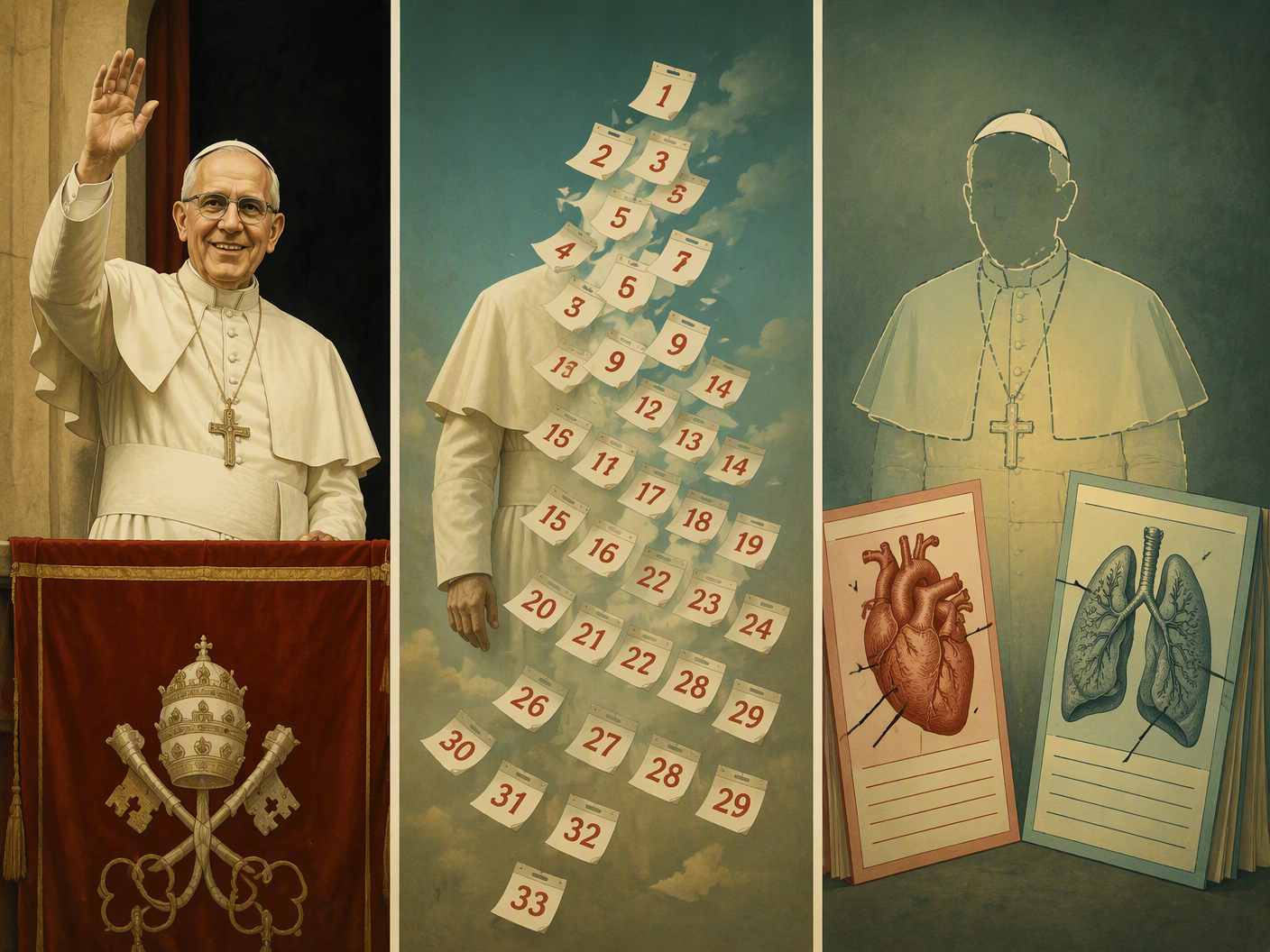
The chronology is compressed: Albino Luciani was elected pope on 26 August 1978, chose the name John Paul I, and died on 28 September. His pontificate lasted 33 days. Those dates are the firm spine of the account, repeated in the official biography and in other captured sources. Around that spine, however, the circumstances of his death remain less settled. The record fixes when his pontificate began and ended more clearly than it explains why it ended.
The Holy See biography records the date of death but gives no cause of death in the captured text. That omission is narrow but important. It does not show that no cause was ever stated elsewhere, and it does not establish that the cause was unknowable. It establishes only what this official biographical record contains: a date, and no medical conclusion attached to it.
A 25 October 1978 address by John Paul II described John Paul I’s death as unexpected and referred again to the 33-day pontificate. The address is a contemporaneous institutional statement. It gives the death a public description, but it is not an independent medical or forensic finding. Its authority helps define the official frame without answering the medical question left open by the biography.
This is where the record’s structure matters. An official biography supplies a fixed date. An institutional address supplies language about the unexpected death. Neither captured Vatican source supplies a medical cause. The result is not a proven mystery and not a proven crime. It is a documented boundary: institutional sources establish the short pontificate and the death, while the captured material does not establish what medically caused it.
A 1989 UPI report introduced a different layer of authority: the account of John Cornwell’s book and its conclusions. UPI reported that Cornwell rejected earlier murder theories but argued that John Paul I’s death resulted from serious illness and neglect, or lack of care, within the Vatican. That is a verified description of what the report attributed to Cornwell. It is not independent confirmation that illness, neglect, or institutional responsibility caused the death.
The distinction between reporting and establishing is central. The captured article presents competing medical assertions, including an official heart-attack account and Cornwell’s reported pulmonary-embolism theory. Those assertions appear as reported claims rather than as an independently verified medical conclusion. The article therefore documents disagreement about the cause without resolving it.
Murder occupies a separate place in the record. The UPI report said Cornwell discounted earlier murder theories. The Vatican biography and John Paul II’s address, as captured here, contain no evidence of murder. Taken together, the packet does not substantiate a murder claim. That limitation is not proof that murder was impossible; it is a statement about what these sources establish.
The same caution applies to neglect. The reported allegation is specific enough to matter: Cornwell’s account, as described by UPI, attributed the death to serious illness and neglect or lack of care within the Vatican. But the captured material does not independently establish the illness, the neglect, or institutional responsibility. The allegation remains reported and disputed rather than demonstrated by the record supplied here.
A1 might appear to offer a route toward medical clarification because its title concerns dropsy and papal deaths. But only the title and access-page text are provided. The substantive article is absent from the captured material. It cannot establish what the article argues, whether it addresses John Paul I specifically, or whether it supports any medical conclusion about his death.
The mechanism by which competing narratives gain force is therefore visible in the documents themselves. The official sources carry institutional authority over the election, name, dates, and public description of the death. The reported account carries a different kind of authority: it records a later investigation and its claims. Because the captured official biography does not state a cause, the reported theories can occupy the unresolved space without becoming established findings.
That unresolved space has limits. It cannot turn the allegation of neglect into proof. It cannot turn earlier murder theories into substantiated claims. It cannot turn a title-only academic source into medical evidence. And it cannot erase the strongest chronology in the packet: election on 26 August 1978, a 33-day pontificate, and death on 28 September.
John Paul I’s brief pontificate is established. The circumstances of his death are not established to the same degree. The record supports the dates, the institutional descriptions, and the fact that later reporting presented competing accounts. It does not supply an independent medical conclusion, prove neglect, or substantiate murder. The responsible account is consequently narrower than the most dramatic theories: a fixed chronology, an absent cause in the captured biography, and claims that remain claims.
Companion notes
The Evidence Boundaries Around a 33-Day Pontificate
Official records establish the dates of John Paul I’s 33-day pontificate. Later reporting preserves competing explanations for his death without independently settling its medical cause.
Chronology
The Vatican biography records Albino Luciani’s election as pope on 26 August 1978, his choice of the name John Paul I and his death on 28 September. A public address by John Paul II describes the pontificate as lasting thirty-three days, and a later UPI report independently repeats that chronology. These are the most stable facts in the available record. S1, S2, A2
The chronology is clear: election, brief pontificate, death. The medical circumstances are not documented with comparable certainty. Precise dates and an unresolved cause sit beside one another throughout the record. S1, S2, A2
Institutional Record
The Vatican biography lists the death date without stating a cause. That silence belongs to this particular biography; it should not be mistaken for a claim about every Vatican record. In a public address on 25 October 1978, John Paul II described the death as unexpected and referred to the 33-day pontificate. S1, S2
John Paul II’s address is a contemporaneous institutional statement, not an independent medical or forensic finding. It shows how the death was publicly characterized, but it does not settle the medical cause. S2
Reported Explanations
A 1989 UPI article reported that John Cornwell’s book rejected earlier murder theories and instead argued that John Paul I died after serious illness and inadequate care inside the Vatican. The article establishes what Cornwell argued, not whether his medical or institutional conclusions were correct. A2
The UPI article places an official heart-attack account beside Cornwell’s pulmonary-embolism theory. It reports the disagreement without supplying an independent medical conclusion capable of resolving it. A2
Cornwell’s conclusion, as reported by UPI, was that earlier murder theories should be rejected. The Vatican biography and John Paul II’s address provide no evidence for those theories. Nothing in the available record substantiates a murder claim. A2, S1, S2
Academic Limitation
A medical-journal lead titled The Dropsy of Popes (1555–1978): A Bad Prognostic Sign Foreboding of Death cannot settle the issue. Only its title and access-page text were available, not its substantive argument or any passage showing that it addresses John Paul I specifically. A1
The Vatican sources establish the chronology and contemporary institutional description. UPI preserves later competing accounts. The medical article contributes nothing beyond a title until its contents can be examined. The evidence establishes the 33-day pontificate and date of death, but not a medical cause or institutional responsibility for the death. S1, S2, A1, A2
Source key
Open the associated evidence packet for visible source URLs, source roles and the complete claim ledger.