Institutional accountability · 2010–2018
Francis Admitted Serious Errors in Chile, Then Removed Karadima
In 2018, Pope Francis acknowledged serious errors in his assessment of the situation in Chile. The Holy See documented a report from special envoys, announced meetings with five priests identified as victims, and recorded Karadima’s immediate removal from the clerical state.
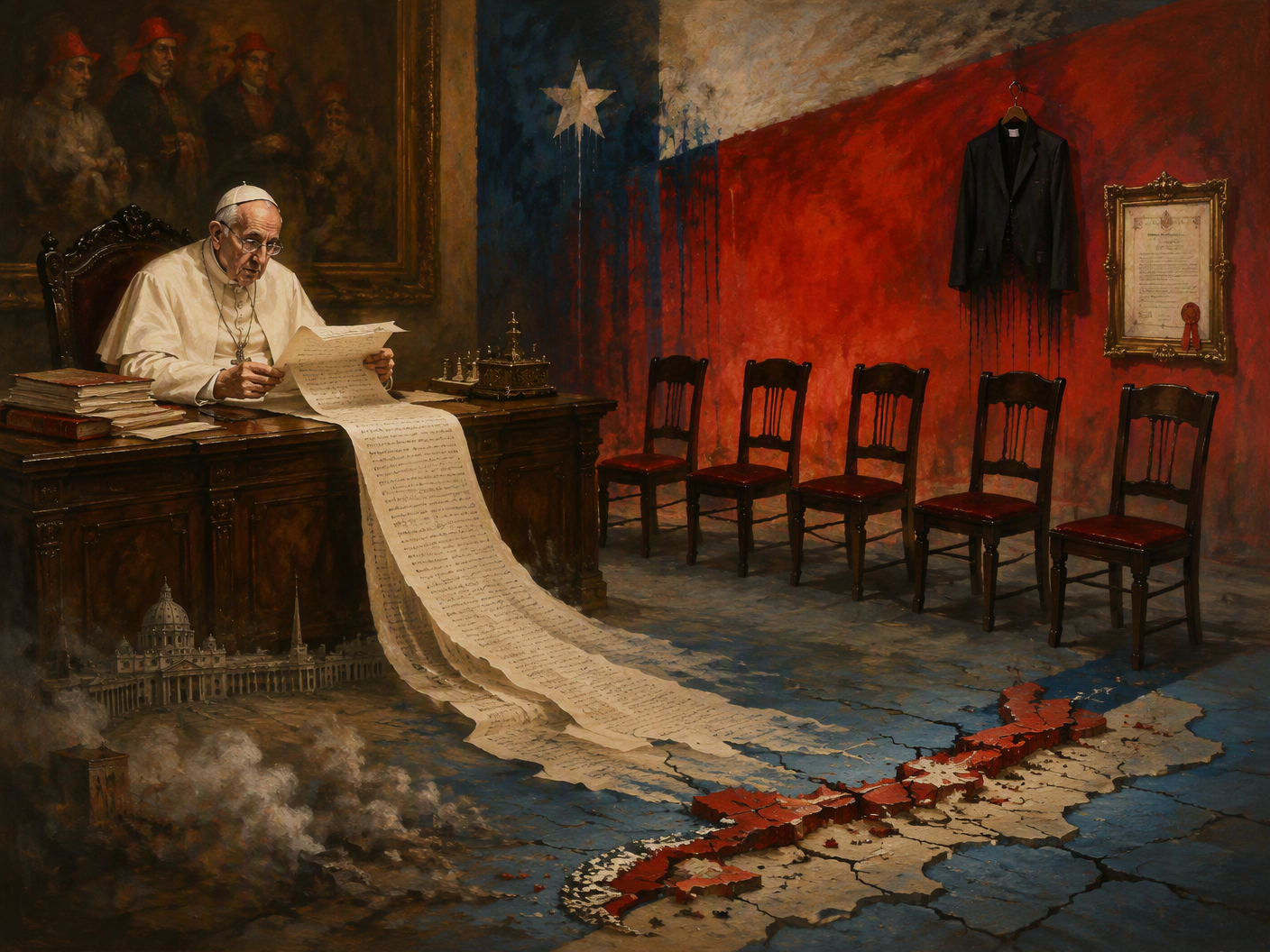
In April 2018, Pope Francis said he had made serious errors in evaluating and perceiving the situation in Chile, attributing them especially to a lack of truthful and balanced information. He asked forgiveness from those he had offended. His statement followed delivery of a report assembled by special envoys. The Holy See later announced meetings with five priests identified as victims and, months after the admission, documented a decree removing Fernando Karadima from the clerical state.
The Associated Press reported that a Vatican court convicted Karadima in 2010 of sexually and psychologically abusing minors. The captured account supports that report but does not include the judgment or an independent court record. That limitation matters: the available evidence establishes the reported conviction, while the underlying judgment itself is not part of the locked record.
The crisis also involved allegations about the conduct of Bishop Juan Barros. Juan Carlos Cruz alleged that Barros witnessed, ignored, or helped cover up abuse. The allegation was reported amid a dispute surrounding Barros, but the available account does not establish it as an adjudicated fact. The record therefore contains both a serious allegation and a clear boundary around it: attribution is documented; final factual adjudication is not.
The route by which information reached the pope was itself contested. The Associated Press reported that a 2015 letter from Cruz reached Cardinal Sean O’Malley, who said he delivered it to Francis. A photograph supported the letter’s arrival at O’Malley, and O’Malley provided the assurance about the final handoff. The available account does not independently establish that Francis personally received or read the letter.
Francis placed information at the center of his explanation. He said his errors arose especially from a lack of truthful and balanced information. The record does not supply the full factual basis for those earlier judgments, but it does preserve the pope’s own account: the information available to him had not been sufficient or balanced.
In April, Francis said he had received more than 2,300 pages completing the report from his special envoys. He also said the envoys had collected 64 testimonies in New York and Santiago. The official letter establishes the size of the material and the number of testimonies as Francis presented them. It does not include the underlying Scicluna report, so the locked record cannot independently assess every account gathered in that process.
The documented sequence is direct: envoys collected testimony, a report was delivered, and the pope publicly acknowledged error. A broader conclusion about every institutional decision before or after it would go beyond the available claims. The record establishes those steps, not a complete reconstruction of how each allegation was evaluated.
The Holy See then announced meetings scheduled from 1 to 3 June 2018. Francis was to meet five priests identified as victims of abuse of power, conscience, and sexual abuse connected to the El Bosque parish. The communiqué also identified two assisting priests and two laypersons who would participate. It described planned meetings and participants, but it did not disclose confidential testimony or independently verify each underlying account.
In its communiqué, the Holy See characterized the abuse connected to El Bosque as part of an abusive system established approximately a decade earlier. That wording is an institutional characterization, not an independently corroborated finding in the captured sources. It shows how the Holy See framed the problem in 2018: not only as allegations concerning individual conduct, but as a system associated with a parish. The qualification remains essential because the locked record does not independently confirm that characterization.
The record does not disclose what was said in the confidential meetings, nor does it establish the effect of each participant’s account. It does establish that the Holy See announced meetings in which five priests identified as victims would meet Francis, alongside supporters and participants.
The final documented action concerned Karadima’s status in the church. On 27 September 2018, Francis signed a decree removing him from the clerical state. The decision took effect immediately, and Karadima was notified on 28 September. The official communiqué establishes the decree and its timing, but it does not provide the decree’s full reasoning or evidentiary record.
That decree gives the 2018 response its clearest institutional endpoint, but not a complete account of the crisis. The record contains a reported Vatican conviction from 2010, allegations concerning Barros, an uncertain chain of communication around Cruz’s 2015 letter, a large report and 64 testimonies, an admission of serious error, announced meetings with five priests identified as victims, and Karadima’s removal from the clerical state. It does not turn every allegation into an adjudicated fact, disclose confidential testimony, or provide every underlying document.
Companion notes
The 2018 Record of Review, Apology, and Sanction
The locked sources document an institutional reversal, but they do not supply every underlying record. Their strongest evidence concerns official actions and statements; allegations and institutional characterizations remain qualified.
The reported conviction and the disputed network
The Associated Press account reports that a Vatican court convicted Fernando Karadima in 2010 of sexually and psychologically abusing minors. The source is reporting, not a primary court record in the locked materials. The same account reports Juan Carlos Cruz’s allegation that Bishop Juan Barros witnessed, ignored, or helped cover up abuse. That allegation is attributed to Cruz and is not established here as an adjudicated fact. A1
The available AP account also traces a disputed information channel. A 2015 letter from Cruz reached Cardinal Sean O’Malley, according to photographic evidence and the named participants’ statements. O’Malley said he delivered it to Francis. The record does not independently establish that Francis personally received or read it. The chain is therefore partly documented and partly dependent on reported assurance. A1
The report and the admission
Francis’s 11 April 2018 letter states that he received more than 2,300 folios completing the report from his special envoys. It also credits them with collecting 64 testimonies in New York and Santiago. The official letter establishes those figures as Francis presented them. The underlying Scicluna report is not included in the captured source set. S1
The same letter records Francis’s acknowledgment of serious errors in evaluation and perception. He attributed them especially to a lack of truthful and balanced information and asked forgiveness from those he had offended. This establishes the pope’s admission and apology. It does not establish the complete factual basis for the judgments he made before the report. S1
The announced meetings
The Holy See’s 22 May communiqué announced meetings from 1 to 3 June 2018 with five priests identified as victims of abuse of power, conscience, and sexual abuse connected to the El Bosque parish. It also named two assisting priests and two laypersons as participants. The communiqué describes the planned meetings; it does not disclose confidential testimony or independently verify each underlying account. S2
The communiqué characterized the El Bosque abuse as part of an abusive system established approximately a decade earlier. That wording is an official institutional characterization. The captured sources do not independently corroborate it, so it should not be treated as a separately established finding beyond the Holy See’s description. S2
The canonical endpoint
On 27 September 2018, Francis signed a decree removing Karadima from the clerical state. The Holy See said the decision took effect automatically at that moment and that Karadima was notified on 28 September. The communiqué establishes the decree, its immediate effect, and notification. It does not provide the decree’s full reasoning or evidentiary record. S3
Source key
Open the associated evidence packet for visible source URLs, source roles and the complete claim ledger.