
Witch trials and the record · 1620
Karen Roeds in a Modern Account of Ribe’s 1620 Witch Trials
The Lex account’s Ribe table lists Karen Roeds as executed by burning in 1620. The available sources place that entry in a wider history of accusations, confessions and torture, but do not establish what happened in her individual case or whether she personally underwent torture.
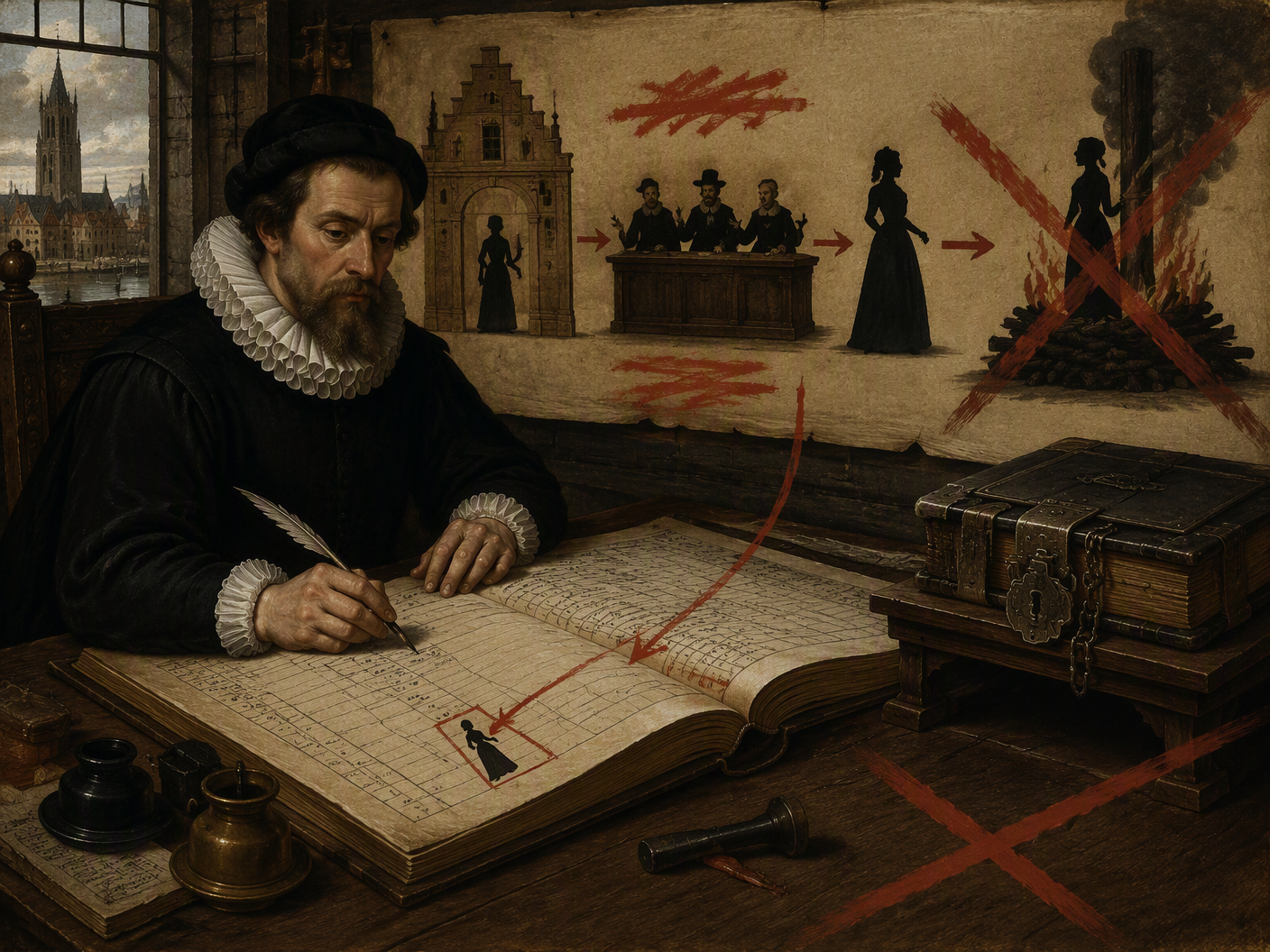
The Lex account’s Ribe table lists: Karen Roeds — 1620 — woman — executed by burning.
That is the full shape of the case in the modern Lex account’s table: a name, a year, a gender, and an outcome. The entry is precise enough to assign Roeds to Ribe’s witch-trial history, yet narrow enough to leave the central questions unanswered. The captured material does not include a scan or transcription of the underlying 1620 record. What remains is a reported table entry, not a case file that can be read line by line.
The distinction matters because a recorded outcome is not the same as a recorded procedure. The available material identifies Roeds as a woman executed by burning in 1620. It does not provide the contents of the judicial proceedings attached to her name, describe an interrogation, or state whether torture was used against her. The entry establishes a conclusion attributed to Lex; it does not supply the sequence of decisions that produced it.
There is an archival object associated with the period: the Danish National Archives catalogue lists a 1620 volume of the Ribe City Bailiff’s judicial protocol. A judicial protocol is the kind of record that could matter to the question, because it is identified as a record of judicial proceedings. But the catalogue entry establishes the volume’s existence and date, not the contents of a particular case. It does not, in the captured material, connect Karen Roeds to a readable passage in that volume.
That gap is the story’s evidentiary problem. The name appears in one modern account, while the archival catalogue points to a 1620 protocol without exposing its contents here. A catalogue can tell a researcher where a volume belongs in the archive. It cannot, by itself, show what was written about an accused person, what a court decided, or how an interrogation proceeded. The existence of the volume therefore strengthens the possibility of further investigation without resolving this case.
The broader Ribe record is substantial enough to make the entry historically consequential. Lex identifies 26 separate witch trials in Ribe between 1572 and 1652, with 15 ending in execution. Those figures are aggregate statistics reported by Lex, not a fresh recalculation from the archival material captured here. They show the scale of the recorded trial activity, but they do not tell us which steps occurred in Roeds’s case.
A scholarly study gives a second period-level measure. It states that 15 people were accused of witchcraft in Ribe between 1610 and 1652, and that four were acquitted. The study does not, in the captured text, identify Karen Roeds by name. Its figures help place 1620 within a documented field of accusation and judgment, while preserving the problem of identity: a number about the period cannot be converted into a detail about one woman.
The table places people among the accused and records outcomes including acquittal and execution. In Roeds’s case, the surviving account gives the most consequential outcome—execution by burning—without giving the case-specific material needed to reconstruct how authorities reached it.
The study also describes the coercive setting around several Ribe trials. Confessions by accused witches survive for several trials, and interrogations were often repeated under torture. That is important context for understanding the proceedings as a system in which interrogation could be coercive. It is not evidence that Roeds confessed, was tortured, or faced repeated interrogation. The study’s wording, as captured here, describes several Ribe trials without naming her.
This is where a general history can be misread as a personal biography. Because torture appears in the broader account, it may seem natural to attach it to every named person whose outcome was execution. The available sources do not permit that move. They establish torture and repeated interrogation as features of some Ribe trial proceedings, not as facts about Roeds’s individual treatment.
The question of a systematic post-conviction torture procedure is even more specific. The captured sources do not establish that Roeds underwent one. Lex and the scholarly study describe torture in Ribe witch-trial cases generally; the National Archives catalogue identifies the 1620 protocol but does not reveal its contents. None of those sources supplies case-specific evidence showing that Roeds personally underwent such a procedure.
Nor do the sources provide two independent source groups that both identify Roeds’s specific 1620 case and corroborate its execution details. Lex is the source that names her and gives the burning outcome. The scholarly study supplies broader statistics and context without naming her in the captured text. The catalogue supplies the existence of the 1620 protocol, not its contents. The evidence is therefore mixed: a named outcome is supported, while the underlying case narrative remains unavailable here.
The responsible conclusion is neither that nothing can be known nor that the missing details can be supplied from the surrounding history. The record supports saying that a modern Lex table lists Karen Roeds as a woman executed by burning in Ribe in 1620. It supports placing that entry within a documented period of witch trials, accusations, acquittals, executions and coercive interrogations. It does not support saying that Roeds confessed, was tortured, underwent repeated interrogation, or was subjected to a systematic post-conviction torture procedure.
The smallness of the entry is therefore not a reason to enlarge it with inference. It is the reason to keep its boundaries visible. Karen Roeds’s name and reported outcome survive in the available account; the contents of the relevant 1620 judicial protocol do not appear in the captured sources. Until case-specific evidence is available, the record can establish the listing and its limitation, but not the personal experience behind it.
Companion notes
A Name, a Catalogue Entry and an Unresolved Procedure
The sources divide the case into three levels: a named table entry, broader scholarship on Ribe’s trials, and an archival catalogue listing. Their limits are as important as their findings.
The named entry
The Danish reference work Lex lists Karen Roeds as female, gives the year as 1620, and records the outcome as execution by burning. It is the only available source that names Roeds and states an outcome for her. Lex does not reproduce a scan or transcription of the underlying 1620 record, so its table entry cannot be checked here against the original wording. S1
The entry supports a narrow conclusion: Lex reports that Roeds was executed by burning in Ribe in 1620. It gives no accusation narrative, confession, interrogation record or torture procedure. Those details cannot be inferred from the outcome alone. S1
The wider numbers
Lex reports 26 separate witch trials in Ribe between 1572 and 1652, with 15 ending in execution. These are aggregate figures rather than an independent recalculation from the archival records, and they do not identify which proceedings belong to any one named person. S1
A scholarly study of Ribe’s early seventeenth-century trials reports that 15 people were accused of witchcraft between 1610 and 1652 and that four were acquitted. The study does not identify Karen Roeds by name in the available text. Its statistics establish period context, not a case-specific account. S2
Coercion as context
The same scholarly study says confessions survive from several Ribe trials and that interrogations were often repeated under torture. That finding describes the broader trial environment. It does not establish that Roeds confessed, was tortured or underwent repeated interrogation. S2
Lex and the scholarly study describe torture in Ribe’s witch trials generally, but neither supplies case-specific evidence for Roeds. Her name cannot responsibly be attached to a particular interrogation or torture procedure without the underlying case record. S1, S2
The archival gap
The Danish National Archives catalogue lists a 1620 volume of the Ribe City Bailiff’s judicial protocol. The catalogue confirms that a volume for that year exists; it neither identifies Roeds’s case nor reveals what the volume says. S3
The three sources stop at different points. Lex names Roeds and reports the burning outcome. The scholarly study supplies broader statistics and torture context without naming her. The National Archives identifies a relevant judicial volume without exposing its contents. Together they support the listed outcome, but not a reconstructed account of her interrogation or treatment. S1, S2, S3
Source key
Open the associated evidence packet for visible source URLs, source roles and the complete claim ledger.