
Religion · –
Simon de Montfort’s Siege of Minerve in 1210
The verified record places Minerve within the early-summer 1210 Albigensian Crusade, while leaving alleged atrocities and references to Bram unestablished.
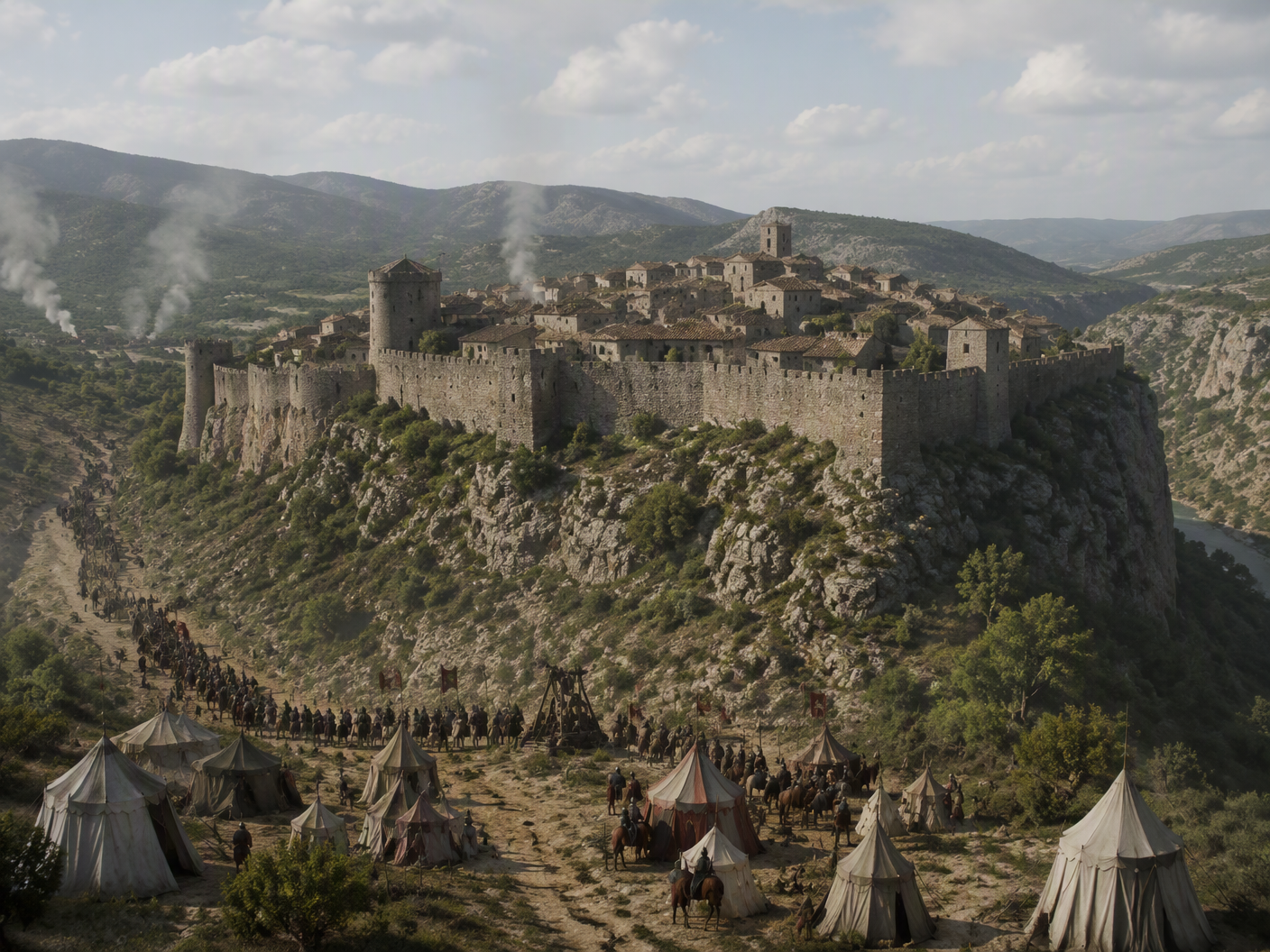
Simon de Montfort besieged Minerve in the early summer of 1210. The episode belongs to the Albigensian Crusade, a campaign fought in southern France. That basic frame is firmly supported, but it is also limited: the available material establishes the siege and its setting, not every event that may have occurred within it. The distinction matters because a military episode can be historically significant without every later allegation being demonstrated.
Minerve was not described merely as an unnamed settlement. One historical account identifies it as a public fortress of the county of Narbonne. That description places the site within a political and military structure, while also clarifying the kind of place Montfort confronted. The evidence supports Minerve’s fortified status and its association with Narbonne; it does not, in the material reviewed here, provide a complete architectural description or a detailed account of the defenses.
The siege therefore sits at the intersection of local lordship and a wider regional war. The sources place the history of Minerve’s lords within the Albigensian Crusade, and they situate Montfort’s campaign in Languedoc, in southern France. Those geographical and political descriptions are supported. They should not be expanded into claims about every community involved, every military objective, or the precise experience of civilians, because the verified extracts do not supply that fuller narrative.
The early summer of 1210 is the specific temporal qualification attached to Montfort’s action at Minerve. This is more precise than simply placing the siege somewhere in the year, yet it remains a limited date marker. The verified material does not establish a day-by-day chronology, the duration of the operation, or the sequence of individual encounters. What can be stated is that Montfort’s siege occurred during that early-summer campaign window.
The wider conflict is described as changing in character. According to the academic history, it began as a war over heresy and quickly became a struggle for political control of the region. This is a contextual interpretation of the broader war, not a finding about one particular action at Minerve. It helps explain the campaign’s political setting, but it cannot by itself establish motives, decisions, or consequences specific to the siege.
Minerve’s importance in the record is also comparative. A military history identifies the site among Montfort’s major sieges during the 1210 campaign and later uses Minerve as a measure of scale. That comparison supports treating the siege as a significant episode in the campaign. It does not provide a complete incident-by-incident account, nor does it establish that every aspect of the operation was recorded in the reviewed sources.
The comparison becomes explicit when the history turns to 1211. In that year, Montfort conducted sieges on the scale of Minerve and Termes. The statement concerns the scale of later sieges, not a new date for the Minerve operation. It confirms that Minerve functioned as a benchmark in the military narrative, while preserving the chronology: the Minerve siege itself belongs to the early summer of 1210.
That chronology prevents a common collapse of separate claims. A reference to 1211 does not move Minerve into 1211, and a comparison with Termes does not establish that the two sites experienced identical events. The verified record supports only the narrower proposition that later sieges were conducted on a scale described through comparison with Minerve and Termes. The distinction is necessary when reconstructing a campaign from concise historical accounts.
The evidence also does not establish events at Bram. The defined campaign boundary concerns Montfort’s campaign against Minerve in the early summer of 1210, within the Albigensian Crusade. The reviewed material does not establish a specific atrocity account there or elsewhere in this record. Accordingly, Bram cannot be treated as an evidenced location for the Minerve siege or as proof of a broader episode.
Nor do the verified extracts establish alleged wartime atrocities. That absence is not a finding that no violence occurred; it is a boundary on what these materials demonstrate. The sources identify the siege, its campaign setting, Minerve’s status as a fortress associated with Narbonne, and the later comparison with Termes. They do not supply verified details sufficient to present an atrocity allegation as established history.
The most defensible account is therefore deliberately bounded. Montfort besieged Minerve in early summer 1210 as part of the Albigensian Crusade in southern France. Minerve was a public fortress of the county of Narbonne, and the episode is characterized as significant within Montfort’s 1210 campaign. The broader war developed from a conflict over heresy into a struggle for regional political control, but that interpretation remains contextual.
Taken together, the sources support a concise historical conclusion rather than a complete reconstruction. Minerve was a major 1210 siege in Montfort’s campaign, important enough to serve as a scale comparison for sieges conducted in 1211. The evidence does not verify a Bram episode, a specific atrocity account, or a full sequence of events at Minerve. Preserving those limits is part of accurately reporting what the record can establish.
Companion notes
What the record establishes—and what it does not
Dek: Two historical works support the campaign’s chronology, setting, political context, and military significance, while leaving alleged atrocities outside the verified record.
Chronology and campaign setting
The historical study of Minerve’s lords directly places Simon de Montfort’s siege at the beginning of summer 1210. The same account situates Minerve within the Albigensian Crusade and identifies the region as southern France. These are the core chronological and geographical findings, while the available material does not provide a complete operational timeline. A1
The military history independently frames Montfort’s 1210 activity as a campaign of major sieges within the Albigensian Crusade, though its available excerpt does not independently name the Minerve siege. Read with the direct account, it supports the broader campaign setting without supplying additional incident-level detail about Minerve itself. A1, A3
Minerve and Narbonne
The Minerve history describes the site as a public fortress of the county of Narbonne. That wording supports both its fortified character and its political association. It does not, however, establish the fortress’s dimensions, defensive arrangements, population, or the experiences of people present during the siege. Those details remain outside the verified claim set. A1
The same source connects the site’s lords with the wider crusading history. This supports treating Minerve as more than an isolated local action, but it should not be converted into a comprehensive account of regional allegiance or administration. The evidence establishes the association with Narbonne and the crusade, not every political relationship surrounding the fortress. A1
Political context and military scale
The academic history interprets the broader conflict as beginning over heresy before becoming a struggle for political control of the region. This is useful context for the campaign, but it is not a source-specific finding about what motivated each participant at Minerve. The wording should therefore remain attributed as an interpretation of the war’s development. A3
That history also states that Montfort’s 1211 sieges were conducted on the scale of Minerve and Termes. The comparison establishes Minerve as a benchmark in the military narrative. It does not make the later operations identical to Minerve, alter the siege’s 1210 date, or establish particular tactics, casualties, or outcomes. A3
Limits on atrocity claims
The reviewed historical extracts do not establish a specific atrocity account connected to Minerve. They support the siege, its campaign setting, the fortress’s association with Narbonne, and its significance in the military narrative. They do not provide verified incident-level evidence that would justify presenting an alleged wartime atrocity as an established fact. A1, A3
The material likewise does not establish events at Bram within this account. That absence should not be recast as proof that no violence occurred; it is a limit on the evidence available for this draft. A careful report must keep the siege of Minerve, later comparisons, and unsupported atrocity allegations analytically separate. A1, A3
Source key
The associated evidence page provides source roles, links, and the claim ledger.