
Inquisitions & Religious Courts · 1950s-1970s
Tibetan Buddhist Monasteries and Religious Heritage Were Devastated During the Cultural Revolution
Verified accounts document extensive destruction of monasteries, religious practice, texts, images, and sacred objects, while qualifying the reported scale and recording partial, restricted revival after 1979.
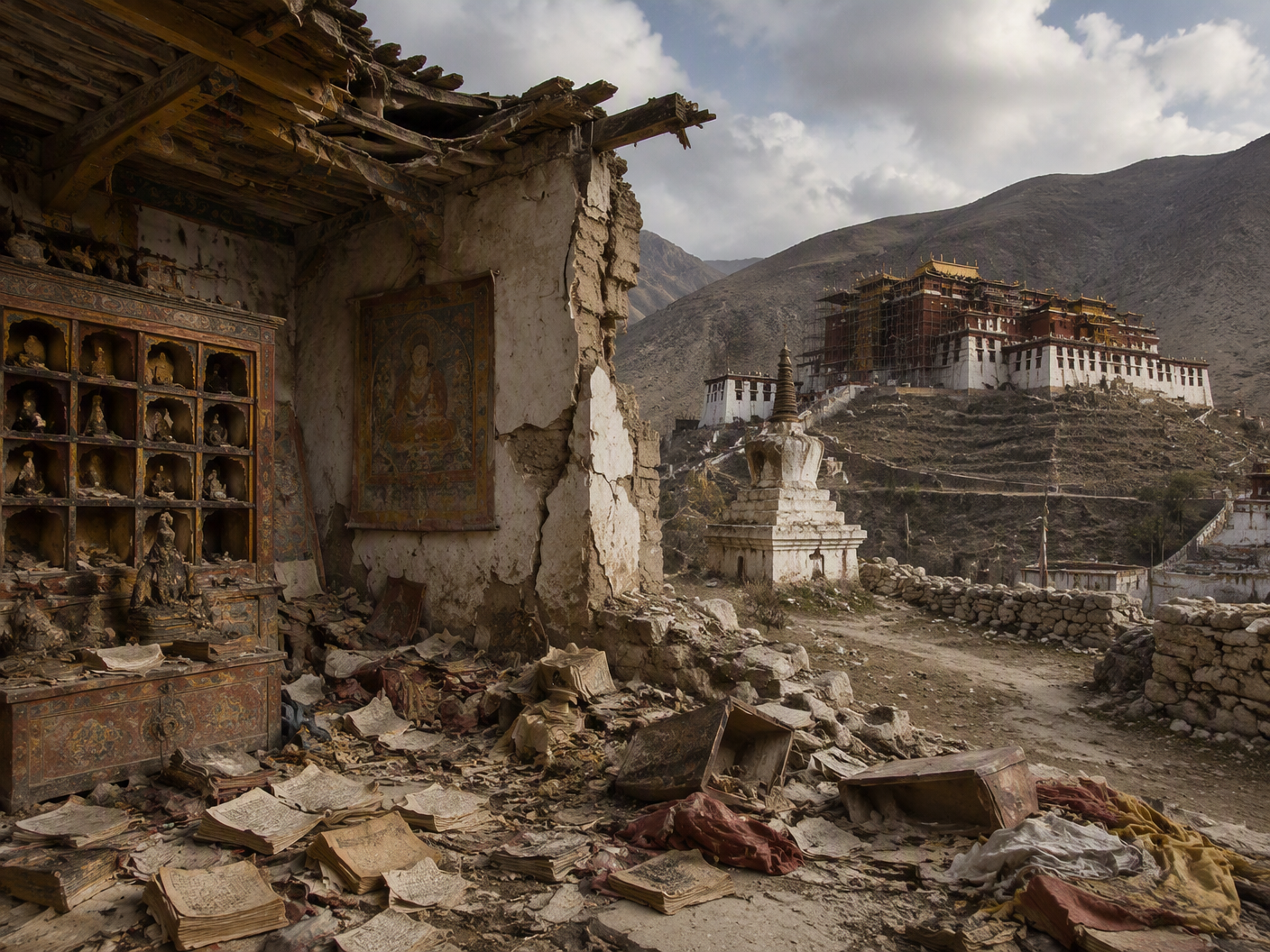
In Tibet, the Cultural Revolution began in 1966 and continued through 1976. During that decade, Tibetan cultural and religious institutions faced sustained attack, according to an International Commission of Jurists report and an academic study of medicine and memory. Their accounts place monastery destruction within a wider assault on institutions, practices, and material heritage, while also preserving important qualifications about what was destroyed, what survived, and how reported scale should be understood.
That assault did not begin from an untouched religious landscape. The International Commission of Jurists reported that functioning monasteries and temples in the Tibet Autonomous Region fell from 2,711 in 1958 to 370 in 1960. It also said post-1959 depopulation and closure left most monasteries as empty shells by 1966. This earlier deterioration forms essential context for the destruction documented during the Cultural Revolution itself, rather than evidence that all damage occurred after 1966.
During the Cultural Revolution, Red Guards and other revolutionary forces attacked religious sites in Lhasa and across rural Tibet. The documented targets included monasteries, temples, monuments, scriptures, artworks, statues, shrines, and other sacred objects. The academic study describes the physical destruction of the Mentrong and Lhünding Monastery buildings in rural Tsang, while the Jurists’ report records destruction or defacement across the capital and countryside. The evidence therefore describes both concentrated attacks and damage beyond Lhasa.
The reported scale was extensive. The International Commission of Jurists wrote that few of Tibet’s thousands of monasteries survived and that virtually all monasteries in Tibet had been destroyed by the end of the Cultural Revolution. Those formulations convey a near-total devastation in the report’s account, but they are not a verified nationwide count. The available evidence does not establish a precise number of monasteries destroyed, and the wording should not be converted into one.
Yet the destruction was not literally uniform across every major site. The Jurists’ report distinguishes physical destruction from defilement at the Jokhang, Potala, Drepung, and Sera. The academic study likewise records survival of some medical texts, paintings, and private collections at particular institutions. These exceptions do not lessen the severity of the broader campaign; they establish that the surviving record includes protected or preserved materials as well as losses.
Damage extended beyond architecture. Monastic populations were removed, religious practice was attacked, and scriptures, images, sacred objects, and other ritual materials were destroyed. The Jurists’ report also describes monastery materials being converted to secular uses. The academic study adds libraries, medical works, thankas, instruments, and related cultural materials to the record, showing that Tibetan Buddhist heritage included living institutions, knowledge, images, objects, and the people who sustained them.
The medical and cultural record makes the breadth of loss visible through particular institutions. It describes attacks on the Lhasa Mentsikhang and the destruction of buildings at Mentrong and Lhünding Monastery in rural Tsang. It also identifies surviving medical texts and other protected materials. These details show why a building-by-building account cannot capture the whole history: libraries, works of knowledge, images, instruments, and other documented materials were also at stake.
Lhasa’s most prominent monuments therefore require careful description. The available account does not treat the Jokhang, Potala, Drepung, and Sera as identical cases of physical ruin. Some were defiled without being physically destroyed, while lesser or rural sites could suffer more complete destruction. The distinction matters because the evidence supports severe and extensive damage without supporting a claim that every major religious structure met precisely the same fate.
The two accounts also differ in reach. The International Commission of Jurists provides the broad formulation about monasteries across Tibet, but it could not access Tibet directly. The academic study supplies independent institutional examples and records surviving materials, yet it does not turn those examples into a national total. Read together, the sources establish a large-scale historical pattern while limiting claims about exact numbers and universal uniformity.
After 1979, the Chinese government permitted some cultural and religious revival. The Jurists’ report describes partial restoration of monasteries and renewed religious and cultural activity. It also records continuing restrictions, meaning that restoration did not amount to an unrestricted return to the pre-destruction religious landscape. The post-1979 period is therefore part of the evidence: it shows rebuilding and renewed activity alongside limits on what could be practiced.
Taken together, the evidence establishes a sequence rather than a single episode. Monasteries had already been depopulated and closed before 1966; the Cultural Revolution then subjected religious and cultural institutions to sustained attack through 1976. Buildings, communities, practices, texts, images, and objects were affected. Later partial restoration confirms that some sites and activities returned, but it does not erase the documented destruction or resolve the uncertainty around its exact scale.
The strongest defensible conclusion is consequently precise in two directions. Tibetan Buddhist monasteries and religious heritage suffered devastating, extensive damage during the Cultural Revolution, in a process preceded by serious losses after 1959. At the same time, the record preserves distinctions: some major monuments were defiled rather than destroyed, some materials survived, and no verified nationwide count is supplied. The history is one of broad destruction, uneven survival, and restricted revival.
Companion notes
What the Historical Record Establishes—and What It Does Not
Dek: Two independently reviewed accounts document a broad assault on Tibetan Buddhist heritage while limiting claims about exact totals, uniform destruction, and the meaning of later restoration.
Chronology and Prehistory
The chronology begins before the Cultural Revolution. The International Commission of Jurists reported a sharp fall in functioning monasteries and temples after 1958, linked to depopulation and closure, and said most monasteries were empty shells by 1966. This establishes prior damage and prevents the later campaign from being treated as the starting point of every loss. A1
Both accounts place the Cultural Revolution in Tibet from 1966 through 1976. The academic study independently describes attacks on Tibetan medical, cultural, and religious institutions during that period, while the Jurists’ report presents the assault as extending across Tibetan culture. The shared chronology supports a sustained period of institutional attack rather than an isolated incident. A1, A2
Targets Across Lhasa and Rural Tibet
The Jurists’ report describes Red Guard attacks in Lhasa and the countryside, including damage to religious sites, monuments, scriptures, statues, shrines, and sacred objects. Its geographic language supports destruction beyond the capital, although it does not provide a complete site register. The evidence therefore establishes breadth of attack without supplying a definitive inventory. A1
The academic study adds concrete rural and urban examples: attacks on the Lhasa Mentsikhang and destruction of the Mentrong and Lhünding Monastery buildings in rural Tsang. These examples corroborate the broader account while remaining examples, not a census. They show that the record includes both institutional assault in Lhasa and physical destruction in rural areas. A2
Scale and Its Limits
The Jurists’ report says few of Tibet’s thousands of monasteries survived and that virtually all had been destroyed by the end of the Cultural Revolution. Those phrases are important evidence of reported scale, but they should not be recast as a precise national total. The available material verifies the formulation, not a complete numerical count of destroyed monasteries. A1
The same report distinguishes defilement from physical destruction at the Jokhang, Potala, Drepung, and Sera. The academic study records surviving medical texts, paintings, and private collections. Together, these qualifications show severe but uneven damage: prominent sites and materials could survive in altered or protected form even amid widespread destruction. A1, A2
Heritage, Practice, and Restricted Revival
Religious heritage included people and practices, not only structures. The Jurists’ report describes monks being removed, religious practice being attacked, scriptures and sacred objects being destroyed, and monastery materials put to secular uses. The academic study documents libraries, medical works, thankas, instruments, and related materials, broadening the documented impact across living and material culture. A1, A2
After 1979, the Jurists’ report describes partial monastery restoration and renewed cultural and religious activity, while emphasizing continuing restrictions. This evidence supports limited revival rather than full restoration. A1
Source key
The associated evidence page provides source roles, links, and the claim ledger.