
Scandals & Feuds · 2020s
Caitlin Clark, Angel Reese, and the Rivalry Built Across College and the WNBA
The public record traces the rivalry from Angel Reese’s taunting gesture during the 2023 NCAA championship game through repeated meetings, draft-day pairing, hard fouls, and league scrutiny of alleged hateful fan comments after a 2025 WNBA game. It establishes the sequence of visible events while leaving no single gesture, reaction, or racial explanation sufficient to account for everything that followed.
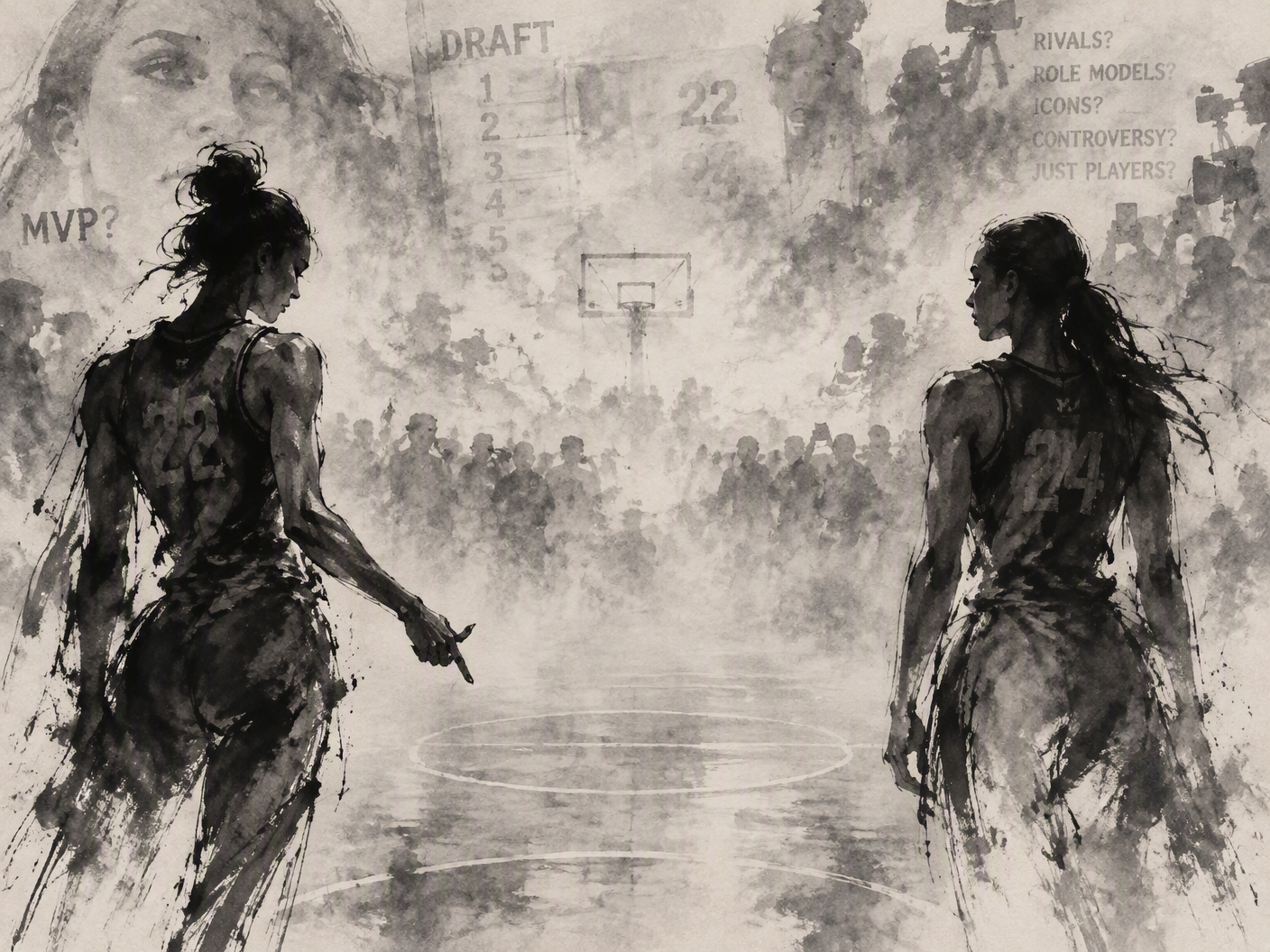
On April 2, 2023, near the end of the NCAA women’s championship game at the American Airlines Center in Dallas, Angel Reese turned toward Caitlin Clark and made a taunting gesture. LSU was defeating Iowa, and the gesture entered the public record at the exact moment the championship was being decided. It was visible, legible, and easy to replay. In the days that followed, the act became the scene most often used to explain the relationship between two players who had not yet entered the professional league. But the gesture was an event, not a complete origin story.
Clark’s response resisted the simplest version of the controversy. She said Reese should not be criticized for directing the gesture at her. That statement did not erase the image or prevent others from using it as a measure of the players’ personalities. It established something else: Clark herself did not describe the moment as a private injury requiring public punishment. The surrounding reaction belonged to broadcasters, commentators, fans, and institutions that assigned meaning to a brief exchange after LSU had won the title. Their interpretations would travel farther than the game’s final possessions.
The next meeting supplied a different result without dissolving the earlier one. On April 2, 2024, Iowa and LSU met in the Elite Eight of the NCAA tournament, one round before the championship game. Iowa defeated LSU. Clark and Reese had now faced each other in two of the sport’s most visible settings: first with LSU winning the title, then with Iowa advancing toward another championship opportunity. The second game gave viewers a new contest to place beside the old gesture, and it moved the rivalry from a single closing sequence into a continuing athletic history.
Two weeks later, the college rivalry acquired a professional address. At the WNBA draft in New York on April 16, Clark was selected first overall by the Indiana Fever. Reese went seventh to the Chicago Sky. The choices separated them by six selections but kept them inside the same league, where their games would be scheduled, sold, televised, and measured against one another. Clark entered Indiana as the draft’s top selection; Reese joined Chicago as another first-round pick. Their pairing was no longer dependent on tournament brackets or the chance of a postseason rematch.
The first WNBA meeting came on June 1, 2024, at Gainbridge Fieldhouse in Indianapolis. Indiana defeated Chicago, converting the college-era narrative into a league game with its own result and its own points of conflict. During the contest, Chicago guard Chennedy Carter knocked Clark to the floor on an inbounds play. The incident gave the matchup a physical episode to stand beside the earlier taunt. Reese was later fined for failing to appear at the post-game press conference, adding a league response to the game’s immediate aftermath.
The importance of that afternoon did not depend on deciding which player had become the other’s antagonist. Clark and Reese were now young professionals occupying different institutional roles: Clark in Indiana, Reese in Chicago, each carrying the attention attached to a first-round selection and to a college rivalry that had already been replayed for a year. Carter’s contact became part of the public account of their first WNBA meeting, while Reese’s absence from the required post-game setting produced a separate administrative consequence. The league treated the game not as a private continuation of college history but as an event within its own rules.
The attention accumulated through repetition. A gesture in Dallas, a tournament rematch in 2024, two draft selections, and the first Fever-Sky game supplied distinct moments for audiences to connect. Each encounter also changed the conditions of the next one. The players’ professional identities were formed in public beside images from their college careers, and ordinary basketball actions could be read through those earlier scenes. The rivalry therefore grew across games and institutions rather than remaining attached to one exchange at the end of a championship.
On May 17, 2025, Clark and Reese met again in Indianapolis. This time Clark committed a hard foul against Reese and received a flagrant foul. The call placed Clark, previously knocked down during the 2024 meeting, at the center of the game’s physical controversy. The sequence did not settle the meaning of either player’s conduct. It added another officially recognized basketball action to a relationship already crowded with remembered gestures, tournament results, draft status, and earlier contact.
After that game, the WNBA said it was investigating allegations of hateful fan comments. The league condemned racism, hate, and discrimination while addressing the reaction surrounding the matchup. That institutional statement established the seriousness with which the WNBA treated the allegations, but it did not identify a named individual responsible for every comment or convert all public discussion into one verified account. Racial commentary and fan backlash had become part of the story around Clark and Reese; the league’s intervention made that surrounding conduct a matter of official attention.
By May 2025, the rivalry had acquired an afterlife larger than any single score. Reese’s gesture remained the first widely repeated image, but it stood beside Iowa’s 2024 victory, the draft that placed both players in the WNBA, Carter’s contact in Indianapolis, Reese’s post-game fine, Clark’s flagrant foul, and the league’s review of alleged hateful comments. The enduring record is not a verdict on one player or one cause. It is a sequence: college competition became professional proximity, professional proximity produced repeated scrutiny, and the WNBA was left to govern both the fouls on its court and the hostility directed around it.
Investigative Dossier & Evidence
Read the companion investigation notes, verified source claims, and primary documents.
Read the Companion Notes & Evidence Record →