
Tragedy · 1990s
The Shakhtar Stadium Bombing That Killed Akhat Bragin
On 15 October 1995, a bomb exploded at Donetsk’s Central Stadium Shakhtar during a match, killing club president Akhat Bragin and five security guards. The attack interrupted the game, injured a nearby waitress, and prompted a multi-agency investigation into a suspected gangland killing.
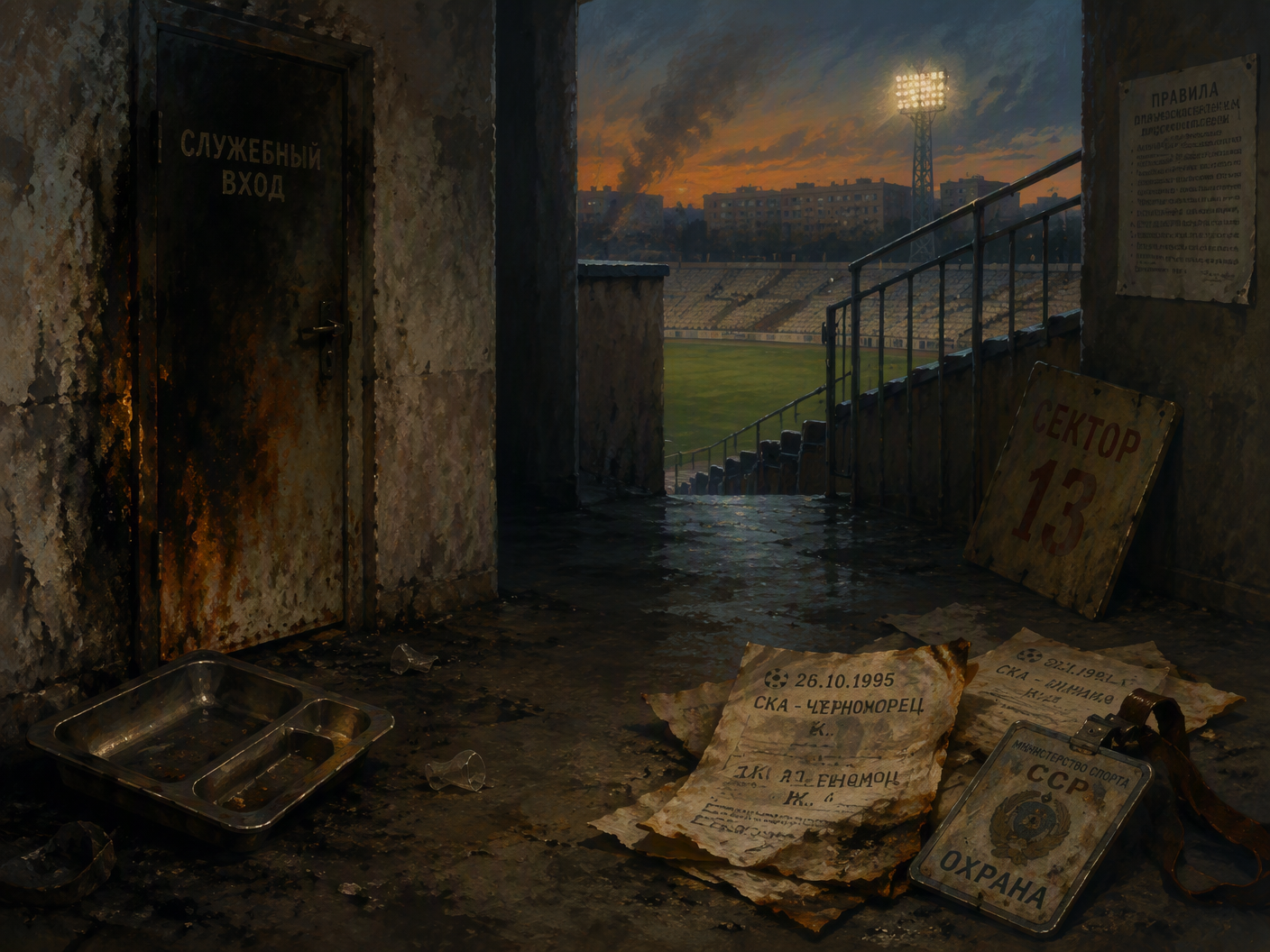
The match was still underway when Akhat Bragin stepped through a service entrance at Central Stadium Shakhtar. Five security guards moved with him. Then the bomb detonated inside the stadium’s working corridors, converting a football afternoon into a killing scene. Bragin and all five guards died at the scene. A buffet waitress nearby suffered critical injuries. In the stands, approximately 2,000 spectators were caught inside the same building, separated from the blast by concrete, distance, and the ordinary architecture of a match day.
The stadium had been built for football, but its service entrances belonged to another world: deliveries, staff movement, security checks, and the unseen machinery that kept the public spectacle running. Bragin entered through one of those thresholds while Shakhtar played Tavriya on the pitch. The violence did not begin in the open, beneath the floodlights and the attention of the crowd. It came through the infrastructure behind the game, where access could be controlled and a club president could be reached at close range.
The explosion interrupted Shakhtar–Tavriya. The match could not continue after the blast, and the afternoon’s sporting purpose disappeared beneath emergency response and death. The spectators were not reported injured, but the stadium had become a crime scene before the crowd could finish being a crowd. Football’s clock stopped in the middle of the fixture. The game would have to wait for another date, another setting of the teams, and a city forced to play around the absence left inside its own ground.
Bragin was not merely a name on the club stationery. He was Shakhtar’s president, and he had acquired control of the club approximately a year before his death. His authority extended beyond the ninety minutes on the field into the money, access, and protection surrounding the team. The killing therefore struck at the institution as well as the man. A football club that had been organized around his power now had to absorb the fact that its president had been murdered inside its stadium.
There had been warnings in the form of violence that came before the bomb. Bragin had survived two earlier attacks in which automatic weapons were fired at his car. Those attacks had failed to kill him, but they placed his movements inside a pattern of pursuit. The service entrance at Shakhtar was not an isolated point in that pattern. It was the place where the pursuit finally reached him, with guards at his side and the noise of football carrying on beyond the walls.
Donetsk regional police treated the bombing as a struggle between criminal groups over spheres of influence. The killing, in their view, appeared to have been ordered rather than improvised. That theory placed the stadium inside the geography of post-Soviet power, where clubs, businesses, security details, and criminal networks could overlap. The football ground was a public institution, but the attack suggested that its private corridors had become part of a contest conducted through intimidation and force.
Police also pursued a possible connection between Bragin and the criminal underworld. The same account carried the limit that mattered: no evidence established that connection. Suspicion occupied the space where proof had not yet arrived. Bragin’s earlier attacks, his control of the club, and the method of his killing formed a narrative investigators could not ignore, but they did not by themselves explain who ordered the bomb or why the service entrance had been selected.
The response moved quickly beyond local police. A special investigative commission brought together the Ukrainian Interior Ministry, the Security Service, and the Prosecutor General’s Office. Their involvement transformed the bombing from a local murder into a national investigation. Multiple agencies entered a case that implicated public safety, organized crime, and the vulnerability of a major football club. The machinery of the state gathered around the blast, while the central question remained brutally simple: who had placed the bomb, and who had ordered the killing?
On 31 October, Shakhtar and Tavriya returned to the fixture that had been broken apart by the explosion. The rescheduled match ended 0–0. A scoreline usually records what happened on the field: goals, chances, advantage, failure. Here it also marked the distance between the sport’s formal continuation and the violence that had interrupted it. The teams could complete the match. The club could reopen its calendar. The people killed at the service entrance could not be restored to it.
The bombing left two timelines running at once. On the pitch, fixtures could be postponed and replayed until the competition resumed its shape. In the corridors, six people were dead, a waitress was critically injured, and the club’s president was gone. The state investigation searched for an ordered killing behind the blast, while the public game attempted to proceed. That separation—football continuing above, violence defining the institution below—became the enduring structure of the Shakhtar Stadium bombing.
Bragin’s death exposed the narrow border between a stadium as a place of sport and a stadium as a place of power. The crowd had come to watch two teams compete. Bragin entered through a door used by the club’s working life and encountered an attack aimed at the authority he represented. The match resumed two weeks later, but the building had acquired a permanent second meaning: not only a ground where Shakhtar played, but the site where its president and his guards were killed.
Companion notes
What the Shakhtar Stadium Bombing Establishes—and Leaves Open
The available sources establish the date, location, casualties, match interruption, rescheduled result, police theory, and formation of a special investigative commission. They do not provide a complete prosecutorial case or a documented final determination identifying the perpetrators.
The Event and the Casualties
The contemporary Kommersant report dated 17 October 1995 supplies the principal account of the bombing: a device exploded at Central Stadium Shakhtar on 15 October while Akhat Bragin and five security guards entered a service entrance during the Shakhtar–Tavriya match. The Shakhtar Stadium reference entry repeats the event and casualty details. Together, these sources support the core chronology, although the reference entry is secondary and should not be treated as an independent confirmation. [S1], [S3]
Both sources state that Bragin and the five guards died at the scene and that a nearby buffet waitress was critically injured. They also state that approximately 2,000 spectators were not reported injured. The captured material does not include hospital records, a police incident file, forensic documentation, or a complete accounting of people outside the reported spectator group. The casualty description is therefore well supported within the supplied reporting but not independently reconstructed from primary medical or investigative records. [S1], [S3]
The Match and Its Afterlife
Kommersant establishes that the match was interrupted and that rescheduling followed the explosion. The uafootball historical match listing supplies the later result: Shakhtar and Tavriya played on 31 October 1995 and finished 0–0. The two sources perform different functions. The newspaper provides the immediate aftermath, while the match listing supports the date and score of the completed fixture. [S2], [S3]
Police Theory and Earlier Attacks
Kommersant reports that Donetsk regional police viewed the bombing as a gangland dispute over spheres of influence and believed the killing appeared to have been ordered. The article also describes two earlier attacks in which automatic weapons were fired at Bragin’s car. These details document the police theory and the reported background, not a proven chain of responsibility. The supplied sources do not identify the attackers in the earlier incidents or provide the underlying police files. [S3]
The same Kommersant account says police believed Bragin had connections to the criminal underworld while acknowledging that evidence establishing such a connection was absent. That internal qualification is essential. It permits the police belief to be analyzed as part of the investigative context but does not convert it into an established fact about Bragin or his conduct. [S3]
The State Investigation and Its Limits
The Shakhtar Stadium reference entry and Kommersant both identify a special commission involving the Ukrainian Interior Ministry, the Security Service, and the Prosecutor General’s Office. The sources establish the commission’s reported creation and participating agencies. They do not supply its investigative files, forensic conclusions, arrests, indictments, trial proceedings, convictions, or a final attribution of the bombing. [S1], [S3]
The same source set identifies Bragin as Shakhtar’s president and places his acquisition of control of the club approximately one year before his death. No corporate registry, acquisition agreement, or independently adjudicated record is included. The supplied evidence therefore supports the public role and approximate timeline while leaving the ownership transaction itself dependent on the cited secondary accounts. [S1], [S3]
Source key
The associated evidence packet contains visible source URLs, source roles and the complete claim ledger.