
Bizarre & Myths · 2010s
Edinson Vólquez’s Memorial No-Hitter and the Replay That Erased a Hit
On June 3, 2017, Edinson Vólquez threw the sixth no-hitter in Miami Marlins history against Arizona at Marlins Park. He did it on a day tied to the deaths of Yordano Ventura and José Fernández, in a game whose official ledger changed when replay removed the only apparent hit.
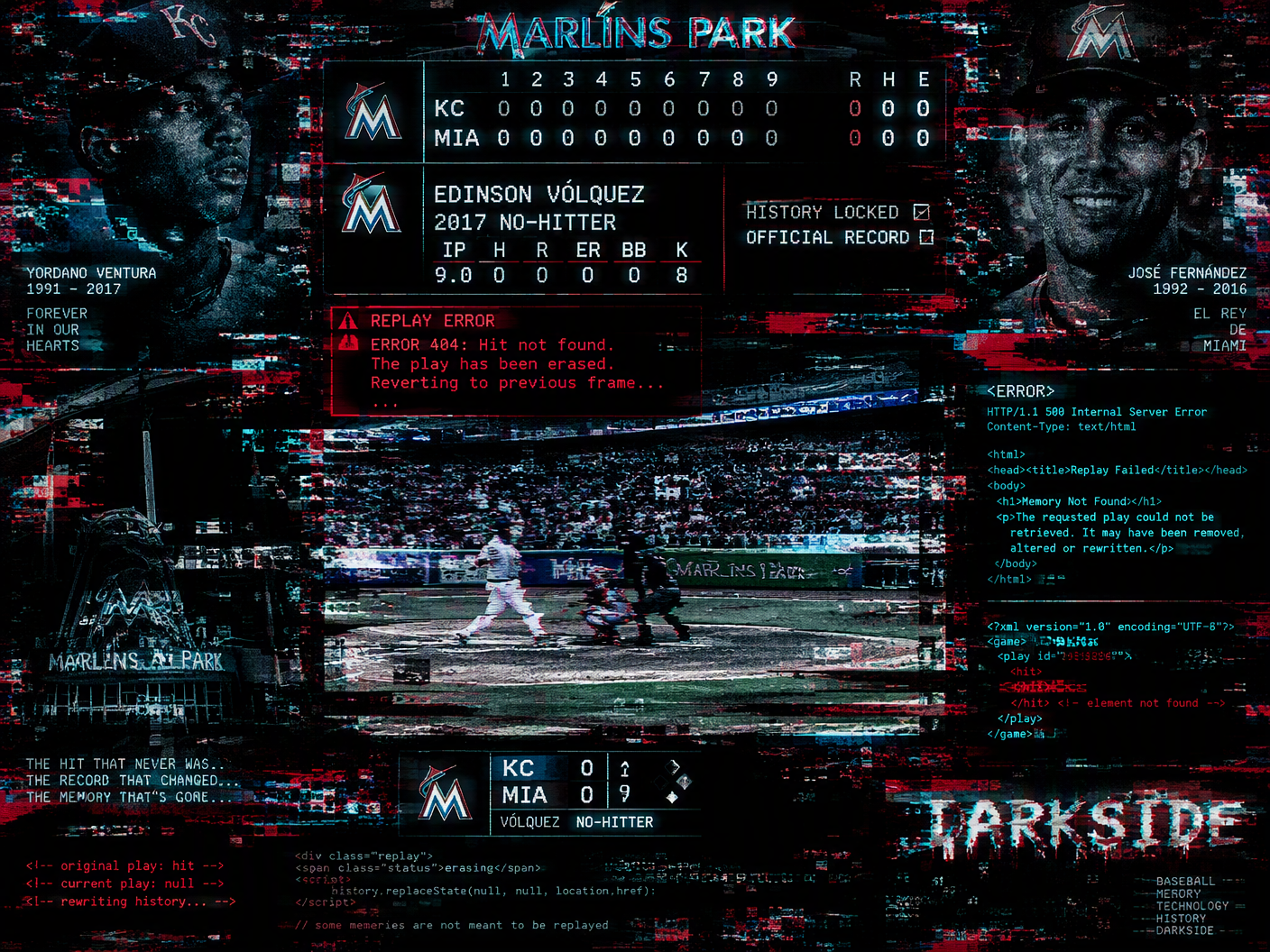
On June 3, 2017, at Marlins Park in Miami, Edinson Vólquez entered the final stages of a game whose meaning had been set before the first pitch. He had dedicated the outing to Yordano Ventura and José Fernández, two pitchers whose lives had ended months apart. The date would have been Ventura’s twenty-sixth birthday. By the time Vólquez completed the ninth inning against the Arizona Diamondbacks, the Miami Marlins had their sixth no-hitter, and a memorial gesture had become part of the franchise’s official record.
The achievement was not built from a perfect line. Vólquez walked two Arizona batters, allowing the opposition to reach base without a hit. He struck out 10 and used 98 pitches, a compact total for a complete game in an era when pitch counts had become a central concern for clubs. The numbers describe control and pressure at once: two openings for Arizona, ten outs taken away by the strikeout, and no ball that remained an official hit after the game’s review process had finished.
One apparent hit briefly stood between Vólquez and the no-hitter. Replay review overturned it, removing the Diamondbacks’ hit from the official ledger. The reversal made the game the first no-hitter in baseball history to include a hit overturned by replay. Technology had not merely settled a close play at the edge of the game; it had altered the category into which the entire performance would be placed. The result became official only after the old distinction between an on-field call and the final record had passed through review.
The two men Vólquez named before the game belonged to different parts of his professional life. Ventura, a Kansas City Royals pitcher, had shared the pressures of a major-league pitching career with him. Fernández had been the Marlins’ own pitcher, a central figure in the club’s recent history before his death. Vólquez’s dedication joined them on a Miami field, while the birthday attached to Ventura’s name gave the afternoon a date-specific significance that extended beyond the box score.
Vólquez arrived at that afternoon with a career already marked by events that did not fit neatly into a single image. On April 20, 2010, Major League Baseball suspended him for 50 games for performance-enhancing drug use. The disciplinary action entered the formal history of his career and remained separate from what happened in Miami seven years later. A league suspension could define a line in a personnel file; it could not explain the pitches Vólquez threw against Arizona on June 3, 2017.
His record also contained a rare offensive interruption. On June 2, 2013, while with the San Diego Padres in San Diego, Vólquez hit a three-run home run against the Toronto Blue Jays. Pitchers were expected to contribute with their arms and survive at the plate; a three-run homer placed him briefly in a different column of the game’s arithmetic. Four years later, the Marlins no-hitter would produce another outlying entry, this time through nine innings of pitching rather than one swing.
Another episode had attached personal loss to his work. On October 27, 2015, Vólquez pitched Game 1 of the World Series for the Kansas City Royals without knowing that his father had died earlier that day. His wife withheld the news until after the game. The circumstances became part of the public account of that World Series appearance, but they did not turn the game into a simple story of grief overcoming competition. Vólquez performed under information he did not possess, and only later learned what had surrounded the assignment.
The 2015 season had brought another formal mark. After the April 23 White Sox brawl, Major League Baseball suspended Vólquez for five games. The suspension belonged to a different incident, a different club, and a different kind of professional judgment than the 2010 drug penalty. Together, the two league actions showed how a pitcher’s career could be preserved in administrative entries as much as in wins, losses, and innings. None of those entries changed the status of the pitch that replay removed in Miami.
The Marlins game itself followed a narrower course. Arizona’s batters reached base twice on walks, but no hit remained after review. Vólquez struck out 10, completed the game in 98 pitches, and gave Miami a result that required no extension into extra innings and no relief appearance to finish the work. The decisive judgment came from the field, the official scorer, and the replay system acting in sequence: an apparent hit was overturned, and the no-hitter stood.
The dedication and the technology belonged to the same event, but they answered different questions. Vólquez’s words placed Ventura and Fernández at the center of the occasion he was trying to honor. Replay answered whether Arizona had recorded a hit. One was personal and commemorative; the other procedural and official. Their coexistence gave the game its particular shape: a performance offered in memory, then certified through a review system capable of changing the historical meaning of a single batted ball.
When the final line was entered, Vólquez had thrown Miami’s sixth no-hitter against Arizona at Marlins Park: 98 pitches, 10 strikeouts, two walks, and no official hits. The earlier suspension, the home run, the World Series played without knowledge of his father’s death, and the later dedication remained surrounding chapters rather than explanations imposed on the game. The enduring arrangement was simpler and more exact. June 3, 2017 remained a no-hitter, and replay became part of how that no-hitter came to exist.
Investigative Dossier & Evidence
Read the companion investigation notes, verified source claims, and primary documents.
Read the Companion Notes & Evidence Record →