
Scandals & Feuds · 2010s
The NBA’s Discipline of Donald Sterling and the Proposed Sale of the Clippers
After a recording attributed to Clippers owner Donald Sterling became public in April 2014, the NBA investigated and Adam Silver announced a lifetime ban and $2.5 million fine. Silver also said he would seek approval to force a sale; on July 28, a probate-court ruling cleared the way for Shelly Sterling’s proposed $2 billion agreement with Steve Ballmer.
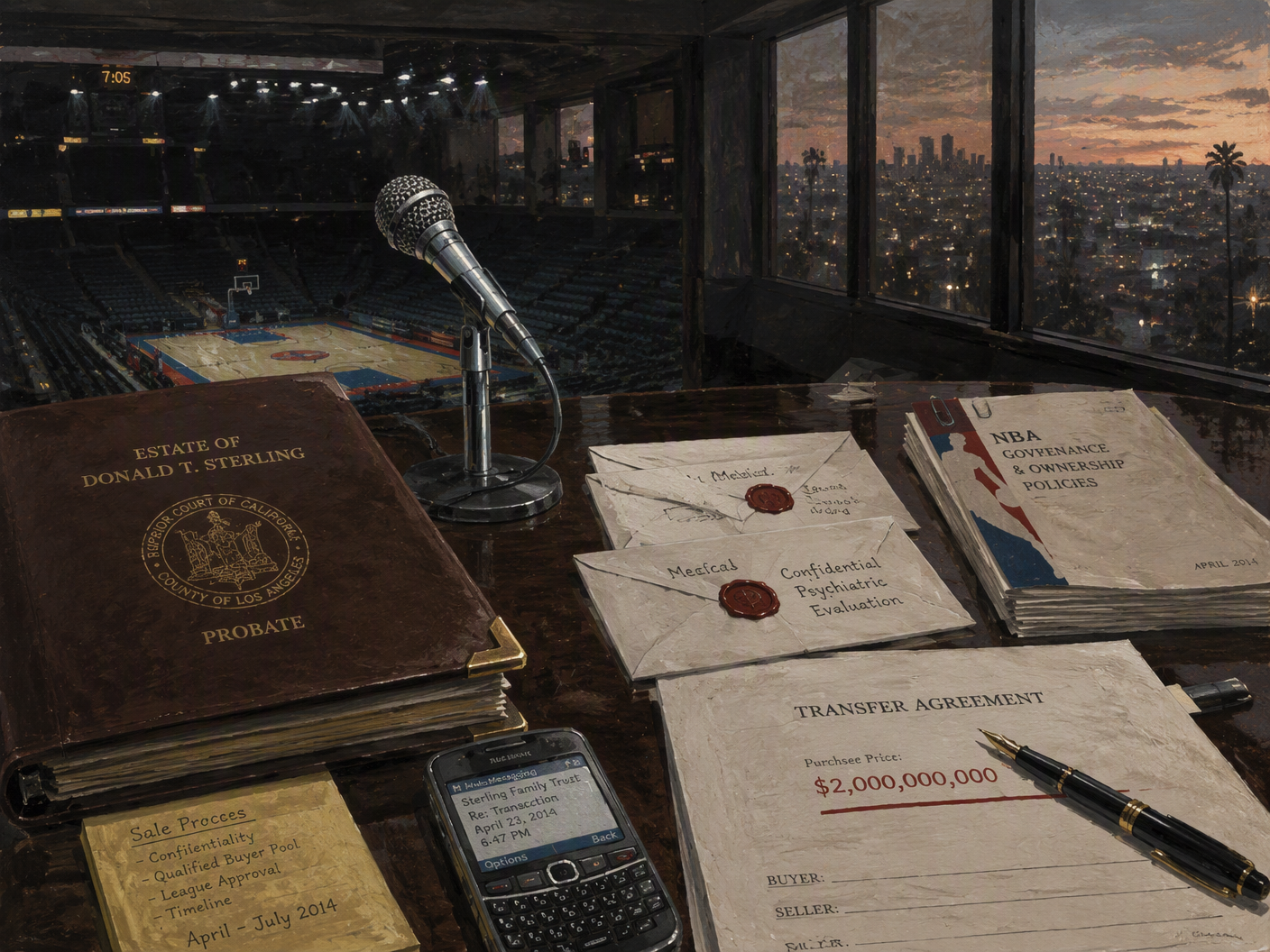
A recording attributed to Donald Sterling became public in April 2014, carrying a private argument into the fluorescent glare of professional basketball. The longtime owner of the Los Angeles Clippers was heard objecting to his companion’s public association with Black people and to bringing them to Clippers games. The comments prompted widespread criticism from people connected to the league and from the public. The controversy did not concern a disputed call or a failed season. It concerned the recorded words of the person who controlled a franchise whose players, staff, and audience were overwhelmingly connected to the Black culture of professional basketball.
The Clippers were a business, a civic symbol, and a workplace in which the owner’s authority reached from the front office to the arena suite. After the recording became public, attention shifted from the team’s performance to Sterling’s conduct and to the consequences of league ownership. Coverage focused on the comments attributed to him, the criticism they generated, and the authority attached to his position. The NBA’s next documented step was an investigation, placing the reported comments within the league’s disciplinary process rather than leaving the response to public statements or an ordinary team fine.
Before Commissioner Adam Silver announced punishment, the league opened an investigation into the reported comments. The sequence established two separate actions: an internal NBA inquiry and, later, discipline imposed through the commissioner’s authority. The NBA did not present the penalty as a criminal judgment or a court ruling. Silver could announce league discipline, but a change in ownership required another institutional step. He said he would seek approval from the Board of Governors, making the proposed transfer subject to the league’s voting process rather than allowing the commissioner to sign the team away on his own.
On April 29, Silver stepped before the cameras and announced the penalty. Donald Sterling was banned for life from the NBA. He was fined $2.5 million, the maximum amount the league’s rules allowed for the conduct at issue. The punishment barred him from attending NBA games or practices, entering team facilities, or participating in league business. It was an administrative sentence imposed in the language of professional sports, but its practical effect was severe: the owner could retain a financial interest while being excluded from the world that made that interest valuable.
Silver went further. He announced that he would seek to force a sale of Sterling’s ownership interest in the Clippers. The proposal still had to pass through the NBA’s Board of Governors, requiring approval from three-quarters of the league’s owners. That threshold exposed the institutional conflict beneath the public condemnation. The NBA could punish a member through the commissioner’s office; removing an ownership stake required the owners to use their collective power against one of their own. The league was attempting to convert a disciplinary decision into a change in property and control.
The next struggle moved from the league’s offices to the Sterling family’s trust and, eventually, a probate courtroom. Shelly Sterling agreed to a proposed $2 billion sale of the Clippers to Steve Ballmer, the former Microsoft chief executive. Ballmer’s money offered the league a route out of the crisis, but the agreement did not end the ownership dispute. Donald Sterling contested Shelly Sterling’s authority to complete the transaction, turning the planned sale into a fight over who could act for the family and who still controlled the franchise.
The legal argument depended in part on the Sterling Family Trust. Two doctors had declared Donald Sterling mentally incapacitated under the terms of the trust before Shelly Sterling proceeded with the sale. The question before the probate court was therefore not simply whether the proposed price was large enough or whether the NBA wanted a new owner. It was whether the trust’s mechanisms had been properly used, and whether Shelly Sterling possessed the authority to act when she accepted Ballmer’s offer.
In the probate case, Donald Sterling’s lawyers argued that Shelly Sterling and Adam Silver had engaged in a scheme to strip him of ownership. Their legal position connected the NBA’s discipline, the proposed sale, the trust, and the doctors’ declarations as parts of an effort to remove him from the franchise he controlled. The alleged scheme was an argument advanced on Sterling’s behalf, not a finding stated here as fact. The judge had to decide whether that argument could overcome the trust documents and the evidence presented in court.
Magic Johnson’s name also appeared in the ownership discussion. A contemporaneous report said Johnson and financial backers might assemble a bid for the Clippers. Johnson, whose history with the Lakers made his name familiar in Los Angeles, publicly denied that he was trying to buy the team while Sterling remained its owner. The account documented a reported possibility and a denial, not a submitted or completed purchase bid. The proposed Ballmer agreement was the transaction before the probate court, where the immediate issue was Shelly Sterling’s authority to advance it.
On July 28, Los Angeles Superior Court Judge Michael Levanas ruled in Shelly Sterling’s favor. The probate court accepted the position that two doctors had declared Donald Sterling mentally incapacitated under the trust’s terms before Shelly Sterling moved forward with the sale. The ruling rejected Donald Sterling’s arguments and cleared the way for the proposed transaction with Ballmer to proceed. The commissioner’s announcement in April had created the pressure for a change; the courtroom ruling supplied the legal route through which that change could move.
The episode’s defined chapter closed with Sterling barred from the NBA and the proposed Clippers sale authorized to proceed, not with the July ruling itself functioning as the transaction’s closing. The record separates the systems involved: NBA discipline produced the lifetime ban and fine; the Board of Governors held the authority to approve a forced sale; the trust supplied the family mechanism Shelly Sterling invoked; and probate litigation tested that authority. Judge Levanas’s ruling removed the legal obstacle described in the case and allowed the proposed Ballmer transaction to advance. The ruling marked authorization to proceed, while the later completion of the sale was a separate step in the transfer of control.
Companion notes
How NBA Discipline Became a Path to Ownership Transfer
The surviving reporting supports the basic chronology from the April recording to the July probate ruling. It also leaves important boundaries intact: the recording’s independent forensic authentication, the NBA’s complete investigative file, the underlying medical records, and the later closing of the proposed sale are not established by the captured materials.
The Recording and the League Inquiry
The April episode is documented through the Donald Sterling and Shelly Sterling reference entries, contemporaneous coverage by Sporting News, and USA TODAY reporting on reactions to the comments. Those sources describe a recording attributed to Sterling and explain why the comments prompted widespread criticism: they concerned his opposition to his companion publicly associating with Black people and bringing Black people to Clippers games. The captured materials do not include an independent forensic authentication of the recording, so the appropriate factual formulation is that comments attributed to Sterling became public. [S1], [S2], [S5], [S7]
USA TODAY’s April 27 account and the reference material establish that the NBA opened an investigation before Adam Silver announced discipline. The record does not contain the NBA’s complete investigative record, interview transcripts, technical examination of the recording, or internal deliberations. The chronology is therefore supported, while the precise scope and methods of the league inquiry remain outside the available documentation. [S1], [S2], [S7]
What Silver Ordered
On April 29, 2014, Silver announced a lifetime ban from the NBA and a $2.5 million fine. The announcement is corroborated by the Sterling reference material, USA TODAY, and the NBA-related reporting captured in the record. This was an NBA disciplinary action, not a criminal conviction, civil judgment, or court-imposed penalty. Silver also announced that he would seek to force a sale of Sterling’s Clippers ownership interest, subject to approval by three-quarters of the Board of Governors. The proposal required league and legal steps; it was not an immediate unilateral sale by the commissioner. [S1], [S2], [S3], [S6]
The Trust and Probate Dispute
The Los Angeles Times account of the July 28 probate ruling, together with the reference material, documents Shelly Sterling’s proposed $2 billion sale of the Clippers to Steve Ballmer and Donald Sterling’s challenge to her authority. The court accepted the position that two doctors had declared Donald Sterling mentally incapacitated under the terms of the Sterling Family Trust before Shelly Sterling proceeded. The record contains the court reporting and described ruling, but not the underlying medical records, complete trust documents, or a full transcript of the probate proceedings. [S1], [S2], [S3], [S4]
Donald Sterling’s lawyers argued that Shelly Sterling and Adam Silver had participated in a scheme to strip him of ownership. That allegation is properly attributed to the litigant’s legal position, not treated as an established fact. The Los Angeles Times and USA TODAY accounts state that Judge Michael Levanas rejected Sterling’s arguments and cleared the way for the proposed sale to proceed. The ruling establishes authorization to advance the transaction; this packet does not independently establish that the later closing occurred. [S1], [S2], [S4], [S6]
The Alternative Bid That Was Not a Sale
Sporting News reported that Magic Johnson and financial backers might assemble a bid for the Clippers. The same reporting, as reflected in the captured record, included Johnson’s public denial that he was trying to buy the team while Sterling remained its owner. The materials support describing this as a reported possibility and a public denial, not as evidence that Johnson submitted or completed a purchase bid. It belongs in the chronology only as a reported potential transaction, while the proposed Ballmer deal was the agreement tested in the probate case. [S1], [S2], [S5]
Source key
The associated evidence packet contains visible source URLs, source roles and the complete claim ledger.