
Tragedy · 2001
The Lap 11 Crash That Ended Dan Wheldon’s Las Vegas IndyCar Finale
On October 16, 2011, a 15-car crash at Las Vegas Motor Speedway stopped the IndyCar season finale and killed Dan Wheldon. The race was cancelled after Wheldon’s death was announced, and the remaining drivers completed five tribute laps instead of returning to competition.
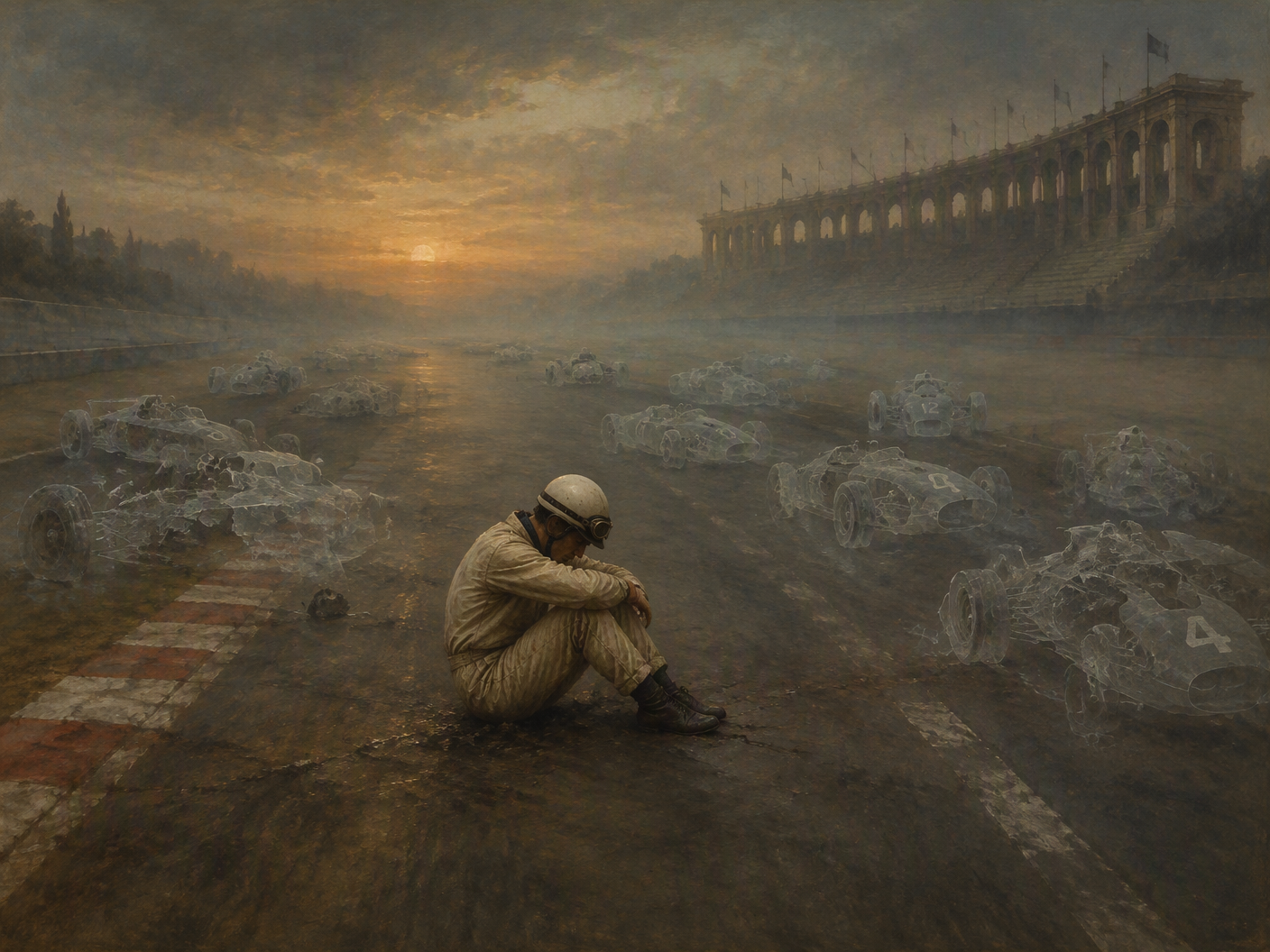
On October 16, 2011, at Las Vegas Motor Speedway, the final IndyCar race of the season changed in the space of one lap. Tony Kanaan had started from pole and was leading the 34-car field when 15 cars became involved in a crash on Lap 11, at Turn 1 and along the front straightaway. Dan Wheldon was among them in the No. 77 car, which had begun the race at the rear. The red flag stopped the competition. What had been a championship finale became an emergency response, followed by a decision that would close the event permanently.
Wheldon’s position at the back of the field carried a particular purpose. He had entered the Las Vegas race as an established IndyCar driver, but the No. 77 car was starting behind the other competitors in a field built for speed on the high-banked oval. Ahead, Kanaan led the opening sequence. Dario Franchitti arrived with the championship still in contention, while Will Power remained part of that title landscape and was also on the track. The race had barely begun its formal story before the distance between cars collapsed into the wreck.
The crash involved Wheldon, Wade Cunningham, J. R. Hildebrand, Will Power, James Hinchcliffe, and Pippa Mann among the drivers caught in the chain of collisions. Fifteen cars were involved altogether. The event was not reduced to a single vehicle or a single isolated impact in the official sequence preserved afterward. It was a multi-car crash at racing speed, and its immediate meaning was operational: cars stopped, the race was red-flagged, and medical personnel began working inside an event that could no longer be treated as a contest awaiting restart.
Power was injured. Hildebrand and Mann were also injured and taken to the hospital for observation. Their injuries formed part of the immediate human consequence of the crash, but the central medical emergency concerned Wheldon. He was airlifted from the speedway to University Medical Center of Southern Nevada in Las Vegas. The movement from track to aircraft and then to hospital marked the separation between what could be seen at the circuit and what physicians would determine beyond it. The race remained stopped while that transfer took place.
Wheldon later died from injuries sustained in the crash. The official cause of death was blunt force trauma to the head. He did not survive the event or return to racing afterward. That fact ended the uncertainty surrounding the medical response, but it did not restore the race’s original purpose. The drivers had entered Las Vegas to complete a championship season; instead, officials faced the task of informing the field and deciding whether any portion of the scheduled competition could continue after one of its competitors had been killed.
IndyCar CEO Randy Bernard announced Wheldon’s death and the cancellation of the race. The decision closed the finale rather than treating the red flag as a temporary interruption. The championship implications were settled through the abandoned event: Dario Franchitti was declared champion after the race was voided. Kanaan’s lead at the moment of the crash no longer carried competitive significance, and Power’s title position was overtaken by the consequences of an event that would produce no further racing laps.
The cancellation also altered the roles of everyone who remained at Las Vegas. Tony Kanaan, who had begun the afternoon at the front, was no longer leading a race that could be won. Franchitti was no longer waiting for a final result to determine the championship. The surviving drivers became participants in an official response to Wheldon’s death. Five laps were arranged as a tribute, a short circulation of the field that preserved the form of racing while removing its competitive objective.
Those five laps did not erase the sequence that preceded them. Wheldon had started last among 34 cars. On Lap 11, the 15-car crash occurred at Turn 1 and the front straightaway. Power, Hildebrand, and Mann were injured; Wheldon was transported by air to the Las Vegas hospital and later pronounced dead. Each action followed the next under the authority of IndyCar officials, who moved from red flag to medical extraction, from announcement to cancellation, and then to a memorial conducted by the drivers who remained.
The event’s later interpretation could not be simplified into a single-driver explanation. The established sequence names the cars and drivers involved, the location of the crash, the medical outcome, and the institutional decisions that followed. It does not assign the wreck to one driver alone. That boundary matters because participation and responsibility are different conclusions. The crash was documented as a 15-car incident, while the consequences were certain: one driver died, others were injured, the race ended, and the championship proceeded without the competition originally scheduled to decide its final afternoon.
Las Vegas therefore remained in the IndyCar record not as a completed season finale but as an event divided by Lap 11. Before the crash, Kanaan led and Franchitti’s championship was still part of the afternoon’s purpose. After it, Wheldon’s death determined the response. Bernard’s announcement cancelled the race, Franchitti received the championship, and the remaining drivers completed five laps in Wheldon’s honor. The enduring record is procedural as well as personal: the red flag became the end of competition, and the final laps belonged to remembrance rather than victory.
Investigative Dossier & Evidence
Read the companion investigation notes, verified source claims, and primary documents.
Read the Companion Notes & Evidence Record →