
Scandals & Feuds · 1981
The 1981 Strike That Rebuilt Baseball’s Postseason
The players’ strike that began on June 12, 1981, canceled 712 regular-season games and forced Major League Baseball to replace its ordinary postseason path with a one-time split-season format. The arrangement brought Kansas City into the playoffs while leaving the St. Louis Cardinals and Cincinnati Reds outside despite their superior overall National League records.
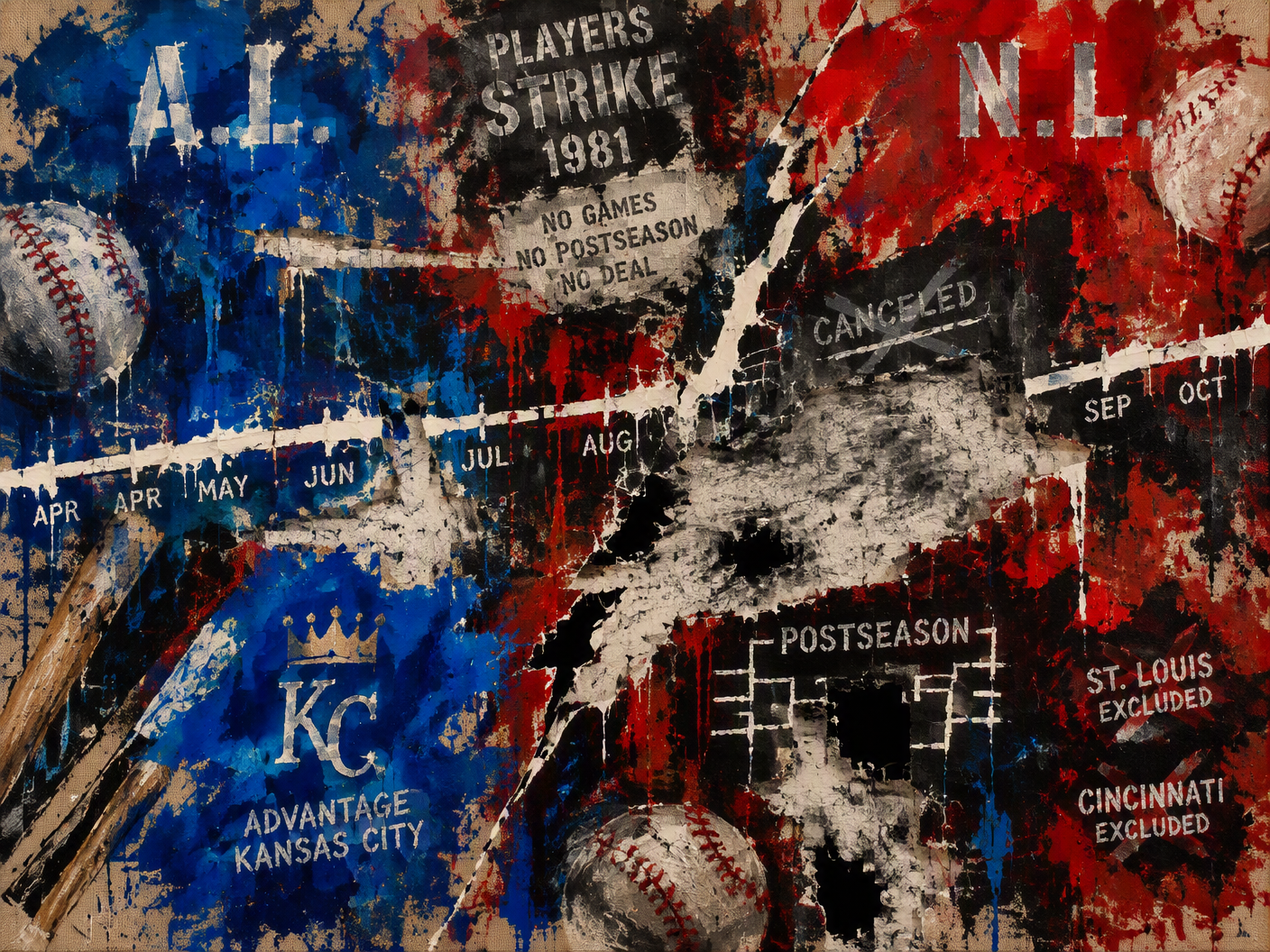
On June 12, 1981, Major League Baseball stopped in the middle of its season. Players represented by the Major League Baseball Players Association went on strike in the United States and Canada, suspending the calendar that determined standings, schedules, and the route to October. Marvin Miller, the union’s executive director, led the players through the labor dispute. Across the sport, clubs still existed, contracts still governed employment, and the pennant races still occupied the public mind, but the games that supplied those races were no longer being played.
The stoppage did not simply remove a stretch of dates from the schedule. A baseball season was built as a chain: one club played another, standings accumulated, and the best records ordinarily supplied the postseason field. Once the strike interrupted that chain, the league faced a problem that could not be solved by announcing a return to work. The lost contests could not all be restored, and the standings could not resume as though the interruption had not changed their meaning. By the time play was restored, 712 regular-season games had been canceled.
The negotiations continued through June and July, with Miller representing the players and Commissioner Bowie Kuhn participating for baseball’s governing side. Their agreement, announced on July 31, ended the strike. That announcement reopened the sport’s schedule, but it did not return the canceled games to the calendar. The settlement resolved the labor stoppage; it left league officials with the separate task of deciding how a shortened and divided season could produce a postseason that clubs and fans would recognize as legitimate.
The answer was not a simple continuation of the standings from June. Major League Baseball divided the 1981 campaign into two sections and tied postseason access to the winner of each half. The arrangement treated the first and second portions of the season as separate competitions. A club could therefore secure a postseason place by leading its division in one segment, even if its combined record across the entire interrupted season was weaker than that of a rival. The format was adopted for 1981, as an accommodation to the strike’s disruption.
That decision altered the meaning of a pennant race. Under the ordinary arrangement, a team’s accumulated record was the central currency of the season. Under the new structure, timing mattered as much as total performance. A club that had already established a lead before the stoppage could find that advantage separated from the later contest for access. Another club could recover in the second half and win the place reserved for that segment. The format did not erase the games that had been played; it placed them inside a new administrative division.
The Kansas City Royals became the clearest American League beneficiary of that division. They won the second-half American League West title and reached the postseason through the temporary route Major League Baseball had created. Their place was procedurally secure because the second-half title carried its own postseason value. The arrangement made Kansas City’s late-season performance decisive in a way that a single, uninterrupted standings table would not have made it.
The National League produced the more difficult contradiction. The St. Louis Cardinals and Cincinnati Reds finished with the league’s best overall records, yet neither reached the postseason under the split-season rules. Their cumulative performance did not supply the segment title required for entry. The clubs were not excluded because the season had been played under an ordinary full-season ranking and they had failed to qualify. They were excluded because the qualification system had changed around the interruption, rewarding designated half-season winners over the strongest total records.
The public resumption came on Sunday, August 9, at Cleveland Stadium. Major League Baseball returned first through the All-Star Game, an exhibition contest between the National League and American League, before the regular-season schedule resumed under the altered arrangement. The National League defeated the American League, 5-4. The game supplied a visible point of return, but it did not restore the old season. When competition resumed, the sport carried forward a settlement, a reduced schedule, and a postseason structure shaped by the weeks in which no one had played.
The Cleveland game also marked the difference between reopening baseball and normalizing it. A labor agreement had brought the players back. The All-Star Game placed the leagues on the field again. Neither event could make the canceled contests disappear or convert the divided schedule into an ordinary championship race. The season that followed August 9 operated under a compromise between competitive custom and administrative necessity: the sport needed October participants, but the calendar no longer offered an uncontested method for choosing them.
In that sense, the oddities of 1981 were not accidents at the edge of the competition. They were consequences of the rule selected to manage the interruption. Kansas City advanced by winning the second half in the American League West. St. Louis and Cincinnati, despite their best overall National League records, were left outside. The postseason therefore preserved a form of order—division titles, league brackets, and an official route to October—by accepting a different kind of disorder in the standings.
The arrangement belonged to that season alone. It did not become a permanent replacement for baseball’s usual postseason structure. Its afterlife remained in the unusual bracket it created and in the administrative lesson contained within the calendar: when a labor dispute removes hundreds of games, the consequences reach beyond the empty dates. They enter the rules that decide who qualifies, which records matter, and whether the team with the strongest season-long performance is still the team permitted to continue.
Investigative Dossier & Evidence
Read the companion investigation notes, verified source claims, and primary documents.
Read the Companion Notes & Evidence Record →