
Violence & Brawls ·
The Morning Quantrill’s Raiders Took Lawrence
On August 21, 1863, guerrillas killed civilians and destroyed much of the Kansas town. Accounts of the massacre describe promises of protection kept at one hotel and broken at another.
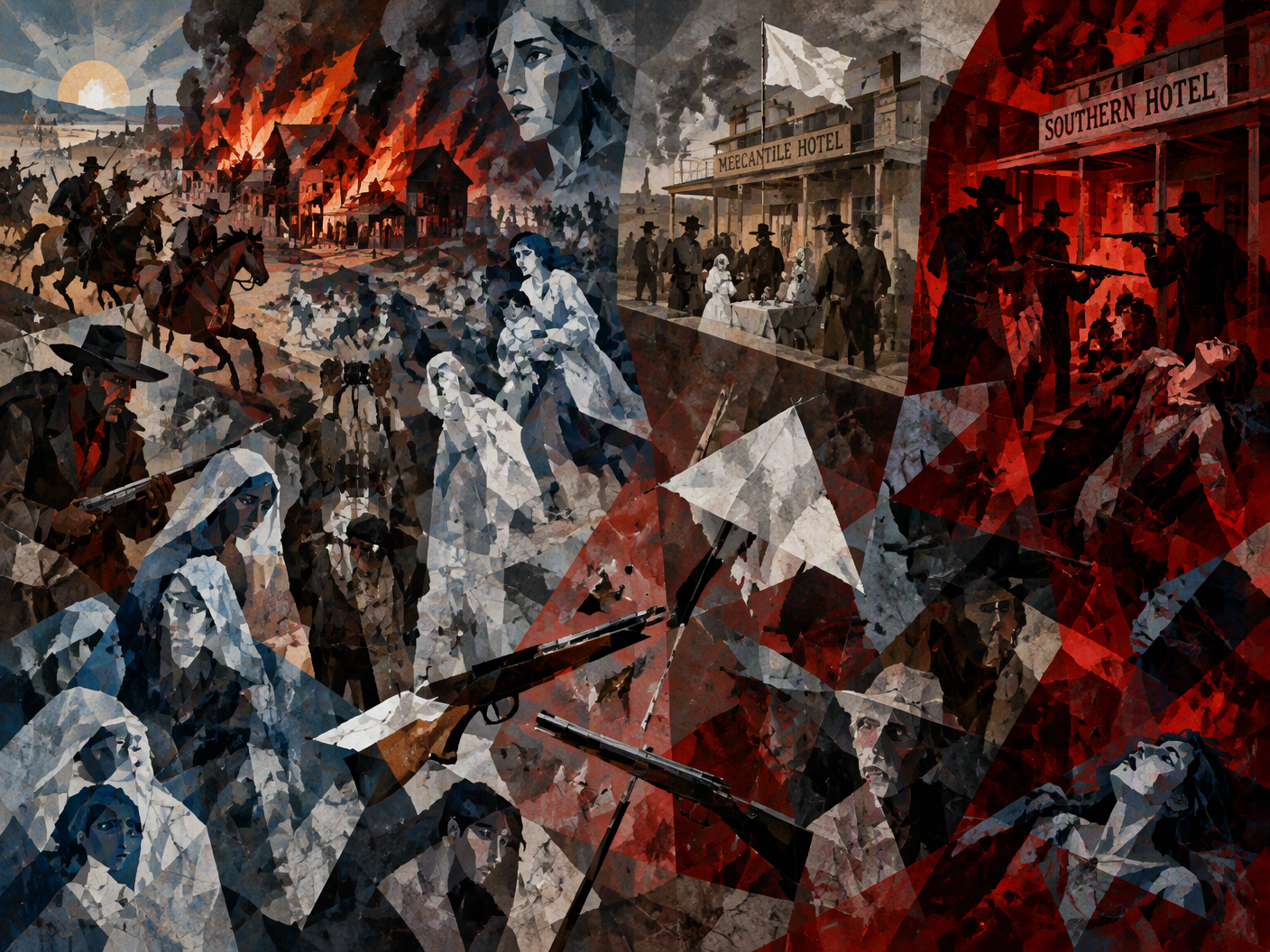
At daybreak on August 21, 1863, William Clarke Quantrill led about 300 guerrillas into Lawrence, Kansas. They killed civilians—men and boys—and burned homes and businesses before withdrawing several hours later. By noon, according to the Kansas Historical Society, more than 200 buildings had been destroyed and 150 men were dead or dying.
Quantrill organized a band in December 1861, claiming to fight for the Confederacy, and led his first attacks the following year. Lawrence was not its first target: the previous September, about 140 raiders had attacked Olathe, killing six men and holding residents in the public square while they looted. The force that entered Lawrence was more than twice as large.
A published account built around a letter by the Reverend Richard Cordley, supplemented with residents’ recollections, describes a town whose preparations had lapsed. Earlier that August, a warning of a planned raid had prompted the mayor to call out the militia and ready the cannon. But troops and cannon sent from Fort Leavenworth were ordered back, and a small detachment stationed in Lawrence was withdrawn. Cordley’s account says residents took those decisions as reassurance that the town was not in danger.
As the raiders approached in the dim morning light, several people on the outskirts mistook them for Union troops, the account says. Once inside Lawrence, they spread through the streets before residents could organize a defense. The town’s arms were stored in a public armory; after the attackers occupied the main street, citizens could no longer reach them. Some men started toward the street with weapons of their own, then turned back when they saw it was already held.
At the Eldridge House, Captain Banks, the state’s provost marshal, displayed a white flag from a window and surrendered the hotel on the condition that its occupants be protected. According to the account, the raiders robbed the rooms and marched the occupants outside. When another raider tried to shoot a young man in the group, a guard intervened and threatened to kill anyone who harmed the prisoners. Quantrill directed them to the City Hotel, where he promised they would be safe. The account says that promise was kept.
At the Johnson House, surrender had a different result. Men were told they would be spared if they gave themselves up. Guards marched them away and shot them, the account says. One, identified as Mr. Hampson, fell wounded and lay as though dead until he could escape unseen. Elsewhere, an unnamed woman recalled meeting successive gangs at her house herself and trying to get them talking.
Lawrence banker H. M. Simpson described the violence in a letter dated September 7, 1863. He wrote that Judge Carpenter had been pursued through his house and shot repeatedly while in his wife’s arms. Mrs. Fitch, he wrote, was not permitted to pull her husband’s body from a burning house, but was “compelled to stand by and see the corpse consumed.”