
Bizarre & Myths · 1990s
Bobby Valentine’s Ejections and the Disguises That Failed
The documented sequence includes a 1989 suspension-era attempt to enter the Metrodome in disguise and the June 9, 1999 return to the Mets dugout in a fake mustache after an ejection. Both efforts ended in recognition, and the later incident brought a two-game suspension; a separate 2013 broadcast decision followed comments about the Yankees and the Mets’ response to September 11.
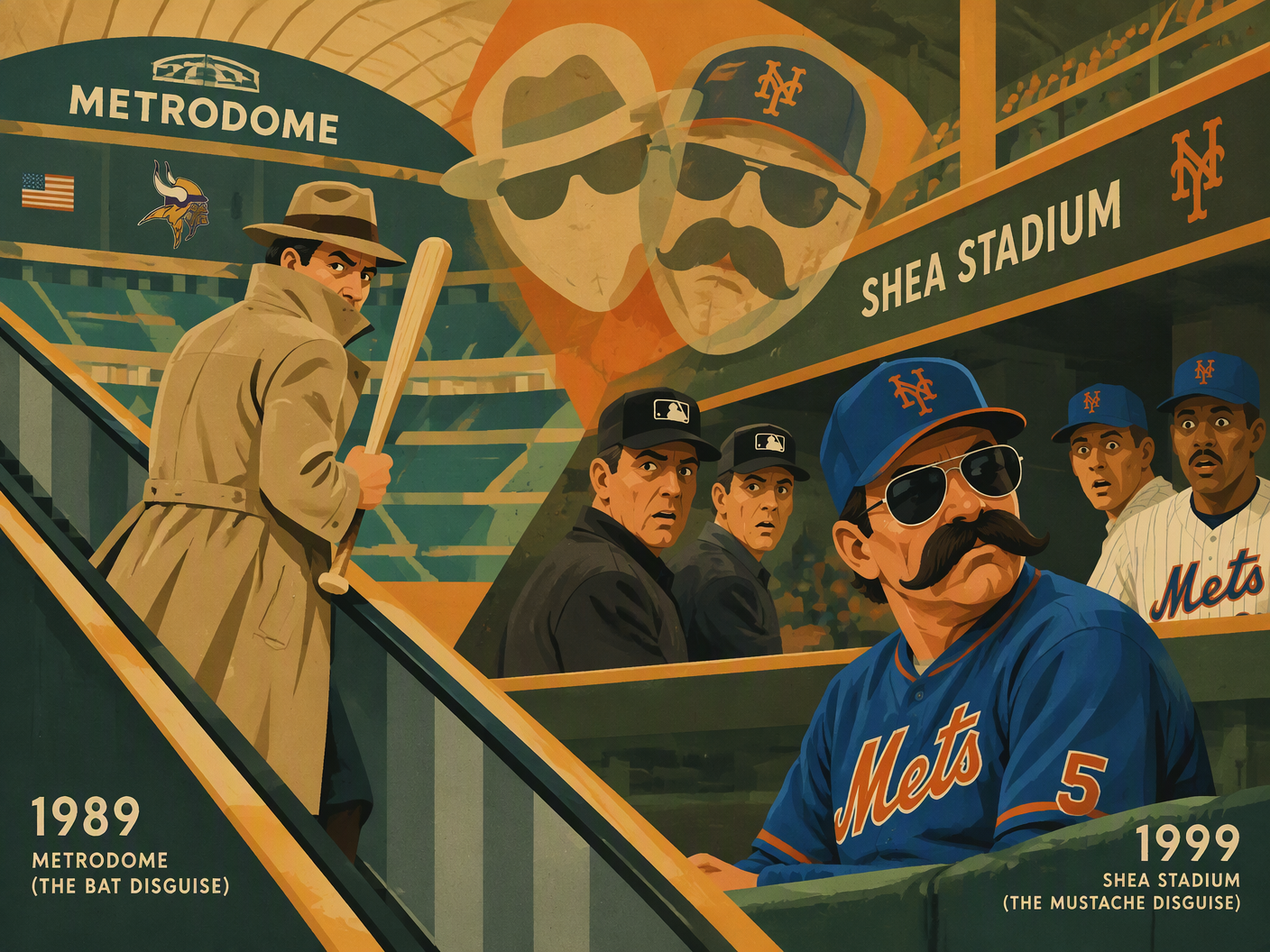
On June 9, 1999, Bobby Valentine was ejected from a New York Mets game and left the field under a rule that ordinarily ended his participation. He did not remain away for long. Valentine returned to the Mets dugout wearing a hat, sunglasses, and a fake mustache, attempting to place himself back inside the game while changing the appearance by which the people around it knew him. The disguise converted an ordinary managerial ejection into a second incident: not a departure, but a return carried out in plain view.
The attempt depended on a simple proposition—that a few altered features could separate the manager from the man. It failed. Valentine was spotted after coming back into the dugout, and the disguise became the central fact of the episode rather than a successful means of avoiding detection. The broadcast crew recognized him, turning the dugout itself into the place where the concealment ended. What had begun as an effort to resume his position became an additional breach of the authority that had removed him.
The punishment followed in administrative form. Valentine was suspended for two games after the June 9 incident. The sanction did not erase the original ejection; it extended the consequences of what happened afterward. A manager who had already been ordered away from the field had returned in altered clothing, and Major League Baseball treated that return as conduct requiring a separate penalty. The episode survived because its details were unusually concrete: the hat, the sunglasses, the false mustache, the dugout, and the suspension that followed.
The 1999 disguise was not Valentine’s first attempt to remain near a game after discipline had removed him from his managerial post. Ten years earlier, while managing the Texas Rangers, he was suspended for one game. The setting was the Metrodome in Minneapolis, where the Minnesota Twins played under the roof and where the boundary between an absent manager and an ordinary spectator was easier to cross physically than institutionally.
During that 1989 suspension, Valentine tried to enter the stadium in disguise and sit in the left-field stands. He was not attempting to direct the Rangers from the dugout; the stated destination was the seating area, among the spectators. The choice carried its own contradiction. A suspension removed his official role, but it did not remove his desire to remain close to the contest. He sought another place inside the building, one that would let him watch while denying the identity that had made the restriction necessary.
The concealment lasted only as long as recognition was delayed. A fan identified Valentine as he went up an escalator at the Metrodome, and the plan collapsed before he could settle into the left-field stands. The encounter established the limit that would recur a decade later: disguise could alter an outline, but it could not reliably suppress familiarity. Valentine was a known manager in a known building, and the people who recognized him did not require a uniform or an official credential to do so.
The two episodes belonged to different clubs and different moments in Valentine’s managerial career. In 1989, the Texas Rangers suspension placed him outside the formal operation of the game, and he tried to watch from the stands. In 1999, the Mets dugout was the place from which he had been ejected, and he tried to return there. The first attempt moved toward anonymity in the crowd; the second moved back toward the center of authority. Neither produced the intended result.
That distinction mattered to the consequences. The 1989 episode ended with recognition during an attempted entry while Valentine was suspended for a game. The 1999 episode began with a formal ejection, continued with a disguised return, and ended with another recognition followed by a two-game suspension. The later incident therefore carried a more complete disciplinary sequence: removal, reentry, detection, and punishment. The disguise was not a method by which Valentine escaped the rules. It was the act that brought the rules back into force.
Valentine’s public career later encountered a different kind of institutional boundary. In 2013, TBS had planned to include him on its Major League Baseball playoff studio show. Those plans were dropped after comments Valentine made about the Yankees and the Mets’ response to September 11. The consequence was not an ejection from a field or a suspension from a game. It was the loss of a planned television role, imposed through a network’s decision about whom it would place before a playoff audience.
The 2013 broadcast episode belonged to a separate period and a separate form of discipline, but it preserved the same public tension that had marked the earlier incidents. Valentine’s conduct had repeatedly collided with the institutions surrounding baseball: first the rules governing a suspended manager, then the authority of an umpire’s ejection, and later the editorial judgment of a television network. The settings changed from an escalator and a left-field seating section to a planned studio desk. The consequence remained practical: access was withdrawn.
The lasting shape of these episodes is therefore narrower than the mythology that grew around them. Valentine did not successfully disappear into the Metrodome crowd, and he did not remain undetected in the Mets dugout. He was recognized in both settings. The documented afterlife is not a story of disguise overcoming baseball’s authorities, but of disciplinary boundaries being tested, breached, and reasserted—through a suspended game in Minneapolis, a two-game penalty after a June 1999 ejection, and a later television assignment that never reached the playoff broadcast.
Investigative Dossier & Evidence
Read the companion investigation notes, verified source claims, and primary documents.
Read the Companion Notes & Evidence Record →