
Scandals & Feuds · 2000s
The Commissioner’s Tie: How the 2002 All-Star Game Ended at 7-7
On July 9, 2002, Bud Selig intervened after the 11th inning of the All-Star Game at Miller Park and ruled that the contest would end in a tie if the National League failed to score. The announcement produced boos, chants, and beer bottles thrown onto the field, ending the game without a Most Valuable Player award.
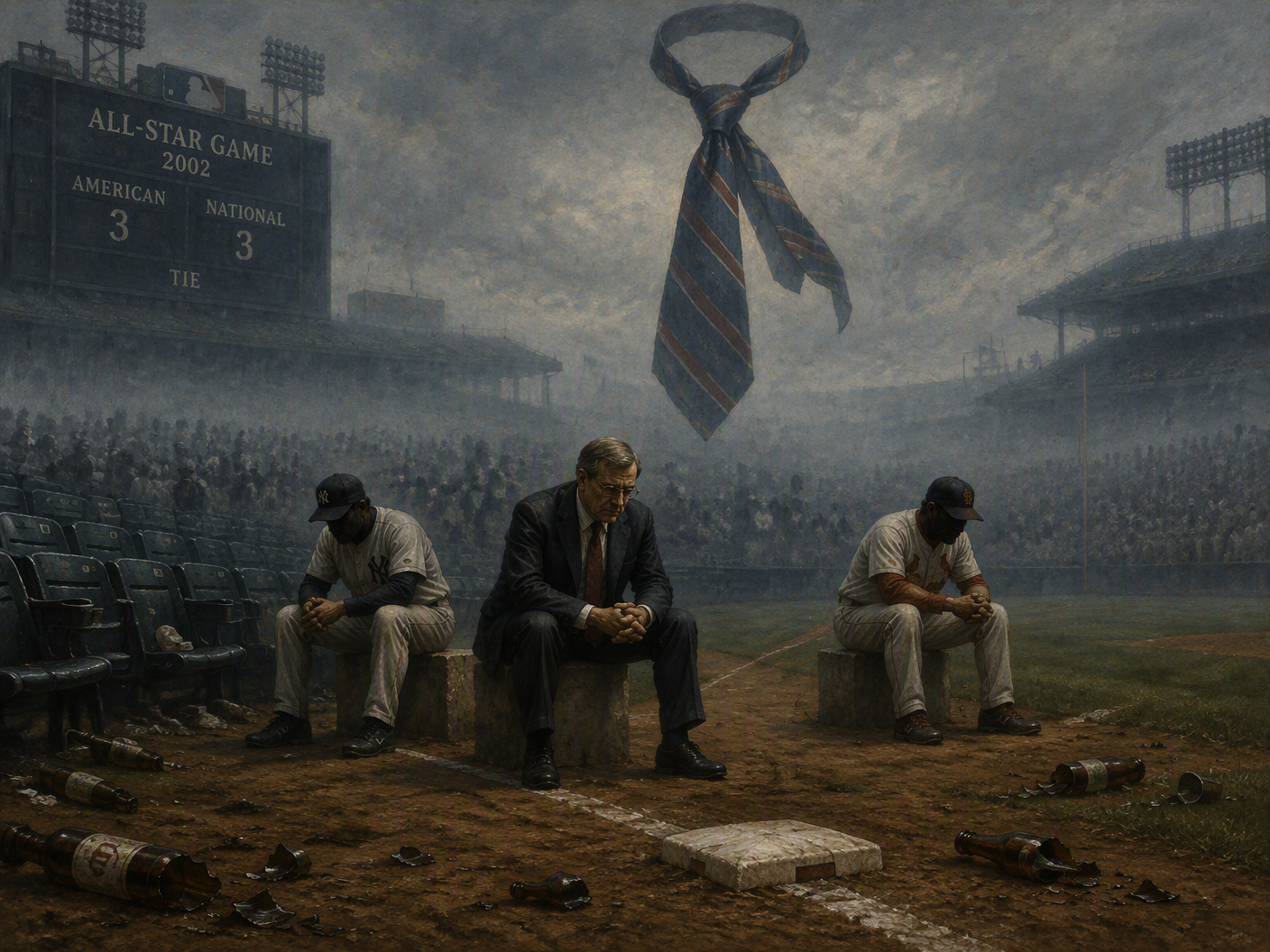
The decision came after the top of the 11th inning ended without a run. With the American League and National League still tied 7-7 at Miller Park in Milwaukee, Commissioner Bud Selig met with Joe Torre and Bob Brenly near the first-base dugout. The discussion concerned the pitching situation, but its consequence reached beyond the next half-inning. Selig ruled that if the National League failed to score in the bottom of the 11th, Major League Baseball would declare the All-Star Game a tie. The contest no longer had an open-ended finish.
The game had been played on July 9, 2002, as an exhibition built around the league’s best-known players and staged in Milwaukee’s new Miller Park. Its formal status did not prevent the score from acquiring competitive weight. By the time the teams reached extra innings, each side had scored seven runs. The players had continued through the 11th, but the supply of available pitchers had become the immediate administrative concern. Selig possessed the authority to determine what would happen next. He used it after consulting both managers.
Torre, managing the American League, and Brenly, managing the National League, participated in the dugout meeting. The consultation mattered because the ending was not produced by a play, an umpire’s call, or a final at-bat. It was produced by a ruling made at field level after the scoreless top half of the inning. Selig converted a discussion about pitching into a condition governing the game’s result: one National League run would continue the contest; no run would end it at 7-7.
The public-address system then carried the decision through the stadium. Fans booed and jeered. Chants rose from the stands: “Let them play!” “Refund!” “Bud must go!” and “Ripoff!” The language turned the commissioner’s ruling into the central event of the night. The crowd was not reacting to a disputed pitch or a collision at home plate. It was protesting an announced limit on the game itself, imposed while the score remained even and the final inning had not yet produced a winner.
Beer bottles followed the chants. Fans threw them onto the field after the tie announcement, converting disapproval into an act that could endanger people working and playing below. The documented reaction identifies the crowd as a collective presence; it does not assign responsibility for individual bottles to named spectators. Its significance lies in the sequence. The announcement came first. The booing, jeering, chanting, and bottle throwing came after it.
The ruling left the bottom of the 11th with an unusual function. The National League could still score and prevent the tie, but a scoreless half-inning would no longer lead to another frame. The players were competing inside a result already bounded by the commissioner’s decision. When the National League did not score, the game ended 7-7 after 11 innings. The tie was not a metaphor and not a later revision. It was the official conclusion announced at Miller Park that night.
The administrative ending also altered the ceremony that normally follows an All-Star Game. No Most Valuable Player award was given. The missing award reflected the awkwardness of a contest without a winning league and without a decisive final play. Individual performances remained inside the statistics of the night, but the customary prize attached to the game’s central narrative had no recipient.
Selig’s role made the ending personal in the public imagination because his name was embedded in the chants that followed the announcement. “Bud must go!” reduced a procedural decision to an individual target. Yet the documented act was specific: Selig met with Torre and Brenly, addressed the pitching situation, and announced the condition under which the game would be declared a tie. The record establishes that intervention. It does not turn the bottle throwing into an act committed by Selig, nor does it place him among the spectators on the field.
The episode acquired a durable place in accounts of Selig’s tenure because it joined institutional authority to an unsatisfying result. He later continued to serve as Major League Baseball commissioner and was elected to the National Baseball Hall of Fame in 2016. Those later developments placed the Milwaukee decision inside a longer public career, but they did not change what happened at Miller Park. The commissioner had ended the game under a declared condition, and the crowd had answered with an organized protest that included thrown bottles.
The final score preserved the logic of the ruling and the anger that followed it: 7-7, after 11 innings, with no Most Valuable Player selected. Selig’s decision had solved the immediate pitching problem by establishing an endpoint. It also transferred the unresolved question of what the night was supposed to produce—from the field to the stands. The players left without a winner, the award remained unassigned, and the fans’ response became the last unmistakable act of the 2002 All-Star Game.
Investigative Dossier & Evidence
Read the companion investigation notes, verified source claims, and primary documents.
Read the Companion Notes & Evidence Record →