
Violence & Brawls · 2010s
The Camp Nou Protest That Briefly Halted Barcelona-Real Madrid
On 18 December 2019, Barcelona and Real Madrid played their delayed match at Camp Nou while thousands of protesters occupied the stadium’s perimeter. The demonstration disrupted access routes, entered the venue through thrown yellow objects, and briefly stopped play within a wider Catalan protest cycle shaped by Supreme Court sentences.
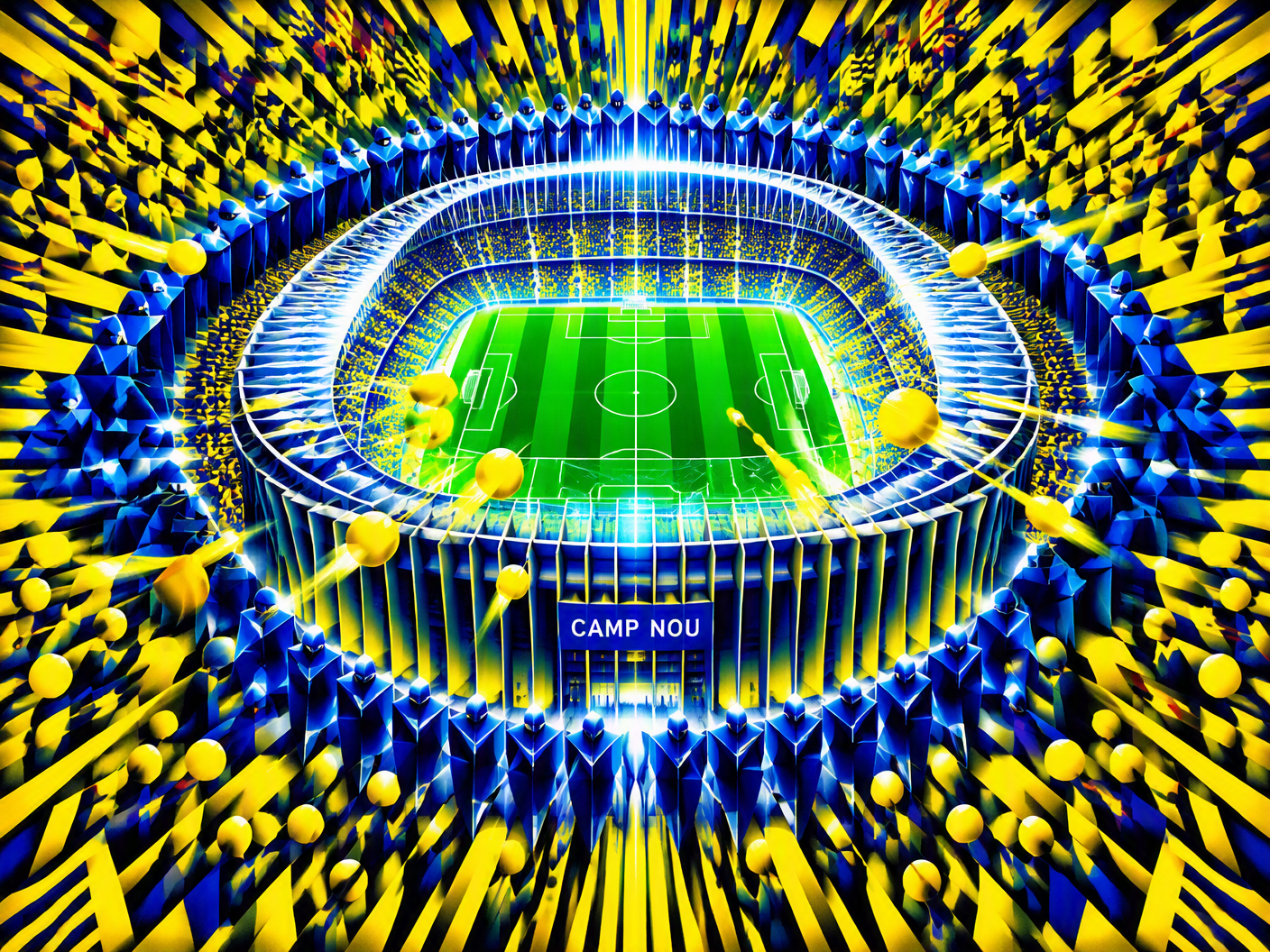
The delayed Barcelona-Real Madrid match began at Camp Nou on 18 December 2019 with a political protest already surrounding the stadium. Tsunami Democràtic, a Catalan protest network, had called supporters to the ground as the two largest clubs in Spanish football prepared to play. The fixture remained on the schedule, but its operating conditions had changed. Police and security personnel had to manage a demonstration outside the venue, crowding at entrances, and movement through nearby streets while the match proceeded inside. The contest was no longer contained by the stadium walls.
About 5,000 demonstrators gathered around Camp Nou. Their presence altered the routes by which spectators approached the ground and forced access points to function under pressure. Some roads were cut off, while entrances became congested. That disruption was practical rather than symbolic: people, vehicles, stewards, and police were competing for the same limited space around a stadium built to receive a crowd for football, not to absorb a large political assembly at the same time. The perimeter became the first site where the protest changed the match.
The protest had been organized in the aftermath of the Spanish Supreme Court’s sentencing of nine Catalan separatist leaders. Those sentences triggered a wider cycle of demonstrations across Barcelona and elsewhere in Catalonia. The political dispute was therefore present before the teams took the field, carried by a network that treated Camp Nou as both a football venue and a public platform. FC Barcelona had publicly condemned the earlier sentences, adding an institutional position from the host club to an already charged setting.
The wider protest wave had already tested the city’s ability to keep transport and public space operating. In October, clashes with police accompanied demonstrations in Barcelona after the sentences, and the disruption reached Barcelona-El Prat airport. One hundred eight flights were cancelled during that earlier wave. The airport episode was separate from the Camp Nou match, but it established the scale of the surrounding conflict: demonstrations could move quickly from political expression into interruptions affecting ordinary travel, policing, and commercial operations.
At Camp Nou, the immediate problem was control of access. The cut-off routes narrowed the approaches to the stadium, and the congested entrances concentrated spectators and security staff at the points where the venue was most vulnerable to delay. The match was played because Barcelona, Real Madrid, officials, and police maintained enough control to bring the fixture into operation. But the arrangement depended on separating the field from the perimeter while the protest continued only a short distance away.
That separation failed inside the stadium. Protesters in the stands threw yellow objects onto the playing area, forcing match officials to interrupt the game for a few minutes. The objects were associated with the independence movement’s protest symbolism, but the operational consequence was simpler: play stopped while the field was cleared and officials restored the conditions required for the match to continue. The interruption was brief. It was also the clearest point at which the demonstration directly affected the competition.
The incident gave the protest two connected locations. Outside, thousands of people occupied the approaches and complicated entry. Inside, thrown objects crossed the boundary between spectators and the field and produced a stoppage. Tsunami Democràtic did not need to cancel the match to alter it. The event’s terms had already shifted: the clubs played beneath a security operation, spectators entered through constricted routes, and officials had to pause the game because political action had reached the playing surface.
The police response belonged to the Mossos d’Esquadra, Catalonia’s regional police force, which deployed security around the stadium as the demonstration developed. Their role was defined by containment: protect access, manage the perimeter, and keep the fixture functioning while a mass protest occupied nearby public space. The October clashes formed the larger context for that deployment, but they were not the same event. The Camp Nou episode is established most clearly through crowd pressure, disrupted access, and the short stoppage inside the ground.
Barcelona and Real Madrid completed the match at Camp Nou despite the protest. That outcome mattered to the institutions responsible for the fixture, but completion did not erase the intervention. A match normally treats the field as a controlled environment governed by officials, players, and club staff. On this night, objects thrown by protesters briefly broke that control, while the streets outside remained affected by the crowd. The event demonstrated how little distance was required for a political mobilization to reach the center of a major sporting occasion.
The documented consequences are therefore specific. Tsunami Democràtic organized a protest outside Camp Nou; roughly 5,000 people gathered around the stadium; access routes were cut off and entrances congested; and yellow objects thrown from inside the venue interrupted play for several minutes. The broader cycle included clashes with police and the cancellation of 108 airport flights after the Supreme Court sentences. Those facts connect the match to Barcelona’s wider unrest without turning every disturbance in the city into part of the football incident.
The final consequence was not a cancelled fixture but a compromised boundary. Barcelona and Real Madrid played on 18 December 2019, yet the match unfolded amid a protest that occupied its approaches and briefly entered its interior. The field was cleared and play resumed. Outside, the political dispute that had brought thousands to Camp Nou remained larger than the ninety minutes scheduled to contain it.
Investigative Dossier & Evidence
Read the companion investigation notes, verified source claims, and primary documents.
Read the Companion Notes & Evidence Record →