
Tragedy · 2000s
Clarence Harding’s Eye Injury and Rugby’s Unresolved Disciplinary Reckoning
Clarence Harding lost sight in his right eye after an eye-gouging incident during a Kent Cup match in January 2010. While Kent police investigated, the Rugby Football Union had not yet contacted him, leaving a permanent injury moving through separate sporting and criminal systems.
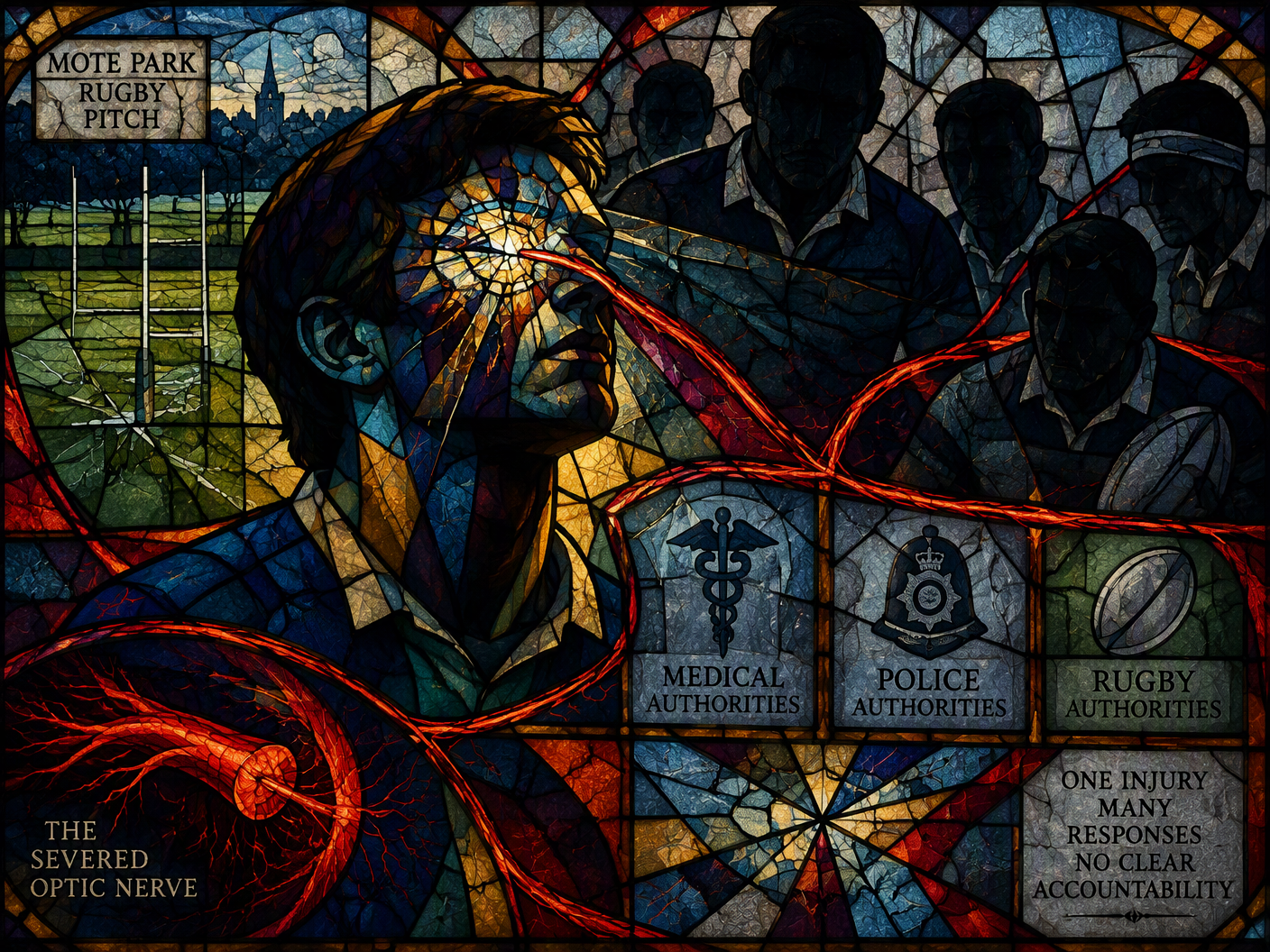
Clarence Harding left Mote Park carrying an injury that would alter the rest of his working life. On 17 January 2010, during a Kent Cup rugby match in Maidstone, the Gravesend number eight suffered an eye-gouging injury. He later lost sight in his right eye and said the optical nerve had been severed. The match belonged to the amateur game, where players returned to ordinary employment between fixtures, but the damage did not remain inside the boundaries of the pitch. Harding’s eye became a medical problem, a police matter, and a test of how rugby treated violence committed in its own workplace.
The injury carried consequences beyond the loss of vision itself. Harding reported blindness in one eye and limitations on his ability to work. For a professional athlete, a damaged body can become a contract dispute or an insurance claim; for an amateur player, it can reach directly into wages, commuting, family routines, and the physical tasks that make employment possible. Rugby had supplied the setting and the rules, but Harding had to carry the impairment into the rest of his life. The sport’s violence was organized for competition. Its costs were left with the person injured.
By May, the incident had moved beyond the post-match language of foul play. Kent police were conducting a criminal investigation into what had happened at Mote Park. That distinction mattered in practical terms: a rugby disciplinary process could suspend a player, while a police inquiry examined whether conduct on the field had crossed into criminal assault. The two systems could proceed alongside each other, but they did not ask the same question or impose the same burden. Harding’s damaged eye required an answer from both, and neither answer was immediate.
The Rugby Football Union had not yet contacted Harding personally when the case was reported in May 2010. The fact was small in administrative language and large in human terms. Harding was the injured player, the person living with blindness and work restrictions, yet the governing body’s response had not reached him directly. Rugby authorities had long possessed procedures for judging dangerous conduct, but procedure did not guarantee attention to the injured person. For Harding, the first months after the match were measured not by a suspension announcement but by medical consequence and an unresolved inquiry.
Rugby already had a vocabulary for eye-gouging, and it was not a mild one. In 1992, the New Zealand Rugby Union’s judicial committee found that Richard Loe had inserted his fingers into Greg Cooper’s eyes with considerable force. Loe received a nine-month ban, while Cooper left the field with an eye injury. The sanction established that rugby authorities could treat gouging as a distinct and serious offense rather than as an indistinguishable incident within the ordinary collisions of the game. A disciplinary code existed. The harder question was how reliably it could identify responsibility when an amateur match produced lasting harm.
The issue had not disappeared from rugby’s public life by the time Harding was injured. In March 2009, John Daniell, a former rugby lock, described gouging as common in French rugby. His account placed the act inside a culture where players and observers understood that contact with the eyes was not merely an accidental by-product of tackling. It also showed the uneven border between accepted physical aggression and conduct treated as punishable. The sport could condemn gouging in a disciplinary room while players still carried stories of its routine presence across changing rooms and playing fields.
That history shaped the expectations surrounding Harding’s case. Rugby did not need to invent a rule against gouging after the Maidstone match; earlier authorities had already demonstrated the power to suspend a player for it. What remained was the more difficult work of attribution. An eye injury could be medically clear while the identity of the person responsible remained unsettled. The body supplied the strongest evidence of consequence: Harding had lost vision. The sport and the police still had to establish how the injury occurred and who, if anyone, should answer for it.
For Harding, the passage from rugby player to injured worker happened without the clean sequence that disciplinary institutions prefer. There was the match at Mote Park, then the medical reality of a severed optical nerve, then police attention, while the governing body had not yet made personal contact. Each institution handled a portion of the event. Doctors addressed the eye. Police pursued a possible crime. Rugby officials held the authority to discipline. The division of responsibility created no single room in which injury, accountability, and future livelihood were considered together.
The earlier Loe case showed what a completed rugby proceeding could look like: a judicial committee finding, a named player, a defined act, and a nine-month ban. Harding’s case had reached a different stage. Kent police were still investigating, and the RFU’s contact with the injured player had not occurred by the time the May account appeared. The contrast was not between rugby’s willingness to punish and its refusal to punish. It was between a settled disciplinary record and an injury whose responsibility had not been fixed through the public process then underway.
The consequences therefore settled unevenly. Harding carried blindness in his right eye and reported restrictions on work. Kent police carried the investigation forward. The RFU retained its disciplinary authority but had not yet contacted the player whose body had supplied the case’s central fact. Earlier rugby history had made clear that eye-gouging could warrant a severe ban; the Maidstone incident showed that a severe injury did not by itself produce an equally clear institutional ending. The field had rules. Harding was left living with what happened when those rules failed to deliver an answer quickly.
Investigative Dossier & Evidence
Read the companion investigation notes, verified source claims, and primary documents.
Read the Companion Notes & Evidence Record →