
Bizarre & Myths · 1990s
Colorado-Missouri 1990: The Fifth Down That Stood
On October 6, 1990, Colorado defeated Missouri 33-31 at Faurot Field after a down-marker error gave Colorado an additional play on its final drive. The Big Eight reviewed the ending, suspended the officiating crew for one week, and left the result unchanged.
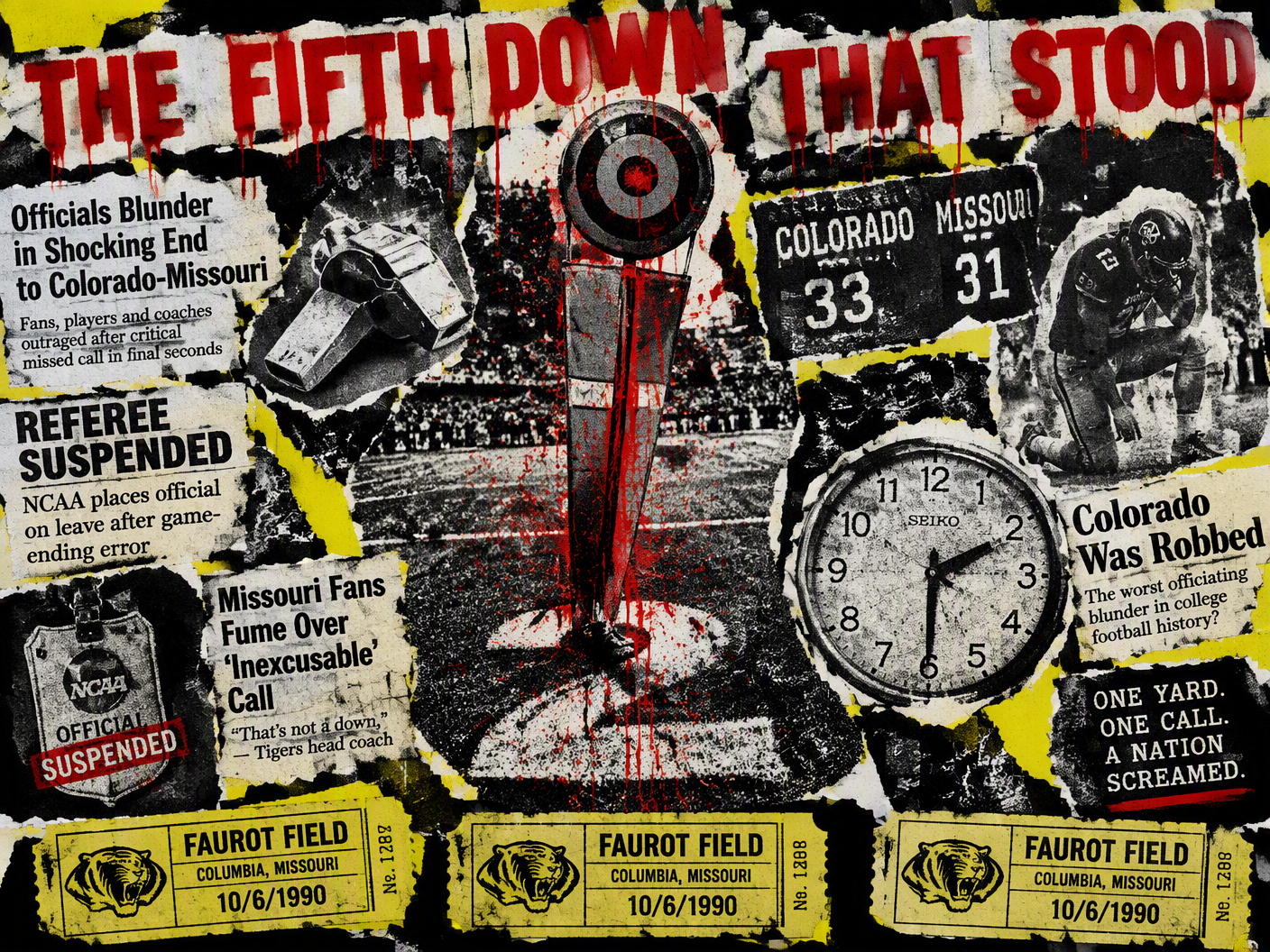
On October 6, 1990, at Faurot Field in Columbia, Missouri, a chain crew failed to advance the down marker from second down to third during a timeout. Colorado then received another scrimmage play. That extra play became the hinge of a 33-31 victory over Missouri, a result that survived a conference review and entered college football memory under a number that the officials had allowed to accumulate. The error did not occur in an abstract record book. It came during a live final drive, with the score, the clock, and the authority to stop the game concentrated in a few people on the field.
The game was played before 46,856 spectators, with Missouri leading 31-27 and 2:32 remaining in the fourth quarter. Colorado had to cross the field before the remaining time disappeared. Its quarterback, Charles Johnson, had started in place of the injured Darian Hagan. The replacement was not a ceremonial one: Johnson completed late-game passes, managed the clock, and carried responsibility for the final sequence while Colorado tried to turn a four-point deficit into a win.
Eric Bieniemy supplied the ground force. He finished the game with 217 rushing yards against Missouri and carried the ball during the closing drive, including a run that was stopped near the goal line. Johnson then spiked the ball to stop the clock. The sequence had the recognizable structure of a late football possession—passes, a clock-stopping spike, a running play, and another effort to preserve one last opportunity—but its conclusion depended on whether the officiating crew and the chain crew kept the count correctly.
During a timeout, the down marker remained on second down instead of moving to third. The failure involved the chain crew, including Ron Demaree and Jack Watkins, and it passed through the authority of the officiating crew led by head referee J.C. Louderback. Because the marker did not change, Colorado was given an additional play. A routine piece of field administration—one number moved along a sideline—altered the number of legal snaps available to the offense at the most consequential point of the game.
Bill McCartney, Colorado’s head coach, spoke to Louderback during the final timeout. McCartney also argued publicly that the field was not playable. The objection placed the officials under immediate pressure while the teams remained engaged in a contest that had not yet been formally completed. What participants knew in that moment was narrower than what later summaries would make of it: Colorado had another play, Missouri was defending a lead, and the officials had to decide how to proceed with the down count already compromised.
The additional snap brought Johnson to the goal line, where he scored the contested touchdown that put Colorado ahead. Accounts of the play have never resolved every detail of whether he crossed the goal line before the ball was dead. That uncertainty concerned the touchdown itself; the separate administrative error was clear enough to define the ending. The officials had allowed Colorado to run a play that should not have existed under the ordinary sequence of downs, and the final score became 33-31.
The officials did not simply end the contest at the touchdown. Colorado was required to attempt the extra point, and Johnson took the snap and went to a knee. That act completed the game under the rules as applied on the field. It also fixed the final margin at two points, preserving the result while leaving the preceding down count exposed to examination. The score was not a provisional entry awaiting permission from the conference; it was the official outcome produced by the final sequence in Columbia.
Carl James, the Big Eight commissioner, said the conference would review the play. The announcement recognized that the ending had moved beyond an ordinary dispute over a spot or a judgment call. The question was whether the officials and chain crew had administered the most basic structure of the sport correctly, and what authority the conference possessed after the teams had left the field. The review could examine the ending, but it did not create a mechanism for replaying the final drive or awarding Missouri a second opportunity to defend it.
The Big Eight review did not reverse the outcome. Colorado retained its 33-31 victory, while the officiating crew was suspended for one week after the game. The penalty marked an institutional acknowledgment that the error required more than private correction, but it stopped short of changing the standings or the result printed beside the two teams. No established finding converted the mistake into a fixed contest or intentional sabotage, and the episode remained an officiating failure with a concrete administrative consequence.
The Missouri game therefore contains two different kinds of certainty. The conventional football facts are settled: Colorado won at Faurot Field, before 46,856 spectators; Bieniemy ran for 217 yards; Colorado trailed 31-27 with 2:32 left; and Johnson led the final drive. The disputed ending is also settled in its essential form: the down marker failed to move, an extra play followed, Johnson scored the contested touchdown, and the result stood. What remains unresolved is the exact boundary of the touchdown and the intent behind the mistake—not the fact that the mistake changed the final sequence.
The lasting record was made from that combination of error and response. A marker stayed on the wrong number; a crew permitted an additional snap; a quarterback finished the play and knelt after the required extra point; a commissioner ordered a review; and a one-week suspension followed. Missouri did not receive the game back, and Colorado did not surrender the victory. The conference’s action preserved both parts of the episode: the score remained official, while the officials’ failure remained attached to the contest whenever its final drive was reconstructed.
Investigative Dossier & Evidence
Read the companion investigation notes, verified source claims, and primary documents.
Read the Companion Notes & Evidence Record →