
Scandals & Feuds · 2010s
Craig Whyte’s £1 Rangers Takeover and the Ticketus Loan Against Future Season Tickets
Craig Whyte acquired Sir David Murray’s controlling interest in Rangers for £1 after arranging financing secured against future season-ticket income. Within nine months the club entered administration, the proposed rescue failed, and the old company was liquidated; Whyte’s later criminal prosecution ended in acquittal.
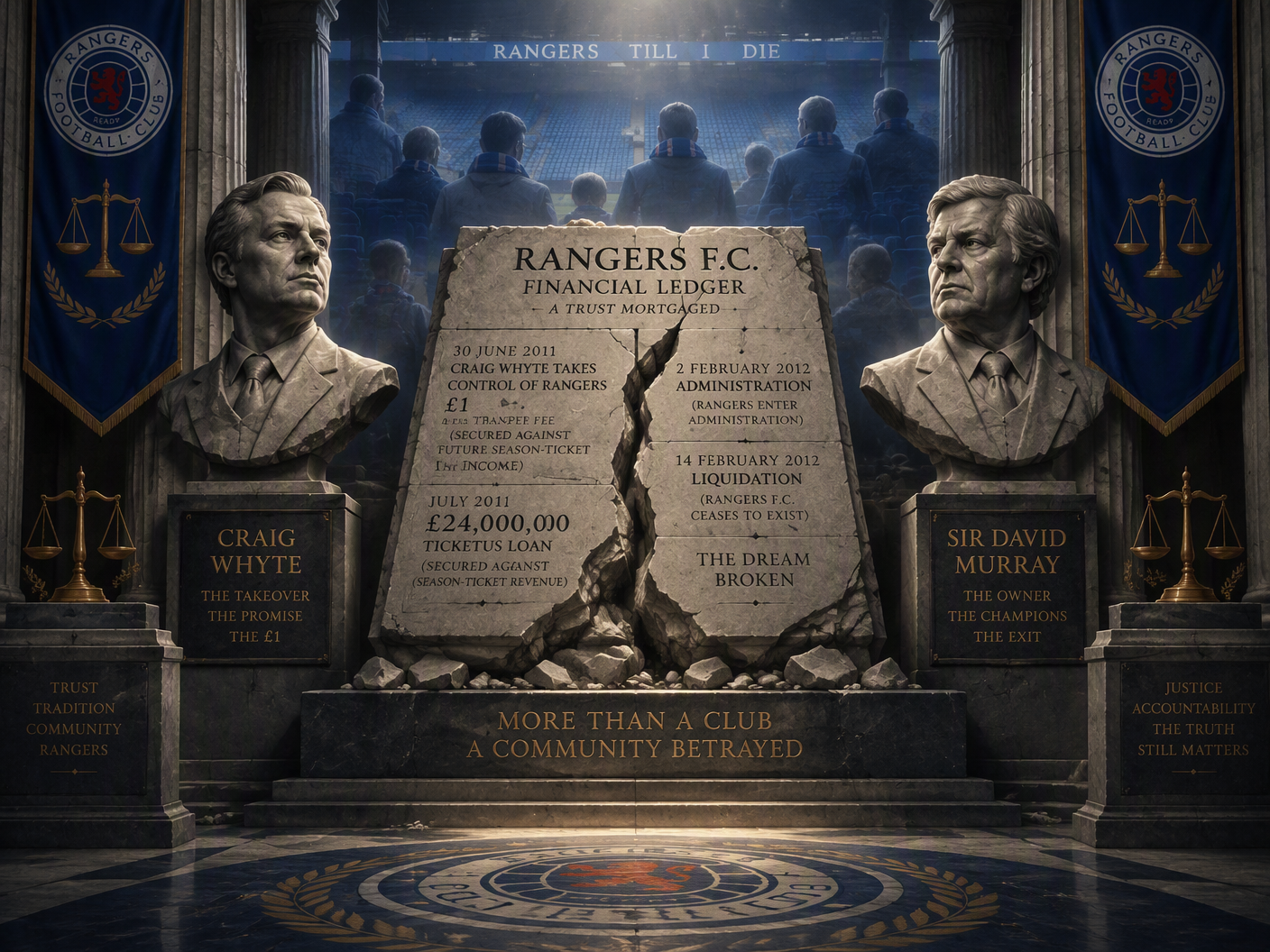
On 6 May 2011, Sir David Murray transferred his controlling interest in Rangers to Craig Whyte’s Wavetower Limited for £1. The purchase price was nominal. The financing behind the acquisition was not. Before the sale completed, Whyte had reached an agreement with Ticketus to borrow £26.7 million against future Rangers season-ticket sales. Control of the club changed hands through a transaction whose immediate cash burden fell elsewhere: supporters would continue buying tickets, and those future receipts stood behind the money raised at the takeover.
Ticketus did not lend against an abstract asset. Its agreement reached forward into the club’s ordinary income, tying the purchase to seats that had not yet been occupied and matches that had not yet been played. The arrangement gave Whyte access to substantial capital before he owned Rangers. It also placed a claim on revenue generated by the club’s future relationship with its supporters. The transfer of ownership was therefore accompanied by a transfer of income, moving part of Rangers’ financial future into the financing of its acquisition.
The figures later presented in court were not identical to the amount recorded in the takeover chronology. At Whyte’s 2017 trial, jurors were told that he had taken out a £24 million Ticketus loan against three years of future Rangers season-ticket sales before he owned the club. The difference between £26.7 million and £24 million belongs to the structure and presentation of the financing, not to the central fact: Ticketus money had been arranged against future ticket income before the ownership transfer was complete.
Rangers’ financial position deteriorated after the takeover. On 14 February 2012, Rangers Football Club plc entered administration and received an immediate 10-point deduction. Duff & Phelps took control as administrators. The deduction altered the club’s position on the field, but the more consequential change occurred outside it: the company that had carried Rangers’ obligations could no longer operate as a normal solvent business. A financing arrangement built on future ticket sales now sat inside an insolvency process.
The proposed rescue required creditor approval. HMRC rejected the company voluntary arrangement on 14 June 2012, blocking the route by which the old company might have continued under an agreed repayment plan. Four months later, on 31 October, The Rangers Football Club plc entered liquidation. BDO became involved in the liquidation of the old company. The sequence was precise: administration, a 10-point penalty, rejection of the CVA, and the corporate death of the entity that had existed before the insolvency.
The collapse made the Ticketus arrangement central to the public dispute over the takeover. Money raised against future season-ticket receipts had been used before the club entered administration, while the club’s later income was needed to meet obligations inherited from the failed structure. That sequence did not by itself answer every question about responsibility for Rangers’ collapse. It did show why the financing became inseparable from the story of the insolvency: the transaction had drawn on revenue that belonged to the club’s future at the moment its present finances were failing.
The criminal case arrived after the corporate break. On 14 November 2014, the Crown Office issued a warrant for Whyte’s arrest in connection with alleged fraud during the Rangers purchase. The warrant converted the long-running dispute over the acquisition into a formal criminal process. It did not resolve the financial history, but it placed the transaction before prosecutors and moved Whyte from the center of a failed ownership story into the position of an accused man facing the state.
On 2 September 2015, Whyte appeared at Glasgow Sheriff Court. He was charged with conspiracy and with an offence under section 28(1) of the Criminal Justice and Licensing (Scotland) Act 2010. Charles Green also appeared in court in proceedings concerning the alleged fraudulent acquisition of Rangers assets. The courtroom process separated the competing strands of the affair: the Ticketus financing and insolvency formed the background, while the charges required the Crown to prove specific criminal conduct connected to the purchase.
The trial reached the High Court in Glasgow and lasted seven weeks. The Ticketus financing remained a central feature of the prosecution case, with jurors hearing that Whyte had arranged the £24 million loan against three years of future season-ticket sales before he owned Rangers. The prosecution’s theory placed the financing at the heart of the takeover. The club’s administration and liquidation supplied the surrounding damage, but the verdict had to address the charges brought against Whyte rather than simply the fact of Rangers’ collapse.
On 6 June 2017, the jury acquitted Whyte of all charges. The decision ended the criminal proceedings without a fraud conviction. It did not reverse the £1 sale, erase the Ticketus agreement, or restore the liquidated company. Rangers had already passed through administration, lost the proposed CVA, and entered liquidation years before the verdict. The legal outcome and the financial outcome therefore remained distinct: the club’s old corporate structure had failed, while the criminal case against the man who acquired it ended in acquittal.
That separation is the fixed point in the Rangers takeover story. Whyte acquired Murray’s controlling interest for £1. He arranged borrowing against future season-ticket receipts before completion. Rangers entered administration, HMRC rejected the CVA, and the old company was liquidated. The state later issued an arrest warrant, brought charges, and tried him in Glasgow. The jury acquitted him on 6 June 2017. The documents preserve the financing, the insolvency, and the prosecution as connected events; the verdict preserves the boundary between a failed financial structure and criminal guilt.
Investigative Dossier & Evidence
Read the companion investigation notes, verified source claims, and primary documents.
Read the Companion Notes & Evidence Record →