
Tragedy · 1990s
The Hamburg Stabbing That Took Monica Seles from Tennis
On April 30, 1993, Monica Seles was stabbed during a match in Hamburg by an obsessed fan of Steffi Graf. She stayed away from professional tennis for more than two years, returned to win the Canadian Open, and later described depression and an eating disorder that followed the attack.
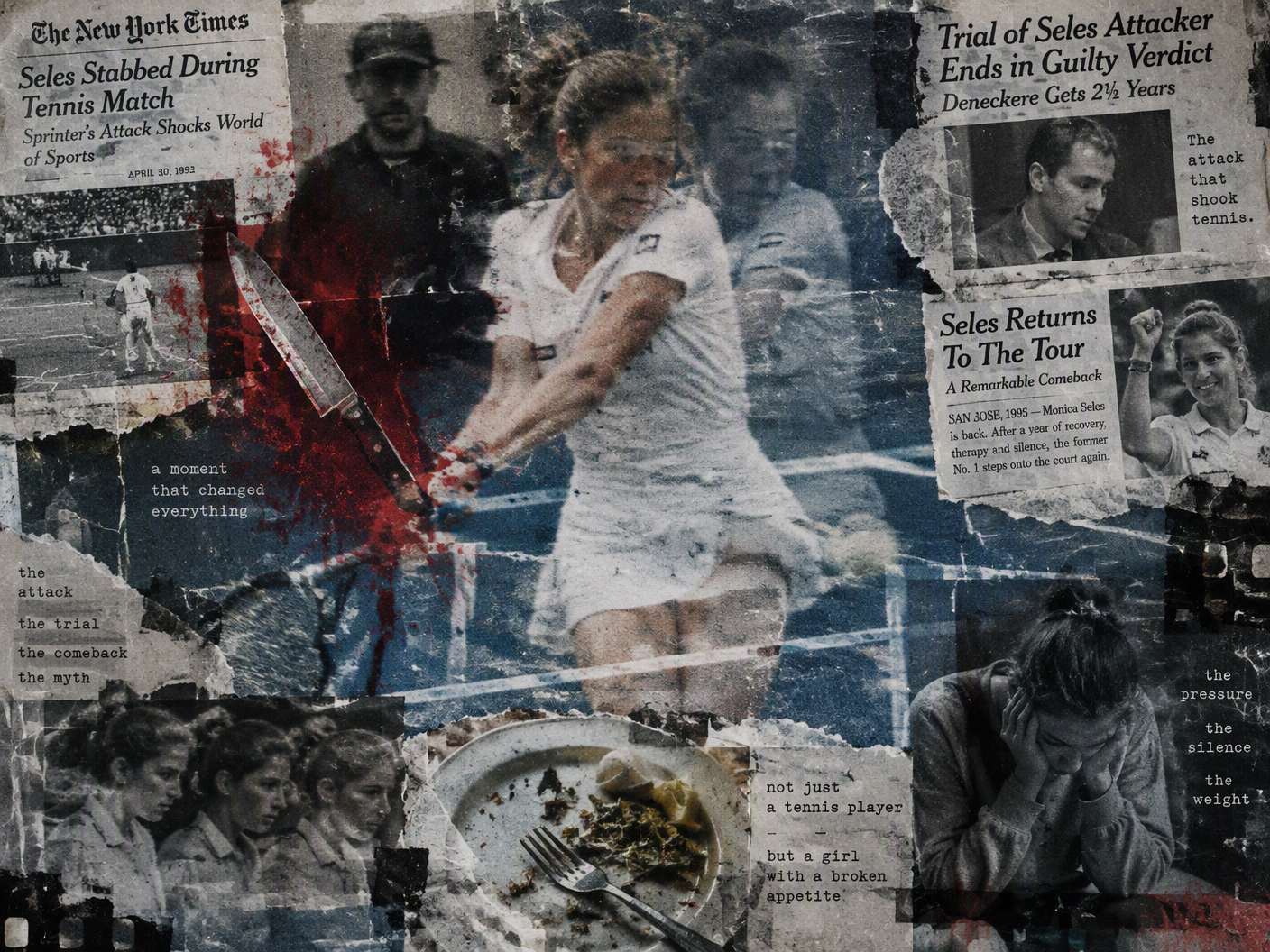
On April 30, 1993, during a quarterfinal at the Citizen Cup in Hamburg, Monica Seles was playing Magdalena Maleeva when Günter Parche ran onto the court during a break between games and stabbed her. Seles was twenty years old and already one of the dominant figures in women’s tennis, the winner of nine major singles titles. The attack divided her career at a precise point: before Hamburg, she was competing at the summit of her sport; afterward, professional tennis became something she could not simply resume when the wound closed.
Parche was identified as an obsessed fan of Steffi Graf, Seles’s principal rival for control of the women’s game. The connection gave the assault a sporting context without turning it into a contest between the two players. Graf visited Seles in the hospital. German authorities and the later trial process concluded that Parche had not acted from a political motive. He was charged and later received probation and psychological treatment, placing the attack within a criminal case even as tennis institutions struggled with what it meant for a player to be assaulted in the middle of competition.
Seles’s absence altered the ranking at the top of the sport. In 1993, the Women’s Tennis Association asked its players to decide whether her ranking should be frozen while she was away. The vote in Rome rejected that protection. Gabriela Sabatini abstained. The decision was made through the customs of a professional tour that treated rankings as both competitive measurements and working currency: they determined entry, seeding, and status. Seles had been removed from play by violence, but the tour still had to decide how much of her place it would preserve.
For more than two years after Hamburg, Seles did not play professional tennis. Her name remained attached to the highest level of the sport, but her body was no longer moving through the tournament calendar. The interruption was not a brief medical withdrawal or a missed season. It separated one competitive life from another, leaving the tour to continue without the player who had won nine major singles championships and had been central to its order.
The public meaning of the absence hardened quickly. A player who had been measured by titles and ranking points was now being discussed through the fact of her disappearance. The attack had taken place in a setting designed to make competition orderly—an enclosed court, a scheduled match, officials regulating the intervals between points—and had introduced a danger that the rules of tennis did not contain. Seles’s withdrawal showed that the consequences of an assault could extend beyond the injury itself, into the routines by which a professional athlete was expected to return.
In August 1995, Seles returned to the tour in Toronto. Her first tournament back was the Canadian Open, and she won it. The result did not erase the time away or settle the private cost of returning. It did establish that the stabbing had not ended her ability to compete at the highest level. The comeback was therefore both an athletic result and a correction to the assumption that the missing years represented the final chapter of her career.
The victory also changed how the interruption could be described. Seles was not returning as a former champion making a ceremonial appearance. She entered competition and won the tournament in which she first tested herself against the demands of the tour again. The Canadian Open supplied a public measure of performance, but it could not measure the private work required to reach that court. The title answered one question—whether she could still win—without answering what the attack had done to her relationship with ordinary life.
Seles later described that relationship in terms of depression. The psychological aftermath did not follow the simple calendar of the injury, and it did not disappear with the Canadian Open title. She also described developing an eating disorder after the stabbing. These difficulties belonged to the period after the public event, when the immediate facts of the assault had given way to problems that were less visible and less easily translated into a score, ranking, or medical timetable.
In a 2009 interview, Seles said that food became her primary comfort after the attack. The statement gave shape to a form of coping that had remained outside the tournament record. Depression and disordered eating were not side plots to the comeback; they were part of the aftermath she later chose to name. Her account connected the assault to mood, appetite, and the search for control, extending the story beyond Hamburg and beyond the court on which she had been attacked.
The two timelines—competition and private recovery—never perfectly aligned. In public, Seles returned in August 1995 and won immediately. In her later account, the years after the stabbing included depression and an eating disorder, with food serving as a primary source of comfort. Both facts belong to the same history. The title demonstrates what she could do under tournament conditions; her later disclosures describe what achievement could not reveal about the life surrounding it.
Hamburg therefore endured in two institutional records. In the criminal record, Parche was prosecuted, received probation, and underwent psychological treatment, while German authorities ruled out a political motive. In the tennis record, Seles’s ranking was not frozen, her absence lasted more than two years, and her return produced a Canadian Open title. In the personal record she later supplied, the assault was followed by depression, disordered eating, and a reliance on food for comfort. The court reopened for her, but the event remained larger than the match it interrupted.
Investigative Dossier & Evidence
Read the companion investigation notes, verified source claims, and primary documents.
Read the Companion Notes & Evidence Record →