
Tragedy · 2020s
The Kanjuruhan Tear-Gas Deployment and the Split Accountability Case
The 1 October 2022 crowd crush at Kanjuruhan Stadium killed 135 people after police fired tear gas into the crowd. A human-rights finding identified excessive and indiscriminate tear-gas use as the main trigger, while criminal and disciplinary proceedings produced different consequences for police officers and match organizers.
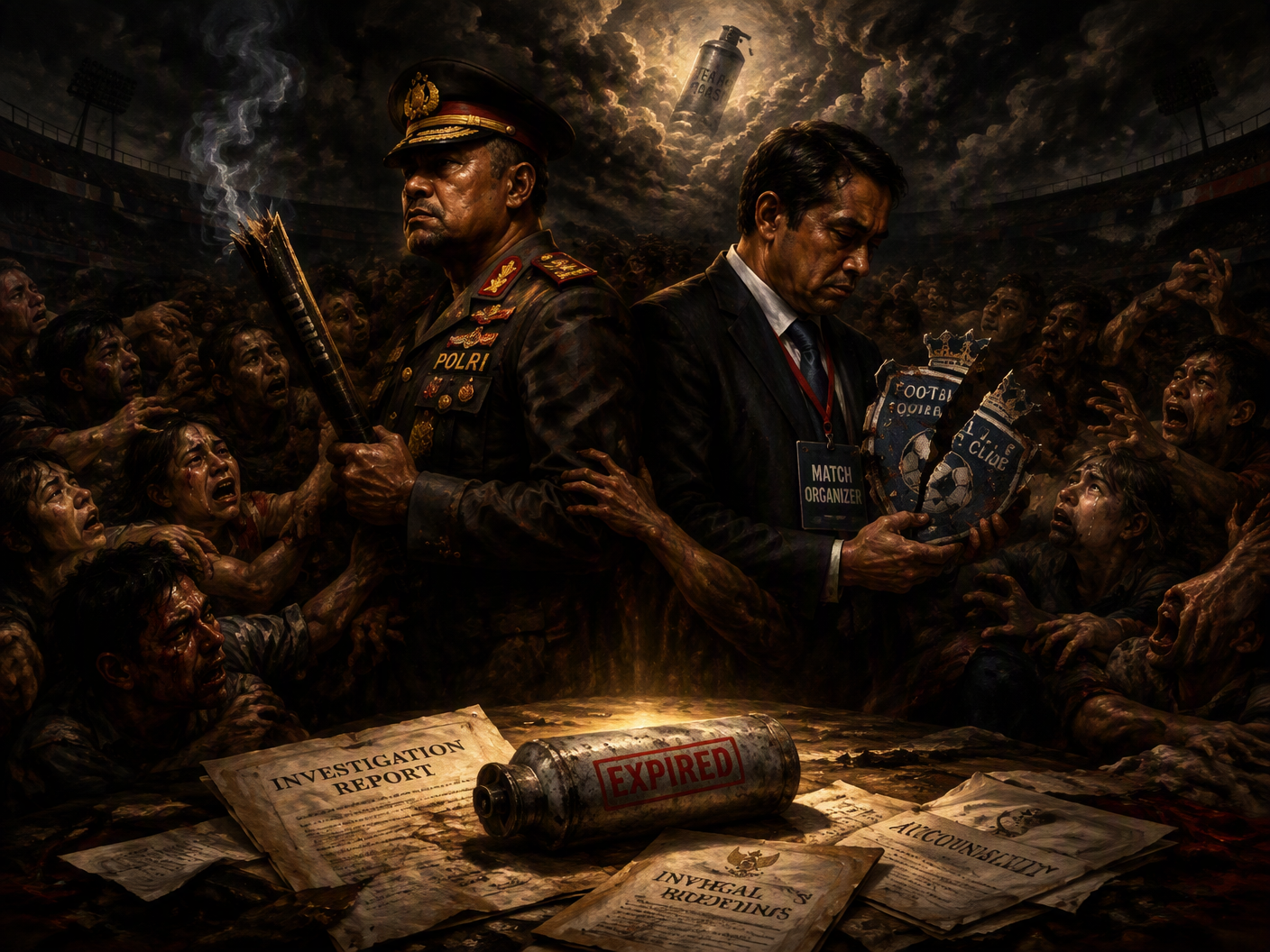
Police fired tear gas into the crowd at Kanjuruhan Stadium on 1 October 2022, after the football match between Arema and Persebaya Surabaya had ended. A crowd crush followed in Malang Regency, East Java. One hundred thirty-five people died. The case that entered the criminal courts was therefore not a dispute over the score or the result. It concerned the response to the match’s ending: police action, crowd movement, stadium management, and the decisions made by the officials responsible for security.
The stadium held supporters of Arema and Persebaya, with Indonesian police assigned to control the post-match disorder. Once tear gas entered the crowd, people moved through a confined stadium environment and the crush developed. The disaster became an accountability case because several authorities had acted before the deaths occurred: police commanders directed crowd-control operations, while football officials managed the event and its security arrangements. The investigation would examine those decisions together, even as later courts assigned criminal responsibility unevenly.
The National Commission on Human Rights gave the police action a defined place in the sequence. It concluded that officers fired tear gas into the crowd and that excessive, indiscriminate use of the chemical agent was the main trigger behind the stampede. That was an institutional human-rights finding, not a criminal verdict. It nevertheless established the central question that prosecutors and judges would have to confront: whether the police response converted a volatile post-match situation into a mass casualty event.
On 6 October, Indonesian police chief Listyo Sigit Prabowo announced six suspects. The list crossed the boundary between law enforcement and football administration: Ahmad Hadian Lukita, director of PT Liga Indonesia Baru; Abdul Haris, chairman of the Arema match-organizing committee; Suko Sutrisno, Arema’s head of security; Malang police operations chief Wahyu Setyo Pranoto; East Java mobile-brigade commander Hasdarmawan; and crowd-control officer Bambang Sidik Achmadi. The announcement turned the investigation from an immediate police response into a formal criminal process involving both officers and organizers.
Four days later, police admitted that expired tear gas had been used at the stadium. The admission added a specific operational failure to the broader question of deployment. The issue was no longer only whether officers had fired the gas, but also what kind of chemical agent had been issued for crowd control and how its use had been authorized. An expired product did not by itself settle the question of causation, but it placed police inventory and command decisions inside the investigation’s central chain of responsibility.
On 5 November, an independent forensic team exhumed and autopsied two victims’ bodies at Dusun Pathuk, Desa Sukolilo, Wajak, in Malang Regency. The process involved Nabil Bahasuan, Devi Athok Yulfitri, Natasya Debi Ramadani, and Naila Debi Anggraini. Families pursued the examinations as a separate route toward identifying what had happened inside the stadium. They expected the bodies to show tear-gas residue. The autopsies did not confirm that residue, leaving the medical examination unable to supply the proof some families had hoped it would provide.
The criminal case reached the Surabaya District Court on 16 January 2023. Police officers and football officials faced negligence charges in the proceedings. Wahyu Setyo Pranoto and Bambang Sidik Achmadi entered the case as police defendants; Hasdarmawan faced the same scrutiny as the East Java mobile-brigade commander. Abdul Haris and Suko Sutrisno represented the organizing side of the prosecution. Ahmad Hadian Lukita, named in the police investigation, remained under police investigation during the trial coverage rather than receiving the same immediate courtroom outcome.
The organizer’s exposure did not end with the criminal filings. Abdul Haris, who chaired the Arema match committee, and Suko Sutrisno, who held the club’s security post, were charged in the criminal case and received lifetime bans from football through the disciplinary process. Those sanctions operated outside the criminal court. They showed that the sport’s governing authorities treated the event as an organizational failure as well as a police-conduct case, assigning permanent professional consequences even while the criminal judgments remained contested.
The Surabaya District Court then divided the police case. It acquitted Wahyu Setyo Pranoto and Bambang Sidik Achmadi of negligence charges. The same court convicted Hasdarmawan of criminal negligence causing death and bodily harm. The split verdict did not erase the National Commission on Human Rights finding about tear gas, but it allocated criminal liability differently among the officers involved. Police conduct could be identified as the main trigger in one institutional inquiry while the trial court reached separate conclusions about the criminal responsibility of individual commanders.
The acquittals did not end the case. On 23 August 2023, the Indonesian Supreme Court annulled the earlier decisions and sentenced Wahyu Setyo Pranoto and Bambang Sidik Achmadi to prison. The appellate ruling reversed the most consequential part of the district court’s treatment of the two officers. Hasdarmawan’s conviction remained the distinct trial-level finding against the mobile-brigade commander, while the organizer cases and disciplinary bans continued to define the football side of accountability.
Kanjuruhan therefore produced several forms of official judgment without a single explanation that displaced all others. The human-rights commission identified excessive and indiscriminate tear-gas use as the main trigger. The police acknowledged that expired gas had been fired. Independent autopsies tested the families’ expectations without confirming tear-gas residue. The courts first acquitted two officers, convicted a third, and then saw the Supreme Court impose prison terms on the acquitted pair. The final legal exposure reached from police command to football administration, with the deaths fixed at 135 and the responsibility distributed across different proceedings.
Investigative Dossier & Evidence
Read the companion investigation notes, verified source claims, and primary documents.
Read the Companion Notes & Evidence Record →