
Scandals & Feuds · 1980s
The Fifteen Trucks That Took the Colts from Baltimore to Indianapolis
On March 28, 1984, Robert Irsay agreed to move the Colts to Indianapolis, and fifteen Mayflower trucks reached the team’s Owings Mills facility that night. The loading operation was completed before Maryland could pass and sign an eminent-domain measure aimed at stopping the departure.
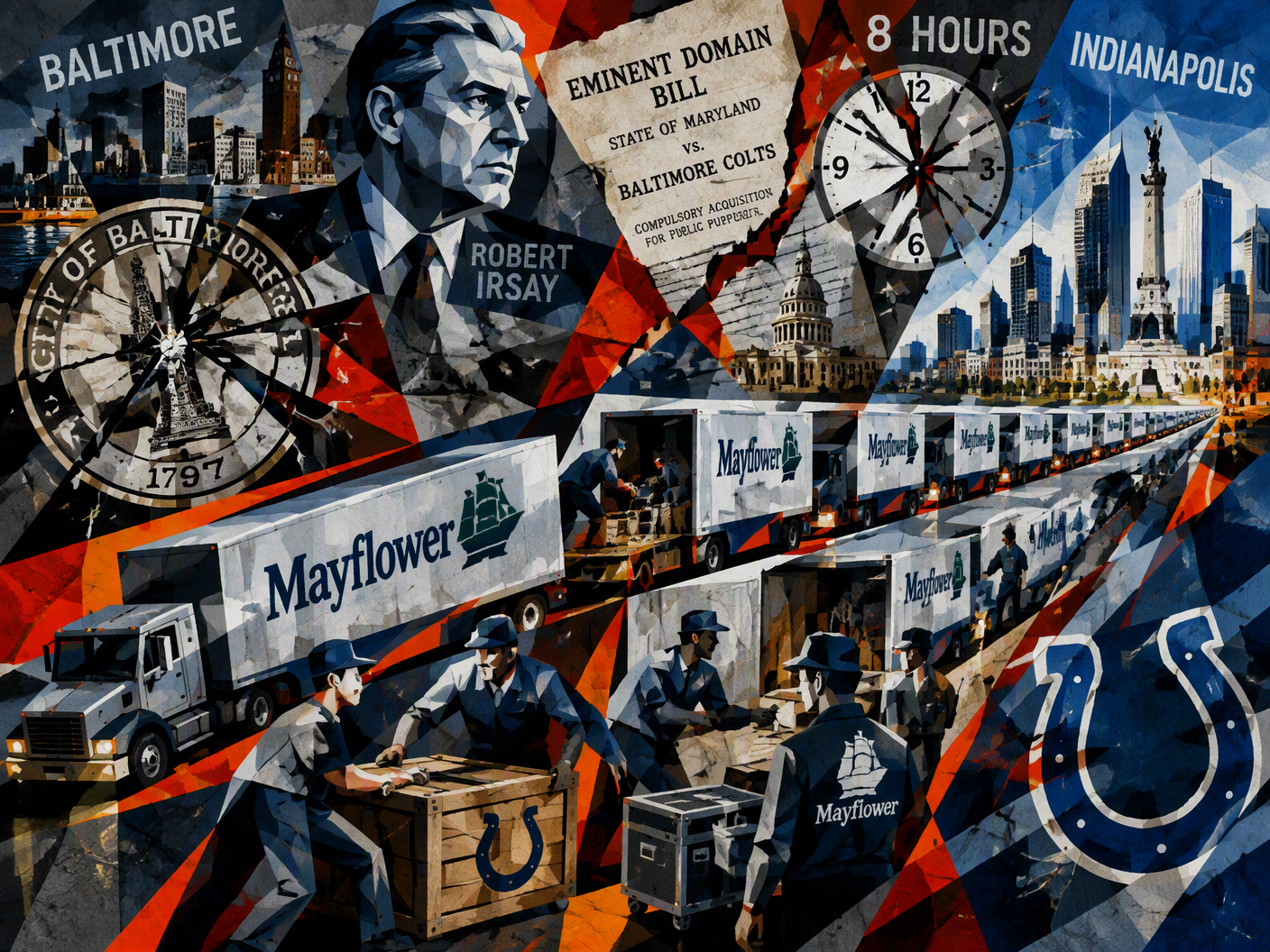
On March 28, 1984, Robert Irsay agreed to move the Baltimore Colts to Indianapolis. The decision converted a dispute over the team’s future into a transportation problem with a narrow window for action. Indianapolis mayor William Hudnut had participated in the negotiations on the city’s side. Once the agreement was reached, Indianapolis officials moved to arrange the practical means of departure, and John B. Smith, the chief executive of Mayflower Transit, sent fifteen trucks toward the Colts’ facility in Owings Mills, Maryland. The public fight was still unfolding. The move itself was already being prepared.
The trucks arrived at the Owings Mills facility at approximately 10 p.m. Workers began loading the team’s belongings into them. The objects were not symbols or promises; they were the physical property of a professional football organization being transferred from one state to another. Equipment, office materials, and the possessions associated with the Colts’ operation moved onto Mayflower trailers under the authority of the owner who had just accepted Indianapolis as the franchise’s destination. The decision made that day acquired its irreversible form in the loading process.
The operation continued through the night. Within roughly eight hours of the trucks’ arrival, the Colts were effectively gone from Baltimore, and the convoy was headed toward Indianapolis. The speed was central to the outcome. Baltimore officials could debate leases, stadium financing, and the powers available to the state; Mayflower workers were performing a task measured in hours. By the time the team’s belongings were on the road, the question was no longer whether Irsay intended to leave. The immediate question was whether Maryland could act before the departure became a completed fact.
William Donald Schaefer, Baltimore’s mayor, had made the dispute part of the city’s political life. He criticized the timing and secrecy of the move and connected the relocation to the fight over Baltimore’s stadium and the city’s leverage over its professional teams. His position reflected the limits of municipal power in an era when an owner could treat a franchise as a movable asset and negotiate its future beyond the city’s borders. Schaefer could condemn the decision publicly, but the trucks were being loaded outside Baltimore’s direct control.
In Annapolis, the response took the form of legislation. On March 29, the Maryland House of Delegates passed a bill allowing Baltimore to seize the Colts through eminent domain. Governor Harry Hughes signed it after the move had already been set in motion and the trucks had departed for Indianapolis. The sequence placed public law behind private action. Maryland had identified a legal instrument intended to preserve the team, but the instrument arrived after the franchise’s property and working operation had crossed the state line.
Indianapolis received the Colts through a negotiation that became concrete almost immediately. Hudnut had helped arrange the city’s side of the agreement, while Smith’s Mayflower trucks supplied the means by which the agreement could be completed. The city did not merely announce a destination for a team still in Baltimore. It participated in the rapid preparation of a move that required vehicles, workers, loading space, and a route east of the state’s legal response. The franchise’s change of address was therefore accomplished through a sequence of decisions made by identifiable people.
For Baltimore, the immediate consequence was an absence created overnight. The Colts had been associated with the city’s professional identity, and their departure left local officials confronting a fact that had been produced before the state’s formal intervention. The speed also shaped the language that followed. The move was described as having shocked the sports world, but the underlying event was less mysterious than the phrase suggested: an owner agreed to relocate, a mayor and city officials in Indianapolis accepted the opportunity, a transit executive dispatched fifteen trucks, and workers loaded the franchise’s belongings.
The contrast between the two governments’ responses was stark in sequence, though not in legal theory. Indianapolis officials acted first through negotiation and logistical preparation. Maryland responded through a bill and a gubernatorial signature. The state’s action demonstrated its willingness to claim an extraordinary remedy, but it did not precede the removal of the team’s property. By the time Hughes signed the measure, the Colts’ departure had passed from a threatened relocation into an accomplished transfer. The law could contest the move after the fact; it could not make the overnight loading disappear.
Later retellings often compress the episode into a single image: trucks appearing in the night and a city waking to find its team gone. The fuller sequence is more exact. The decisive agreement occurred on March 28. The trucks arrived at Owings Mills around 10 p.m. Workers loaded the belongings. Within eight hours, the convoy was moving toward Indianapolis. On March 29, Maryland’s House passed the eminent-domain bill and Hughes signed it. Each step narrowed the next institution’s choices, while none required the participants to wait for a complete public settlement.
The relocation’s immediate institutional afterlife began with that order of events. Baltimore’s political response became part of the memory of the Colts’ departure, as did Schaefer’s criticism and Hughes’s attempt to use eminent domain. Indianapolis retained the franchise because its offer had been accepted and the physical transfer had been completed. Mayflower’s fifteen trucks became the practical marker of the change: not a ceremonial announcement, but the means by which a professional team crossed from one civic jurisdiction into another before the law could close the route.
Investigative Dossier & Evidence
Read the companion investigation notes, verified source claims, and primary documents.
Read the Companion Notes & Evidence Record →