
Scandals & Feuds · 2000s
David Arquette’s Separation, Nightclub, and Second Act in Los Angeles
From his June 2012 divorce filing through an October 2013 interview, David Arquette’s public life moved between a formal family separation, a nightclub built around his mother’s burlesque legacy, and mentoring work with high-risk students. The period shows an actor managing the legal end of a marriage while constructing new professional and personal identities in public.
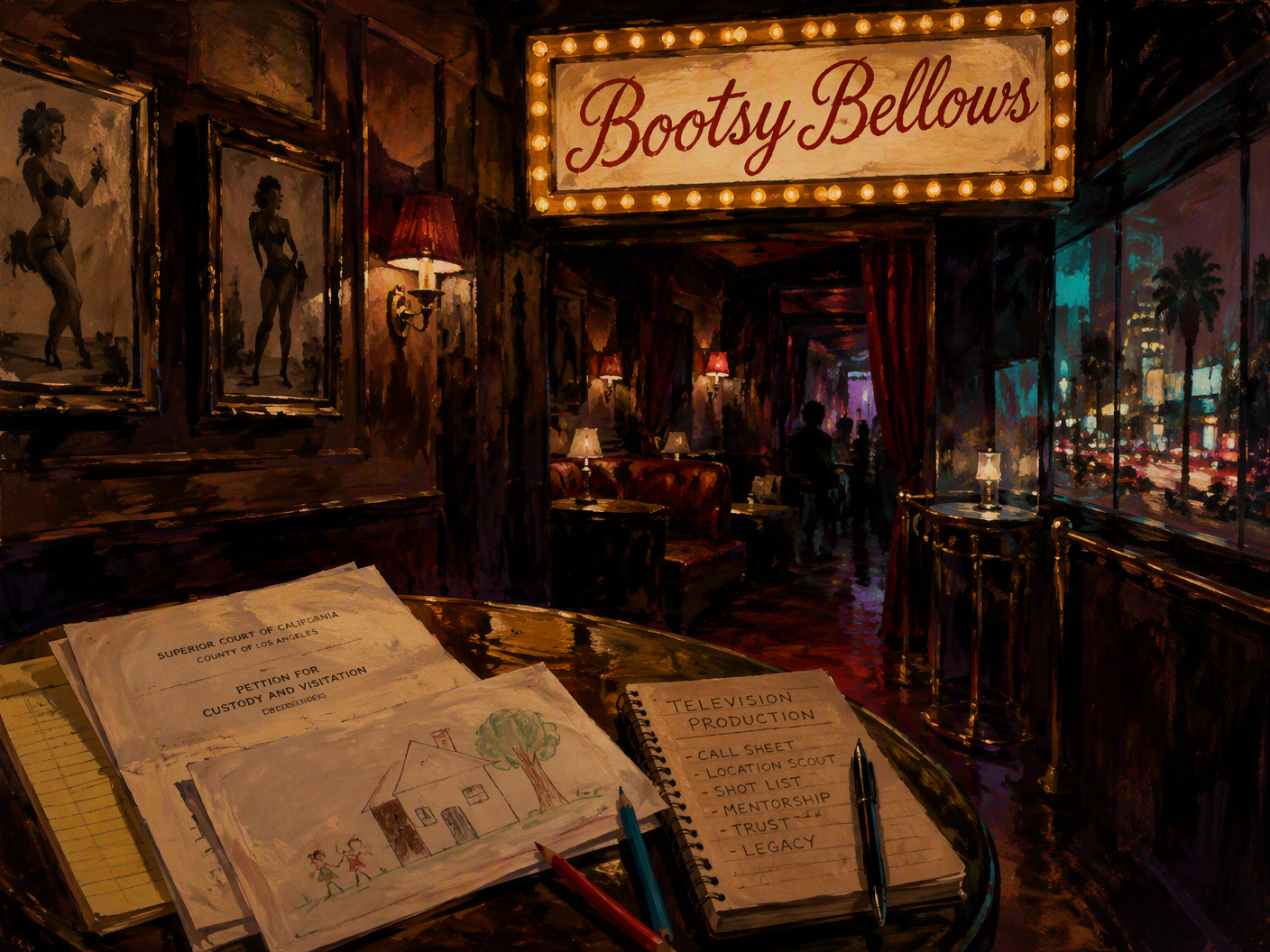
In June 2012, David Arquette filed for divorce from Courteney Cox. The marriage had already been separated, its private ending given a legal shape in a Los Angeles courthouse. The filing cited irreconcilable differences and placed December 31, 2011, as the official date of separation. Their daughter, Coco, remained at the center of the proceeding. Arquette and Cox requested joint legal and physical custody, preserving a shared parental structure even as the marriage itself moved toward dissolution.
The public knew Arquette as an actor, but celebrity had made the boundary between work and private life unusually thin. His marriage to Cox had existed inside that glare, surrounded by television, film, red carpets, and the machinery of entertainment coverage. Now the legal process converted a family transition into a public event. A filing date, a separation date, and a custody request became the visible outline of a household trying to reorganize itself without removing either parent from their daughter’s life.
That same year, Arquette opened Bootsy Bellows, a nightclub on Los Angeles’s Sunset Strip. The name carried a family history into the city’s nightlife. Bootsy Bellows had been the name of his late mother, Mardi, who had worked as a burlesque dancer. The club was not presented as a neutral piece of real estate. Its identity came from a woman whose life in performance had supplied Arquette with both an inheritance and a set of images powerful enough to shape a room.
Inside Bootsy Bellows, vintage topless and bondage photographs of Mardi were displayed as part of the club’s atmosphere. The images turned family memory into décor, and décor into a public business proposition. In the half-light of a Sunset Strip nightspot, the past could be encountered as spectacle: a mother remembered through photographs, a son translating her burlesque career into the language of a modern club. The gesture was intimate and commercial at the same time.
The club gave Arquette another role to inhabit during a period when his most visible identity was changing. He was no longer only the actor attached to familiar screen work or the husband whose marriage had become entertainment news. He was also the person behind a Los Angeles venue, building an environment from family mythology, nightlife, and performance. Bootsy Bellows placed him in the business of staging other people’s nights while his own life was being rearranged in public.
The divorce reached its legal conclusion in May 2013, when a Los Angeles County Superior Court judge entered the final judgment. The court process had begun with a separation and a request for joint custody; it ended with the marriage formally dissolved. The language of the proceeding was procedural, but its consequences were domestic. A family that had once been defined by marriage now had to operate through the terms of a completed divorce.
The end of the marriage did not erase the relationship between Arquette and Cox. In October 2013, Arquette described Cox as one of his closest friends. He spoke of the two of them remaining supportive and connected after separating, a formulation that replaced the simpler public script of estrangement with something more difficult: a relationship altered by divorce but not discarded by it.
That account belonged to Arquette, and it revealed the way he wanted the post-marriage period understood. The legal document had defined the separation in terms of irreconcilable differences. His later words emphasized friendship, support, and continuity. Between those two languages stood the practical reality of shared parenthood. Coco remained the fixed point around which the former couple’s public story continued to turn, even as each parent pursued a separate life.
In 2013, Arquette also became involved with Dream School, a television project in Los Angeles built around high-risk students. His role was not simply to appear before the cameras as an actor. He mentored students whose circumstances had placed them at risk, entering a setting where celebrity had to be converted into attention, patience, and personal contact. The project offered a different kind of public performance from a nightclub or a film set: one measured through encounters with young people under pressure.
Taken together, the period forms a portrait of movement rather than a single reinvention. Arquette moved from a divorce filing to a finalized judgment, from a family name attached to a burlesque past to a nightclub operating in the present, and from acting into a mentoring role aimed at high-risk students. His public projects did not cancel the upheaval in his family life. They existed alongside it, each demanding a different version of the same person.
By October 2013, Arquette’s public life contained several overlapping rooms: the courtroom where a marriage ended, the nightclub where his mother’s past was turned into an aesthetic, the television project where he mentored students, and the continuing family connection he described with Cox. None of those rooms was private for long. The period’s defining tension was not a spectacular collapse, but the labor of remaining connected while changing the terms of connection in full view of an audience.
Companion notes
What the 2012–2013 Record Shows About David Arquette’s Public Life
The captured material establishes a sequence of legal, professional, and personal events but offers only a limited view of their private meaning. Court reporting confirms the divorce and custody request; entertainment coverage documents the nightclub and mentoring projects; Arquette’s own interview supplies the post-separation account of his relationship with Cox.
The divorce filing and custody request
Reuters reported that Arquette filed for divorce from Courteney Cox in June 2012, citing irreconcilable differences and identifying December 31, 2011, as the couple’s official separation date. Reuters also described the request for joint legal and physical custody of their daughter, Coco. These are the clearest procedural facts in the captured material: a filing occurred, the petition identified a legal ground, and the parents sought shared custody. [S2]
The custody request should not be expanded into a later custody outcome. The captured material confirms what Arquette and Cox requested in the divorce proceedings, but it does not provide a separate ruling detailing custody arrangements after the case concluded. The distinction is important because a petition records a party’s position, not necessarily the final terms governing a child’s care. [S2], [S3]
Final judgment
USA Today reported that a Los Angeles County Superior Court judge entered the final judgment in May 2013, finalizing the Cox-Arquette divorce. That source establishes the legal endpoint of the marriage, while Reuters supplies the earlier filing and separation chronology. Together, the two institutional news accounts support a sequence running from the June 2012 petition to the May 2013 judgment. [S2], [S3]
Bootsy Bellows and the family archive
The Hollywood Reporter described Bootsy Bellows as a new Sunset Strip nightclub opened by Arquette in 2012. It linked the venue’s name to his late mother, Mardi, and described her as a former burlesque dancer. The article also described vintage topless and bondage photographs of Mardi displayed at the club. The source documents the venue’s public presentation and the family story used to explain it. [S4]
The captured article does not include ownership records, financing documents, or a chain of custody for the photographs. It does not establish who produced or originally published each image. The supported conclusion is narrower: the club was presented as Arquette’s 2012 Los Angeles nightspot, named for his mother, and decorated with photographs connected to her burlesque past. [S4]
The October 2013 interview and Dream School
ABC News reported Arquette’s October 2013 description of Cox as one of his closest friends and his stated desire for the former couple to remain supportive and connected after separation. This is Arquette’s own account of the relationship, not an independent measurement of Cox’s private view or of the family’s day-to-day arrangements. [S5]
The same ABC News coverage identified Arquette’s involvement with Dream School, a television project in which he mentored high-risk students in Los Angeles. The source establishes his participation and stated role. It does not independently assess the program’s outcomes, the students’ later circumstances, or the effectiveness of his mentoring. [S5]
Biographical framing and limits
The captured coverage identifies Arquette as an actor. That description is contextual rather than evidence about the quality or significance of his professional work. Wikipedia’s page on his World Championship Wrestling involvement supplies additional biographical framing, but it is a reference source with weaker authority than the Reuters, USA Today, Hollywood Reporter, and ABC News materials. It does not alter the narrower 2012–2013 findings. [S1], [S5]
Source key
The associated evidence packet contains visible source URLs, source roles and the complete claim ledger.