
Violence & Brawls · 2000s
Portugal–Netherlands: Four Red Cards in Nuremberg
Portugal defeated the Netherlands 1-0 in the 2006 World Cup round of 16, but the result was defined by a disciplinary collapse that produced four dismissals. Valentin Ivanov sent off two players from each team as the knockout match fractured around repeated second yellow cards.
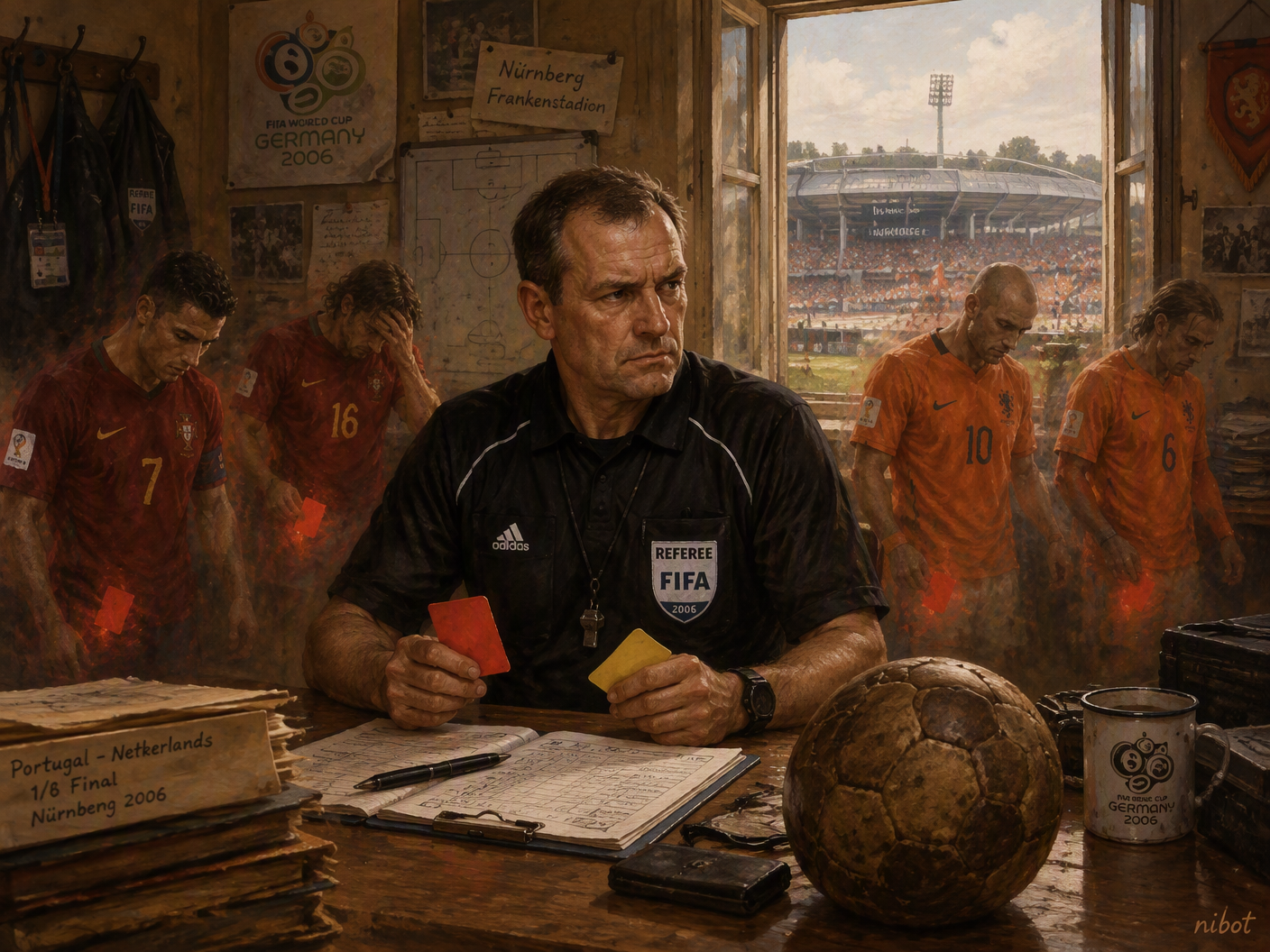
Valentin Ivanov sent off four players at Frankenstadion on 25 June 2006. Portugal still defeated the Netherlands 1-0 and advanced from the World Cup round of 16. The match produced two separate records of its disciplinary volume: one counted 16 yellow cards and described the total as equal to the World Cup bookings record; another counted 20 cards overall, including 16 yellows. The numbers differ. The central fact does not. A knockout match between two major football nations became a contest in which the referee’s cards competed with the scoreline for control.
The first dismissal came before halftime, when Portugal midfielder Costinha received a second yellow card. Ivanov’s decision reduced Portugal to ten players and altered the tactical problem immediately. Portugal had entered the match needing to survive a single-elimination tie; now it had to do so with one fewer midfielder and a disciplinary burden attached to every challenge that followed. The dismissal was not a separate punishment imposed after the game. It was the direct result of the second caution, the same mechanism that would remove three more players before the match ended.
Portugal nevertheless scored the match’s only goal through Maniche. The goal gave the Portuguese side an advantage that could not be separated from the conditions in which it had been secured. A one-goal lead in a World Cup knockout match normally concentrates pressure on the team behind. Here, the pressure was distributed through fouls, cautions, and removals. The score remained 1-0, but the contest no longer had the numerical balance with which it began. Portugal had to protect its lead while the disciplinary count continued to rise.
The Netherlands lost Khalid Boulahrouz after he received a second yellow card. His dismissal brought the teams closer to numerical parity, but it did not restore control. Portugal had already lost Costinha, and the match had acquired a pattern in which a player’s next caution could become a departure. Each booking carried two consequences: the immediate sanction and the possibility that another would remove a player entirely. Ivanov’s authority was visible in every card, yet the accumulating punishments also showed how little stability remained on the field.
Deco was the next Portuguese player dismissed. He received a second yellow card in the second half, reducing Portugal again and leaving the side to defend Maniche’s goal with nine players. The sequence mattered more than any isolated incident because it converted the disciplinary problem into a structural one. Portugal was no longer managing a lead with a depleted midfield; it was managing a lead while short of two players. The Netherlands had also lost Boulahrouz, but the Portuguese advantage on the scoreboard demanded a different kind of calculation from both teams.
With Deco gone, the match became a contest of restricted options. Portugal’s numerical losses narrowed its ability to press, carry the ball, or recover from mistakes. The Netherlands had its own missing defender and a growing list of cautions. Every remaining player operated under the possibility of another booking, while Ivanov continued to administer the match through formal sanctions rather than allowing the contest to settle into a conventional rhythm. The result was not voided by the dismissals. Portugal’s one-goal lead remained the governing fact.
The scale of the card count became part of the match’s identity. One contemporaneous account recorded 16 yellow cards and treated the number as a World Cup bookings record. Another described Ivanov brandishing 20 cards in total, including 16 yellows. The discrepancy is narrow but important: the match is remembered through a precise statistical claim whose published formulations do not fully agree. What they share is enough to establish the character of the afternoon. Ivanov issued an extraordinary number of cautions while four players crossed the line from warning to expulsion.
The final dismissal came in injury time. Giovanni van Bronckhorst, a Netherlands defender, received a second yellow card and was sent off. By then, the match had produced two dismissals for Portugal and two for the Netherlands: Costinha and Deco on one side, Boulahrouz and van Bronckhorst on the other. The symmetry did not make the damage equal. Portugal had the goal, and the Netherlands had the remaining minutes to overturn it with fewer players and less time. Van Bronckhorst’s removal closed the disciplinary sequence.
Ivanov’s role was therefore larger than the simple notation of four red cards. He controlled the formal threshold by which cautions became dismissals, and each second yellow changed the available shape of the match. Costinha’s removal came before halftime; Deco’s followed in the second half; Boulahrouz also departed after a second caution; van Bronckhorst followed in injury time. The sequence moved from an early Portuguese disadvantage to a depleted contest involving both teams. The referee’s decisions did not determine the scorer, but they determined the personnel left to defend the score.
When the final result was recorded, Portugal had won 1-0 at Frankenstadion in Nuremberg and the Netherlands had been eliminated from the World Cup. Maniche’s goal remained the only scoring event. Four players had been dismissed, two from each team, and the match had generated a card total described differently across contemporary accounts. Those facts sit together without requiring the scoreline to be treated as secondary or the disciplinary breakdown as incidental. The match was decided by one Portuguese goal and remembered through the authority Ivanov exercised over every player still on the field.
Investigative Dossier & Evidence
Read the companion investigation notes, verified source claims, and primary documents.
Read the Companion Notes & Evidence Record →