
Scandals & Feuds · 2000s
Gilbert Arenas, the Wizards Locker Room, and the Guns in the Locker
In December 2009, unloaded firearms stored at Verizon Center carried Gilbert Arenas from a team dispute into a police investigation, a criminal case, and a season-long NBA suspension. The consequences continued through his sentence, an amnesty waiver, and a later arrest unrelated to the Wizards incident.
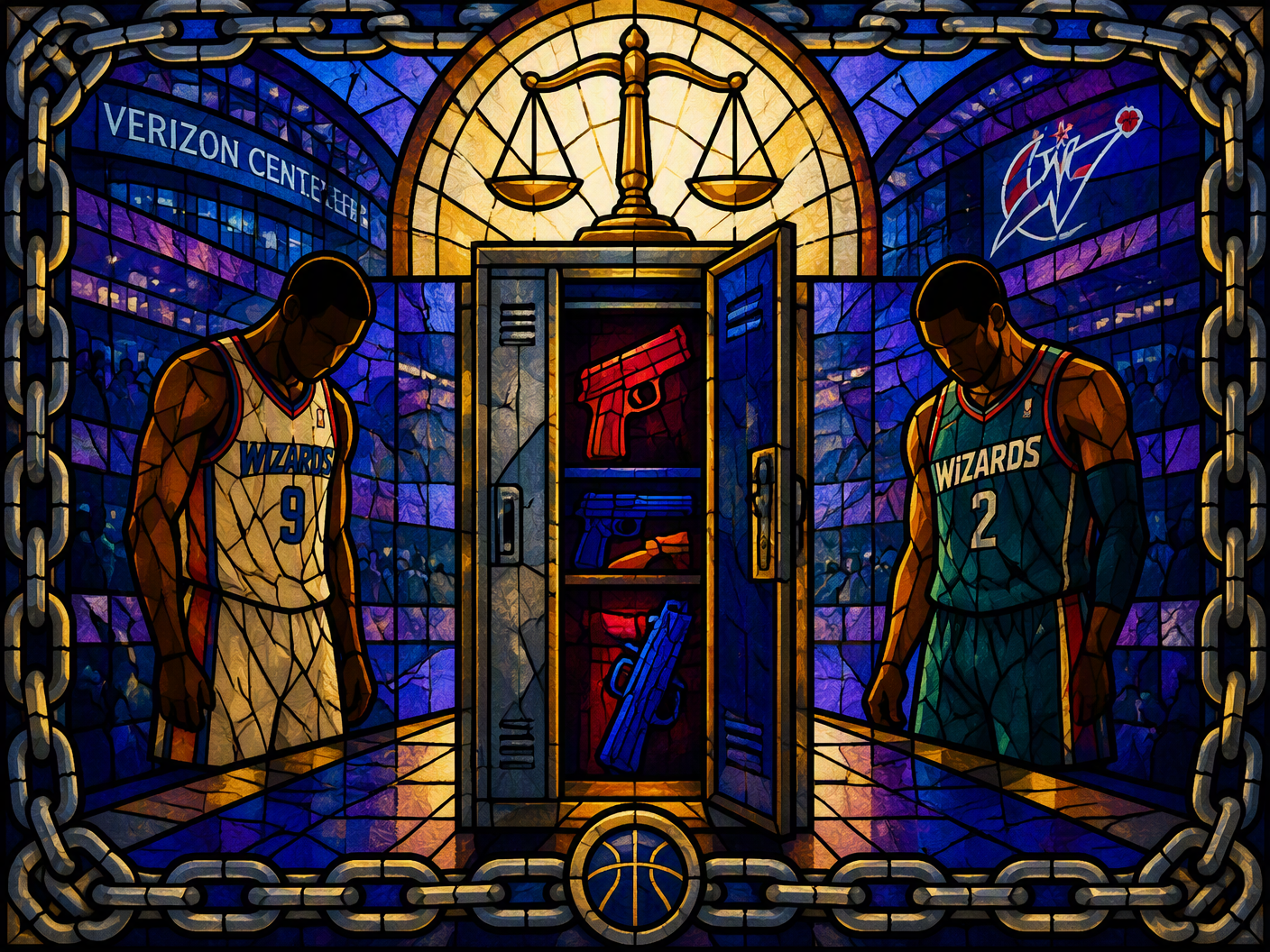
The guns were in Gilbert Arenas’s locker at Verizon Center, stored inside a container and unloaded. By late December 2009, the Washington Wizards had acknowledged that much, and a locker-room dispute had moved beyond the people who had been present. The NBA opened an investigation. Police and federal prosecutors entered the story. The objects had not been fired, but they had crossed the line between an athlete’s private possession and the controlled space where a professional team worked.
Arenas was the Wizards’ guard and one of the club’s central figures, a player whose body and contract occupied serious space in Washington. Javaris Crittenton was his teammate. Their names became tied to the dispute, and the locker room became the place where personal conflict met league rules, criminal law, and the obligations of a team that had to put players on a court. The club condemned the pregame gun-finger stunt connected to the episode as unacceptable. There was no harmless corner left for the joke.
The Wizards’ statement put the essential fact in public view: Arenas had stored unloaded firearms in his locker. That admission changed the nature of the event. It was no longer only a story about what one player claimed another had done, or what teammates might have seen near the lockers. The team had identified the storage itself. The NBA had its own reason to act, because a weapon inside a professional locker room was a conduct and safety matter before it became a question of criminal guilt.
The investigation moved on two tracks. The NBA examined the conduct under its authority, while the D.C. Metropolitan Police and the U.S. Attorney’s Office pursued the firearm matter under law. Arenas was charged and pleaded guilty. The episode had begun with metal in a locker container and a dispute between teammates; it now had a docket, prosecutors, and a player standing before a court. The public performance around the incident could not displace the legal process that followed.
On January 27, 2010, Commissioner David Stern suspended Arenas and Crittenton for the rest of the 2009–10 season. Stern said Arenas was not currently fit to take the court. The punishment removed both men from the workplace where the dispute had taken place and from the games that had made their employment valuable. The suspension was not a fine tucked into a league announcement. It erased the remainder of a season.
The order landed before the court had finished with Arenas. That sequence mattered. The NBA did not wait for a criminal sentence before imposing its own discipline, and the court did not treat the league suspension as the end of the case. One authority controlled access to the floor. Another controlled the criminal charge. Arenas had to answer to both. Crittenton received the same season-ending suspension in the league proceeding, binding his career to the dispute even as the criminal consequences centered on Arenas.
On March 26, Arenas was convicted in Washington, D.C., on firearm-related offenses. The sentence included probation and a term in a halfway house. He began that sentence and completed it on May 7. The legal punishment was measured in supervision and confinement rather than a long prison term, but it remained a conviction. The unloaded condition of the firearms did not erase the offense, and the locker room did not become a private zone beyond the reach of the law.
By then, the player’s standing had changed in practical ways. A team statement had become a league suspension. The suspension had been followed by a guilty plea, conviction, and sentence. The sequence left Arenas with a career to manage after the public part of the case had receded. The Wizards were no longer the only institution tied to his next decision. Contracts, roster space, and the judgment of other clubs would determine whether his value could survive the conduct attached to his name.
After the 2011 lockout, the Orlando Magic waived Arenas on December 9, 2011, using the NBA’s amnesty clause. He cleared waivers. That transaction belonged to the league’s roster and salary structure, not to the criminal sentence in Washington. It showed the player moving through a different kind of consequence: not a courtroom order, but the quiet arithmetic of a club deciding what to carry and what to remove. The contract was handled in an office. The case had begun beside a locker.
Arenas was arrested again on June 27, 2013, in Los Angeles, in a police matter involving possession of illegal fireworks. It was a separate arrest, in a different place, involving different objects and different facts. It did not extend the Wizards locker-room gun case. That earlier case had already passed through investigation, league discipline, conviction, and sentence. What remained from it was not a rumor or a locker-room anecdote, but a set of decisions with names attached: Arenas storing firearms, the league suspending him, and a court imposing punishment.
Investigative Dossier & Evidence
Read the companion investigation notes, verified source claims, and primary documents.
Read the Companion Notes & Evidence Record →