
Violence & Brawls ·
Heysel: The Final Went Ahead After 39 People Died
A surge by Liverpool supporters and the collapse of a retaining wall brought disaster to the 1985 European Cup final. The reckoning also reached police and football authorities.
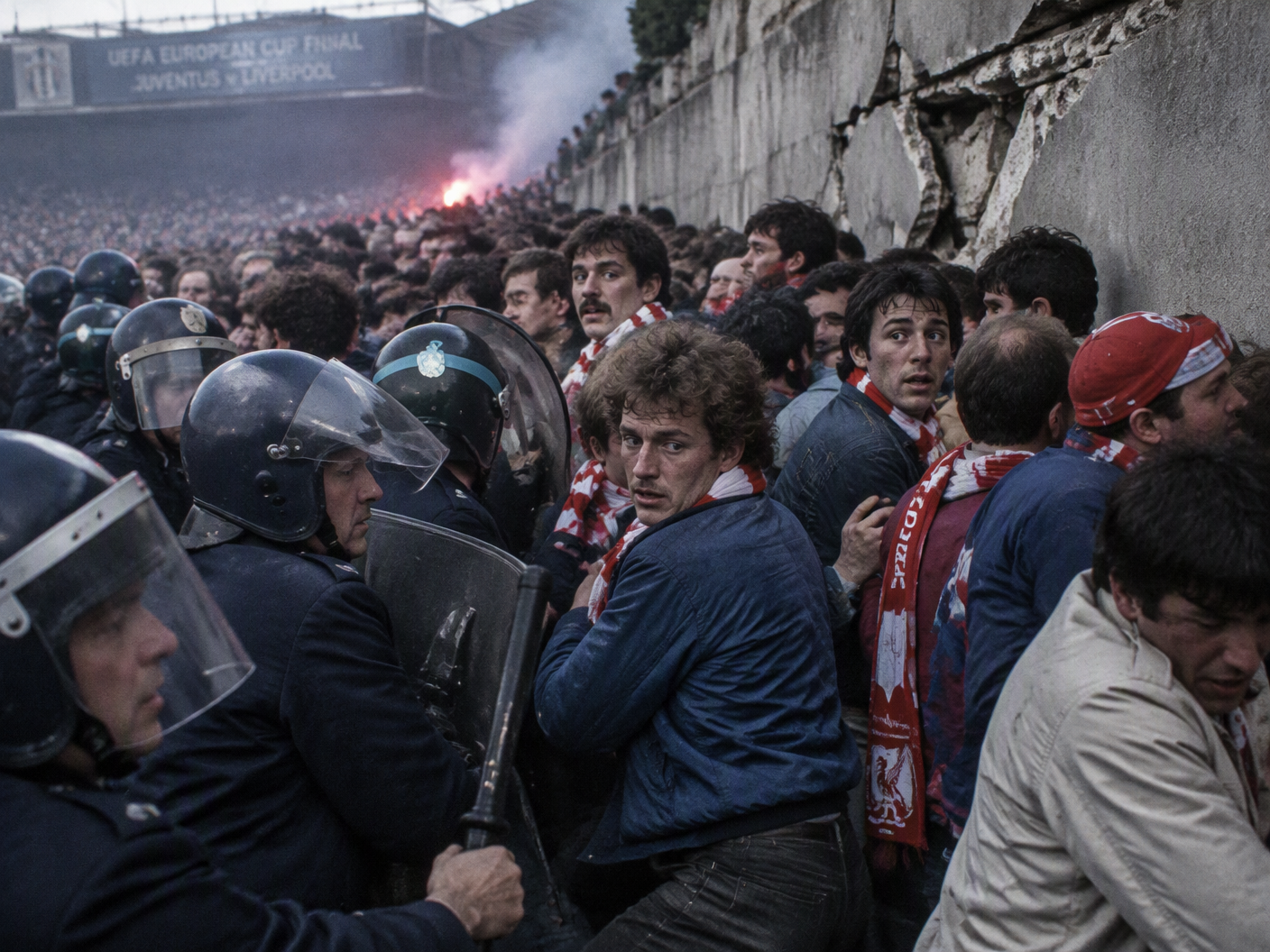
About an hour before the European Cup final was due to begin on 29 May 1985, a contingent of Liverpool supporters surged toward an adjacent section containing many Juventus fans at Heysel Stadium in Brussels. People trying to escape were crushed or trampled; a retaining wall collapsed. Thirty-nine people died. The final went ahead that evening, despite objections from both team managers.
The section where the deaths occurred was supposed to hold neutral spectators. Instead, many Juventus supporters had obtained tickets there, placing them beside Liverpool fans with only a flimsy wire fence between the sections. The stadium had crumbling walls and outdated standing terraces. As confrontations escalated, spectators threw missiles, and a thin police line could not stop the surge.
Tony Evans, a Liverpool supporter who attended with family and friends, later recalled people kicking holes in the stadium walls to get inside. He told The Associated Press that rumors were circulating that Liverpool fans had been stabbed and one had been hanged. They were rumors, not established events. Evans remembered flares being set off before the charge. “That seemed to spark a huge panic, a charge down the front,” he said.
Those fleeing were pushed into a corner beside the wall. Hundreds were injured: the BBC puts the number at more than 350, while The Associated Press and The Brussels Times report about 600. Riot police were called in, and the Red Cross treated injured spectators in tents at the ground. A priest came to give the Last Rites.
Organizers decided to play the match because they believed doing so would prevent further disorder outside the stadium, according to the AP. The game began late. Juventus won 1–0 through a second-half penalty. UEFA then banned English clubs from European competition indefinitely. The exclusion ultimately lasted five years for other English clubs and six for Liverpool.
Responsibility was disputed from the outset. Some Liverpool fans claimed Juventus supporters had precipitated the violence by throwing stones and other missiles. UEFA’s chief observer, Gunter Schneider, declared the following day: “Only the English fans were responsible. Of that there is no doubt.” A report based on an 18-month investigation by Belgian judge Marina Coppieters reached a broader conclusion. Published in November 1986, it found that culpability also rested with police and football authorities and criticized the stadium’s condition, ticketing arrangements and crowd control.
At a Belgian trial in 1989, 14 Liverpool supporters were convicted of involuntary manslaughter and given three-year sentences, half of each term suspended. A Belgian football official and a police chief also received suspended prison sentences.
Among those who died was Alberto, who had flown to Brussels with his father, Juventus supporter Bruno Guarini. In a 2015 interview with The Guardian, Guarini said they had expected Liverpool’s supporters to be like them, “just crazy about football.” Guarini said he had moved toward the wall to escape. “Alberto and I had flown to Brussels together singing on the plane,” he said. “And I flew back with the body of my son.”