
Scandals & Feuds · 1980s
Houston’s 95-21 Rout of SMU After the NCAA Death Penalty
In 1989, Houston defeated SMU 95-21 at the Astrodome, two years after the NCAA had canceled the Mustangs’ season under its death penalty. The game took place while Houston itself was under bowl and television restrictions, placing the result inside a period when both programs were operating under NCAA discipline.
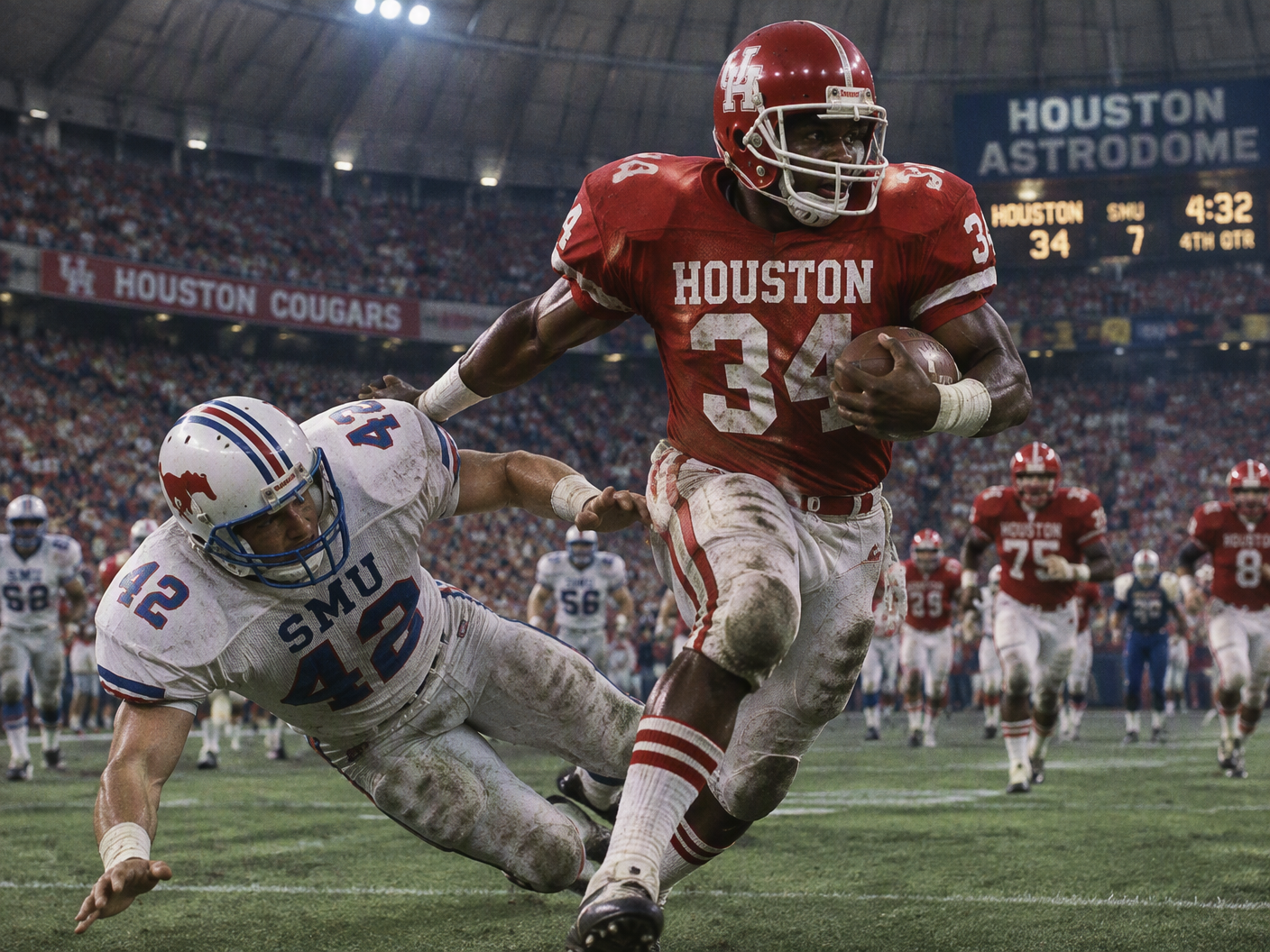
In 1989, at the Astrodome in Houston, the University of Houston defeated Southern Methodist University 95-21. The score was not a close contest distorted by a late break or a single afternoon of mistakes. It was a documented rout between two programs carrying different forms of NCAA punishment. SMU had lost an entire season to the association’s death penalty. Houston was competing under bowl and television bans. The game entered the history of both schools not as a formal NCAA rematch, but as a football result played inside an unusually damaged conference landscape.
The first official restriction had come in August 1985, when the NCAA placed SMU on probation and limited the football program to 15 scholarships. A scholarship limit altered the ordinary work of a college team. It narrowed the number of players a staff could recruit, reduced the margin for injury and attrition, and made recovery dependent on young players arriving in sufficient numbers and developing quickly. For SMU, the penalty was not an isolated administrative event. It became the first fixed point in the sequence that led to the cancellation of the program’s season.
The public pressure around SMU intensified the following year. In November 1986, David Stanley appeared in a WFAA televised report and said that SMU officials had paid him to play at the school. His statement placed a former player at the center of a dispute over how recruits and athletes had been treated. The allegation belonged to the period before the death penalty, when the program was still attempting to operate under the scholarship restriction. It also became part of the public chain of events through which NCAA investigators and university officials confronted the program’s compliance failures.
Another part of that chain involved tight end Albert Reese and booster George W. Owen. Reese was living in an apartment provided by Owen without paying rent. Owen was later barred from involvement with SMU athletics. The arrangement connected a player’s housing to a booster’s private assistance, placing an ordinary necessity—where an athlete lived—inside the rules governing benefits and eligibility. By then, the line between institutional support and outside inducement had become central to the scrutiny surrounding SMU.
In 1987, the NCAA canceled SMU’s entire football season under the death penalty. The sanction removed the program from competition rather than merely reducing its schedule, scholarships, or postseason access. Players who might otherwise have spent the fall preparing for games had no SMU season to play. Coaches and administrators faced the task of rebuilding a program whose immediate competitive calendar had been erased by its regulator. When SMU eventually returned, it did so after an interruption unlike the ordinary cycle of a college football season.
Houston’s position was different but not untouched by NCAA discipline. In the season of the 1989 meeting, the Cougars were under bans on bowl participation and television exposure. Those restrictions did not cancel Houston’s schedule, but they limited the rewards and visibility that usually followed success. The program therefore entered the Astrodome game with its own institutional penalties. The matchup was not a simple contest between an intact power and a sanctioned opponent; both schools were playing within consequences imposed from outside the field.
Against that background, Houston scored 95 points and SMU scored 21. The numbers fixed the game’s place in the public memory of the sanction era. They also imposed a discipline on later interpretation. The NCAA had not announced the contest as a revenge game, and no formal authority turned it into a ceremonial punishment. The result required no such label. Houston won by 74 points, while SMU remained a program rebuilding after the most severe penalty then available to college football.
The meaning of the afternoon depended on where a person stood in the sequence. To Houston, the score was a victory achieved while postseason and television opportunities were restricted. To SMU, it was a loss in the first years after the canceled season, when the effects of probation and the death penalty still shaped the program’s competitive resources. Neither condition transformed the game into a separate NCAA proceeding. The authority of the result came from the score and the circumstances surrounding it, not from a ruling that assigned the matchup a special purpose.
SMU’s compliance troubles did not end with the 1987 sanction or the 1989 score. On December 8, 1999, the university dismissed assistant coach Steve Malin after an independent investigation found NCAA violations involving improper inducements, benefits, and contacts. The episode belonged to a later recruiting period and involved a different set of institutional decisions. It nevertheless showed that the questions surrounding SMU’s treatment of players and recruits had continued into another generation of the program.
On December 13, 2000, the NCAA added sanctions related to Malin’s conduct. The penalties included further recruiting restrictions and the forfeiture of five victories from SMU’s 1998 season. By then, the 95-21 Houston result was more than a line in a schedule. It stood within a longer sequence of probation, lost scholarships, a canceled season, restricted exposure, and later compliance penalties. The separate dates mattered: the Malin sanctions did not alter what happened in 1989, but they extended the institutional record beyond the death penalty.
The enduring document of the Houston-SMU meeting is therefore precise. Houston won 95-21 at the Astrodome in 1989. SMU had reached that game after the NCAA’s 1985 probation and 15-scholarship limit, the 1986 public allegations, and the 1987 cancellation of its season. Houston arrived under restrictions of its own. Later sanctions involving Steve Malin and the forfeiture of five 1998 victories kept SMU’s compliance history open long after the game ended. The score remained fixed, but its setting was defined by institutions that had already taken football away from one program and narrowed the future of another.
Investigative Dossier & Evidence
Read the companion investigation notes, verified source claims, and primary documents.
Read the Companion Notes & Evidence Record →