
Point Shaving & Fixes · 1961
Jack Molinas, the Point-Shaving Scandal, and the End of the Dixie Classic
Jack Molinas’s NBA gambling suspension preceded his conviction in connection with the 1961 college point-shaving scandal that resulted in arrests across 22 universities. In North Carolina, after evidence implicated players from North Carolina State and the University of North Carolina, university officials abolished the Dixie Classic, while Connie Hawkins was excluded from professional basketball for seven years due to his association with Molinas.
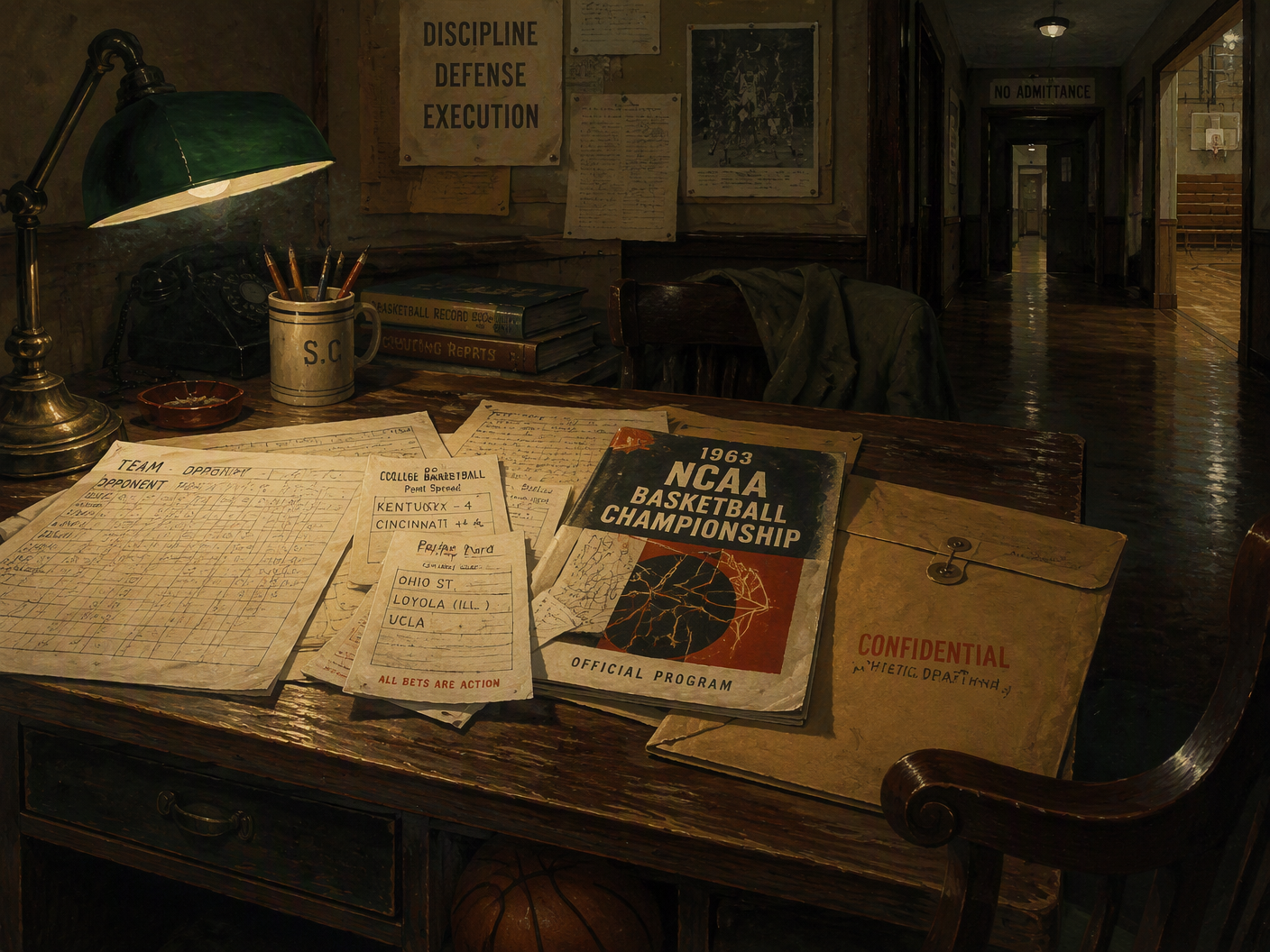
The money was small. The reach was not. During the 1960–61 college season, three Saint Joseph’s players—Jack Egan, Frank Majewski, and Vincent Kempton—confessed to shaving points across three contests. In the drafty, packed fieldhouses of Eastern basketball, where cigarette smoke hung blue beneath the rafters and the shouts of bookmakers echoed from the mezzanine, a game could be won on the court while its margin was quietly bent to satisfy a betting line. For their work across the three games, the three players collected a combined payment of $2,750. The record identifies the confession, the games, and the payment; it does not specify the individual plays or decisions through which the margins were changed.
Seven years before the Saint Joseph’s confessions, Jack Molinas had entered professional basketball. Drafted out of Columbia, Molinas played 32 games as a forward for the Fort Wayne Pistons during the 1953–54 season. His professional tenure ended almost before it had truly begun. Early in that rookie campaign, league authorities learned that Molinas had bet on games, and the NBA imposed an indefinite suspension. The suspension cut short the career recorded in the league’s statistics and preceded Molinas’s later place in the college gambling scandal. The surviving account connects those public events but does not establish the private steps between his departure from the NBA and the later investigation.
The mechanics of the point spread offered the betting scheme its arithmetic. Unlike an outright bribe to lose a contest, shaving points allowed a team to win while the margin moved toward the betting line. A favorite could win by four instead of nine, preserving the official victory while changing the result’s value to those who had wagered on the spread. That distinction made point-shaving different from throwing a game, but it also made the conduct harder to read from a scoreboard alone. The documented scandal connected Molinas to a wider college gambling operation without establishing every intermediary, meeting place, or method by which players were approached.
What began with the Saint Joseph’s confessions did not remain confined to one campus. By the spring of 1961, the reported arrests involved 37 players from 22 colleges. The figure turned a set of admissions about three games into a national college-basketball story, with the names of players and institutions entering the public record in rapid succession. The surviving account does not reconstruct every investigative step or identify the precise disposition of each case. It does establish the reported scale of the arrests and shows how allegations tied to individual game margins became part of a much larger gambling inquiry.
At the center of that web stood Molinas. In New York, state prosecutors placed him on trial in connection with the multi-campus gambling scheme. A jury convicted him in connection with the bribery operation, and a judge sentenced him to a term reported as 10 to 15 years in state prison. The sentence was later reduced on appeal. The proceedings made Molinas a convicted felon and linked the former NBA player’s name to the college point-shaving case that had begun with the Saint Joseph’s confessions. The surviving record supports the conviction and reported sentence, but not a more precise account of his operational role than the court outcome establishes.
North Carolina’s response centered on William Neal Reynolds Coliseum in Raleigh, where the Dixie Classic had been held every December. For twelve years, the holiday tournament brought the state’s major college programs together with national contenders and filled the calendar during the winter season. The Classic’s importance was measured in its longevity and the attention attached to those annual games, not merely in the scores recorded afterward. Its position changed when the investigation produced evidence implicating players from North Carolina State and at least one player from the University of North Carolina in fixing games.
The gambling allegations in North Carolina also carried a reported threat of violence. William Friday, president of the Consolidated University of North Carolina, later recalled that investigators had presented evidence that gamblers threatened at least one North Carolina State player with a gun after a game outcome displeased them. Friday’s account placed an individual player inside the danger surrounding the betting scheme. It does not establish a broader pattern of armed retaliation, identify every person involved, or show that the episode amounted to organized extortion. What it preserves is narrower and more unsettling: an investigator-presented account of a gun threat after a basketball result.
North Carolina university officials abolished the Dixie Classic after evidence implicated North Carolina State players and at least one North Carolina player in game fixing. The decision ended the December tournament after twelve years at Reynolds Coliseum and removed an established event from the state’s college-basketball calendar. In the subsequent legal proceedings, players from both campuses entered the official inquiry, and several received immunity in exchange for testimony as authorities examined the gambling ring. The tournament never returned. Its disappearance was the concrete institutional action that followed the evidence and the testimony surrounding the investigation.
The scandal’s reach extended beyond the players who admitted shaving points. Connie Hawkins was kept out of professional basketball for seven years because of his association with Molinas, while the account of the case states that there was no evidence Hawkins had participated in fixing games. His exclusion therefore became one of the case’s clearest consequences for someone whom the available record did not place among the players manipulating contests. The record establishes the association, the absence of reported evidence that Hawkins fixed a game, and the seven-year professional consequence. It does not establish a formal blacklist or describe every year of Hawkins’s life during that period.
The 1961 betting scandal left a lasting mark across American basketball. Molinas’s NBA suspension, his New York conviction and reported prison sentence, the confessions at Saint Joseph’s, and the reported arrests of 37 players from 22 colleges formed one sequence of professional and college consequences. In North Carolina, William Friday’s recollection of a gun threat accompanied the evidence that led officials to abolish the Dixie Classic. Connie Hawkins’s seven-year exclusion showed how association with Molinas could carry consequences even when no evidence showed that Hawkins fixed a game. The surviving record preserves the proceedings and institutional decisions that followed, along with the limits of what those records establish.
Companion notes
What the 1961 Point-Shaving Record Establishes
The captured material supports a documented sequence from Molinas’s NBA suspension to the college gambling prosecutions and North Carolina’s abolition of the Dixie Classic. It also contains important limits: several figures come from retrospective journalism or summaries rather than complete arrest files, confession records, police reports, or trial transcripts.
Molinas’s professional record and gambling role
Basketball-Reference establishes that Jack Molinas appeared in 32 games for the Fort Wayne Pistons during the 1953–54 season. That database confirms the season and game total; it does not establish why his NBA career ended. The account in VICE, supplemented by the Wikipedia summary of the 1961 scandal, reports that Molinas received an indefinite suspension two months into his professional career for betting on games. The secondary summary is not sufficient by itself to establish the disciplinary procedure, the league’s underlying evidence, or the exact wording of the suspension. [S4], [S5], [S2]
The captured packet contains bibliographic metadata for the Goldstein investigative account, but not the text itself. That packet therefore does not substantiate the account as background on Molinas’s place in a gambling network. VICE identifies Molinas as a central figure in the later college scandal. The record does not include the NBA disciplinary file, bookmaker ledgers, or a complete criminal indictment. The story can state the suspension and his conviction as reported facts, but it should not reconstruct private meetings or assign a more precise operational command structure than the captured material supports. [S3], [S5]
The Saint Joseph’s players and the national spread
VICE reports that Jack Egan, Frank Majewski, and Vincent Kempton confessed to shaving points in three games during the 1960–61 season and split $2,750. The record contains no underlying confession documents, interview recordings, or court transcripts. The fact is therefore attributed to the contemporary or retrospective account represented by VICE rather than presented as independently verified through the players’ sworn statements. [S5]
VICE also reports arrests involving 37 players from 22 colleges, a figure repeated in the Wikipedia summary. The captured material does not contain a complete arrest list, docket set, or charging documents for all 37 players. That number can describe the reported scale of the investigation, but it cannot support individual conclusions about every player’s conduct, conviction, or eventual legal disposition. [S5], [S2]
Conviction, sentence, and procedural limits
The Wikipedia summary states that Molinas was found guilty in New York, while VICE reports a sentence of 10 to 15 years in prison. The supplied material also indicates that the sentence was later reduced on appeal. Accordingly, the 10-to-15-year term is the reported sentence at that stage of the case, not a claim about the final time Molinas served. The record does not include the indictment, verdict sheet, appellate opinion, or corrections record needed to describe the prosecution in greater procedural detail. [S5], [S2]
North Carolina, immunity, and the Dixie Classic
The News & Observer archival account attributes the North Carolina response to evidence implicating at least four North Carolina State players and possibly two North Carolina players in fixing games. It reports that the University of North Carolina system abolished the Dixie Classic and that players received immunity in exchange for testimony. The Wikipedia summary supplies parallel context. Those sources establish the institutional action and the reported investigative allegations; they do not establish that every implicated player was criminally convicted. [S6], [S2]
The gun-threat account has a narrower evidentiary status. The News & Observer attributes it to William Friday’s recollection of what investigators presented: gamblers allegedly threatened at least one North Carolina State player after a result displeased them. The captured packet contains no police incident report, arrest record, ballistics evidence, or court filing independently proving that episode. Connie Hawkins’s exclusion is likewise reported by VICE, which states that he was kept out of professional basketball for seven years because of his association with Molinas while finding no evidence that Hawkins participated in game fixing. That is a reported distinction, not a finding of criminal culpability. [S6], [S5], [S2]
Source key
The associated evidence packet contains visible source URLs, source roles and the complete claim ledger.