
Point Shaving & Fixes · 1980s
The Fine Cotton Ring-In and the Disqualification of Bold Personality
On 18 August 1984, Bold Personality was substituted for Fine Cotton at Brisbane’s Eagle Farm Racecourse and won the race. Suspicion led to a stewards’ inquiry, the horse’s disqualification, jail terms for Hayden Haitana and John Gillespie, and warning-off sanctions against several people, including bookmakers Bill Waterhouse and Robbie Waterhouse.
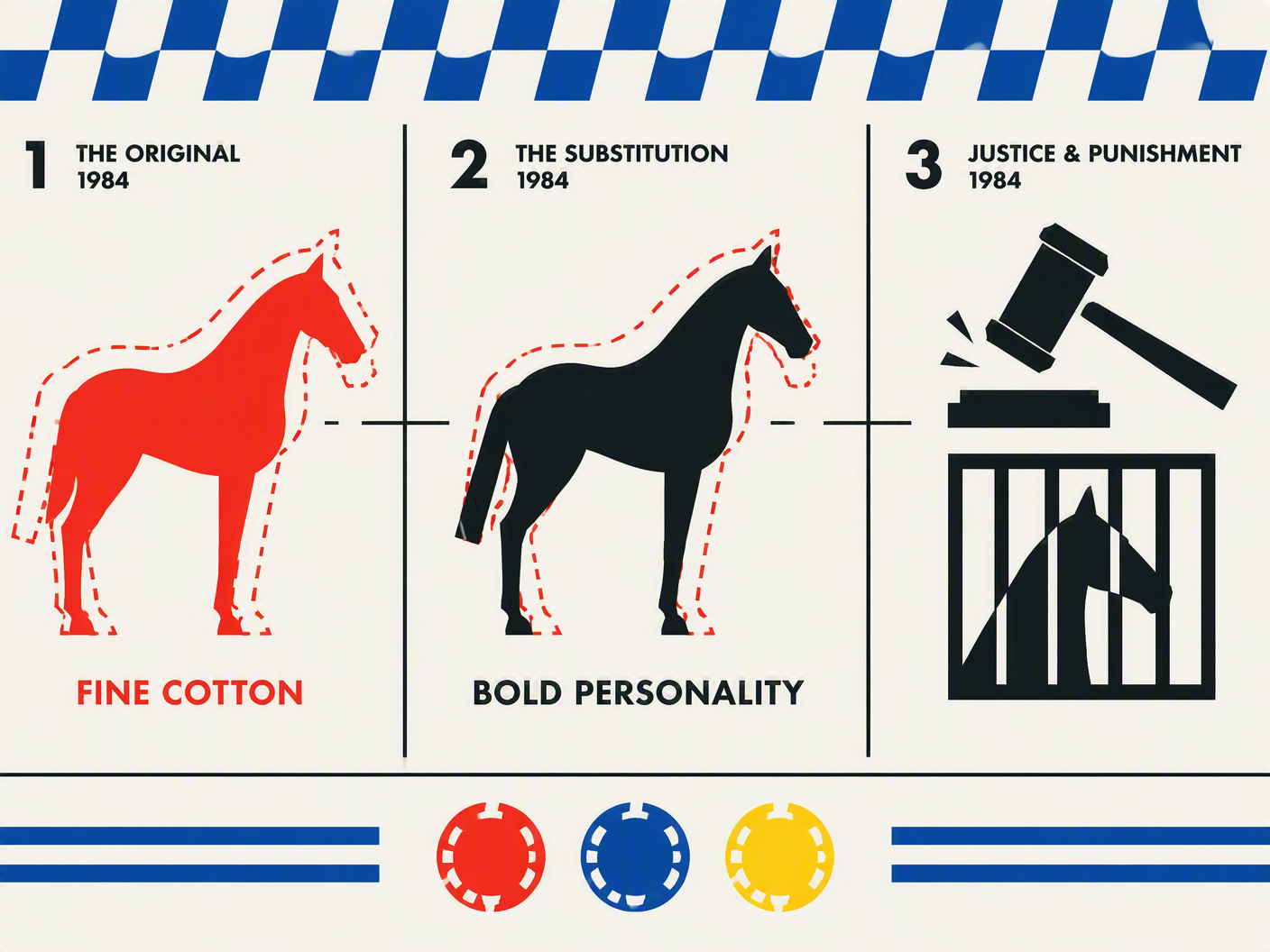
On 18 August 1984, at Eagle Farm Racecourse in Brisbane, a horse entered under the name Fine Cotton ran under another identity. Bold Personality, a bay gelding bred in New South Wales by Mr and Mrs J. P. Curran, took the place of the horse named in the race. He won. For the people who had arranged the substitution, the result appeared to complete the essential transaction: one horse had entered the race, another had carried the name, and the wager depended on the difference remaining unseen.
The racecourse did not operate on the assumption that a declared name was merely a formality. Horses arrived with identities attached to them through registration, stable records, race entries, and the inspection conducted by racing officials. Those systems were built to connect the animal in the stalls with the animal in the field. The substitution attacked that connection directly. Bold Personality was not simply an outsider who ran beyond expectation; he was the wrong horse in Fine Cotton’s place, carrying the race’s official identity across the starting line.
Bold Personality won the Eagle Farm race while being presented as Fine Cotton. The victory gave the substitution its practical value, because a horse’s name governed how the result was understood and how bets were settled. The success also exposed the danger of the arrangement: the better the performance, the more difficult it became to treat the discrepancy as an administrative irregularity. A quiet substitution might pass unnoticed. A winning one forced officials to decide whether the result belonged to the horse that had been entered or to the horse that had actually run.
After the race, racing stewards became suspicious. The suspicion altered the course of the afternoon’s result. What had been recorded as a win was drawn back into examination, and the officials held an inquiry into the identity of the horse that had competed. The inquiry was the point at which the race ceased to be only a completed contest and became a disciplinary matter. Stewards were no longer deciding the order in which horses had finished; they were examining whether the race had been conducted with the declared horse at all.
The official response followed the logic of the substitution. Bold Personality was disqualified after the inquiry, removing the win from the result. The disqualification did not award the race’s meaning to the substituted horse, nor did it preserve the wager as an ordinary sporting outcome. It recognized that the conditions under which the race had been run had been violated. The horse’s body had crossed the course first, but the name attached to the entry belonged to Fine Cotton. That separation made the original result untenable.
The affair also reached beyond the horse and the stewards’ decision. Hayden Haitana, a trainer connected with the Fine Cotton affair, was jailed. John Gillespie, identified as an alleged organiser of the scheme, was also jailed in connection with it. Their punishment placed the episode outside the narrow jurisdiction of racing officials. The substitution had begun as an attempt to alter the conditions of a race and ended with consequences imposed through the criminal justice system as well as through racing administration.
The Australian Jockey Club imposed its own form of exclusion. Several people were warned off after the affair, a sanction that barred them from the club’s racing grounds and from participation within the jurisdiction of organized racing. Among those named were Bill Waterhouse and Robbie Waterhouse, bookmakers who were warned off by the club. The penalty addressed their standing in the sport rather than determining the race’s finishing order. It was an institutional judgment that access to racing could be withdrawn from people connected to the scheme.
The sequence mattered. First came the substitution at Eagle Farm. Then Bold Personality won under Fine Cotton’s name. Suspicion followed the race; an inquiry followed suspicion; disqualification followed the inquiry. Afterward came the wider penalties: Haitana and Gillespie were jailed, while the Australian Jockey Club warned off several people, including Bill and Robbie Waterhouse. Each authority acted within a different sphere. Stewards dealt with the race result, the courts dealt with imprisonment, and the jockey club dealt with who could continue to occupy a place in racing.
The horse at the center of the episode retained a separate identity in the breeding and racing record: Bold Personality was a bay gelding bred by Mr and Mrs J. P. Curran in New South Wales. That detail is more than a catalogue entry. It fixes the animal involved in the substitution and prevents the affair from dissolving into a story about an unnamed replacement. Fine Cotton was the horse whose identity appeared in the race. Bold Personality was the horse that ran and won. The distinction between them supplied the entire basis of the inquiry.
The surviving public account does not supply every step by which the substitution was carried out, nor does it identify every person who knew of it in advance. It does establish the central act and its institutional consequences. Bold Personality was used in place of Fine Cotton at Eagle Farm on 18 August 1984; the horse won; stewards became suspicious; the result was examined and disqualified. Haitana and Gillespie were jailed in connection with the affair, and the Australian Jockey Club issued warning-off sanctions that included the two Waterhouses.
What endured was not the winning margin or the details of the race’s ordinary form. It was the administrative boundary drawn afterward: a declared horse had to be the horse that ran, and a result obtained through substitution could be erased. Eagle Farm supplied the event, Bold Personality supplied the body on the course, and Fine Cotton supplied the identity that had been used. The inquiry separated those elements, disqualified the win, and extended the consequences to the people whose access to Australian racing was then withdrawn.
Investigative Dossier & Evidence
Read the companion investigation notes, verified source claims, and primary documents.
Read the Companion Notes & Evidence Record →