
Tragedy · 1980s
Johnny Owen’s Fatal Challenge for the WBC Bantamweight Title
On 19 September 1980, Welsh challenger Johnny Owen faced champion Lupe Pintor at Los Angeles’s Olympic Auditorium. Pintor stopped him in the 12th round; Owen was carried from the ring, never regained consciousness, and died in Los Angeles on 4 November.
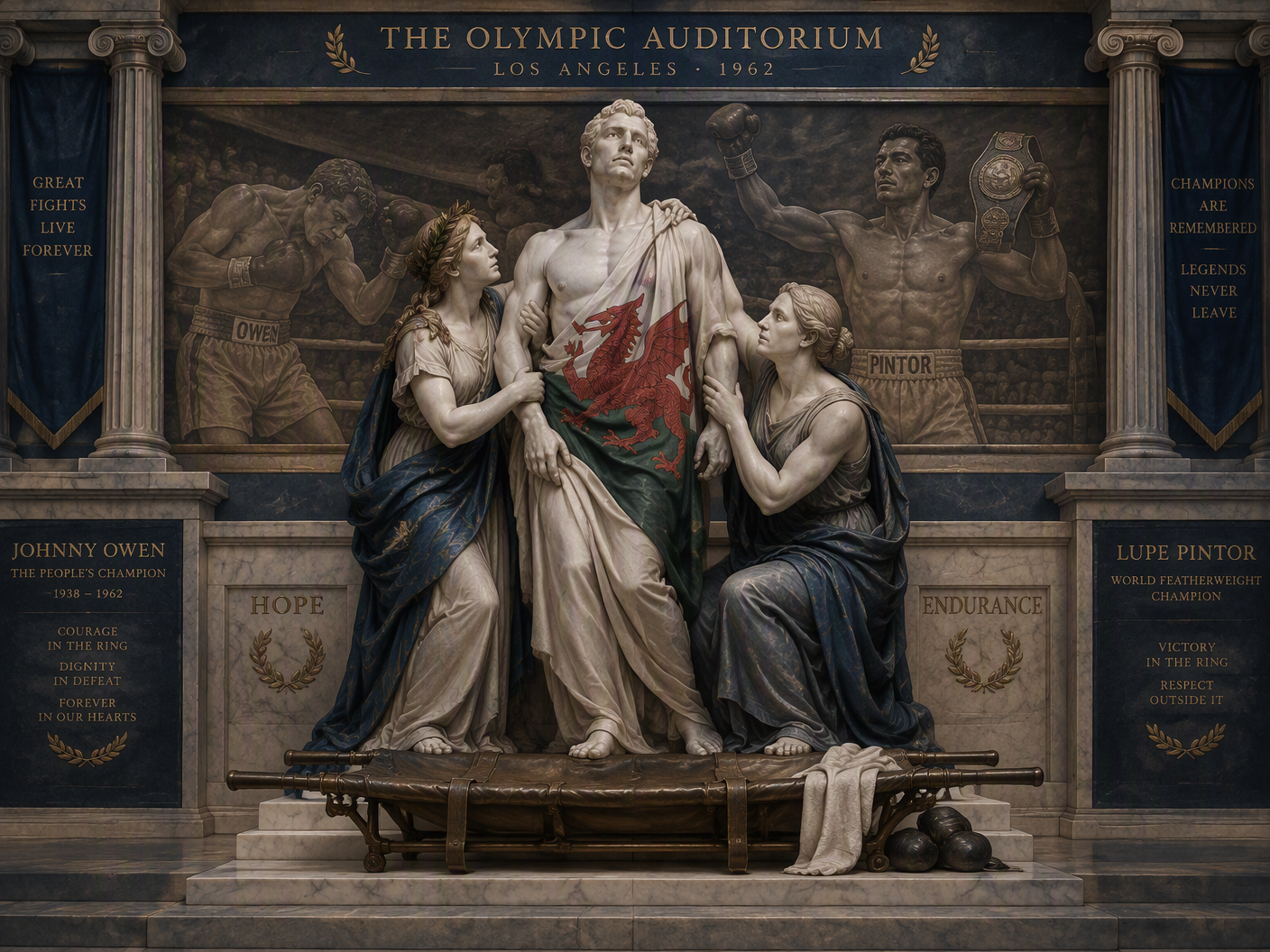
On 19 September 1980, at Los Angeles’s Olympic Auditorium, Johnny Owen’s challenge for the WBC bantamweight title ended with the Welsh boxer being carried from the ring. Lupe Pintor, the defending champion, had stopped Owen in the 12th round. Owen was placed on a stretcher and taken for medical treatment. He would not regain consciousness. The championship had been decided inside the ring, but Owen’s life had entered a different sequence—hospitalization, coma, and a wait that ended on 4 November.
Owen had arrived in California in early September with his father, Dick, for the title fight. He was not an unknown challenger assembled for a single opportunity. Before meeting Pintor, he had held the British, Commonwealth, and European bantamweight titles, collecting the national and continental distinctions that made the WBC contest the next stage of an established career. The journey placed father and son in a foreign setting for a professional obligation whose terms were familiar: prepare, enter the ring, and leave with the championship or without it.
Pintor stood at the center of the contest as champion. Owen came to Los Angeles seeking the WBC belt, carrying the standing of a former British, Commonwealth, and European titleholder into the Olympic Auditorium. The difference between the two men was institutional as well as personal: one defended a world championship, while the other had crossed the Atlantic to take it. On 19 September, those positions were settled through twelve rounds of professional boxing.
The fight did not end with a single exchange. Owen was knocked down three times, and the third knockdown preceded the stoppage in the 12th round. Pintor won by knockout. The result entered the ordinary language of boxing—a champion retained his title, a challenger lost—but the immediate condition of the defeated boxer altered the meaning of the night. Owen did not walk back to a dressing room or leave the building under his own power. He left the ring on a stretcher.
Dick Owen was present in the aftermath. His son was taken for emergency medical treatment in Los Angeles, and the physical boundary between bout and hospital disappeared almost at once. A knockout had become a medical crisis. The stretcher carried Owen away from the place where the contest had been scored and stopped, into care where the central fact was no longer the title but whether he would wake.
He did not regain consciousness after the fight. Owen fell into a coma and remained there through the weeks that followed. The chronology was brutally simple: the final round on 19 September, removal from the ring, hospitalization, and an unbroken period of unconsciousness. For his family, the fight’s conclusion was therefore not a moment but an interval, measured in days while the boxer remained alive and absent from the world around him.
The family gathered around that interval. Dick remained connected to the aftermath in Los Angeles, where Owen was hospitalized. Edith Owen arrived to sit with the family during her son’s coma. The title fight had brought Johnny and his father to California; the injury kept them there under circumstances no itinerary had anticipated. The people closest to him could no longer influence the contest’s result. Their role had become presence—waiting beside a son and brother who never returned to consciousness.
Pintor’s victory remained the official sporting outcome: the WBC bantamweight champion had defended his title against Owen by a 12th-round knockout. Owen’s earlier titles—British, Commonwealth, and European—could not change the decision at the Olympic Auditorium. Nor could the prestige of the contest alter what followed. The belt stayed with Pintor, while Owen’s condition continued in a hospital, removed from the customary finality of a result announced after the last round.
The weeks after 19 September did not produce a second ending. Owen remained in a coma in Los Angeles. His father and mother lived through the prolonged aftermath of the bout, with the family’s attention fixed on the unconscious boxer. The distinction between a fight that had ended and an injury that had not became the defining feature of the case. For Owen, there was no recovery to report, no return to Wales, and no later account from the fighter himself.
On 4 November 1980, Johnny Owen died in Los Angeles. He was twenty-four years old. The death came after the 19 September fight, following the knockout, the stretcher removal, and the coma from which he never regained consciousness. Pintor had won the championship contest in the 12th round; Owen’s life ended forty-six days later in the same city to which he had traveled for the title.
What endured was a sequence that resisted the usual compression of sporting history. Owen remained a Welsh boxer who had held the British, Commonwealth, and European bantamweight titles and traveled to Los Angeles to challenge for the WBC championship. Pintor remained the defending champion who won by knockout. But the decisive aftermath was carried not by a belt or a result sheet. It was carried by the stretcher, the coma, and the date—4 November 1980—when the title fight’s consequences reached their final recorded point.
Investigative Dossier & Evidence
Read the companion investigation notes, verified source claims, and primary documents.
Read the Companion Notes & Evidence Record →