
Doping & Drugs · 2000s
José Guillén and the HGH Shipment Inquiry That Reached the Giants’ Postseason Roster
José Guillén’s disciplinary history moved from a 2004 club suspension to an MLB drug-program suspension, a Mitchell Report linkage, and a 2010 inquiry into human growth hormone shipments. The final documented act was the DEA’s interception of fifty HGH syringes addressed en route to his house.
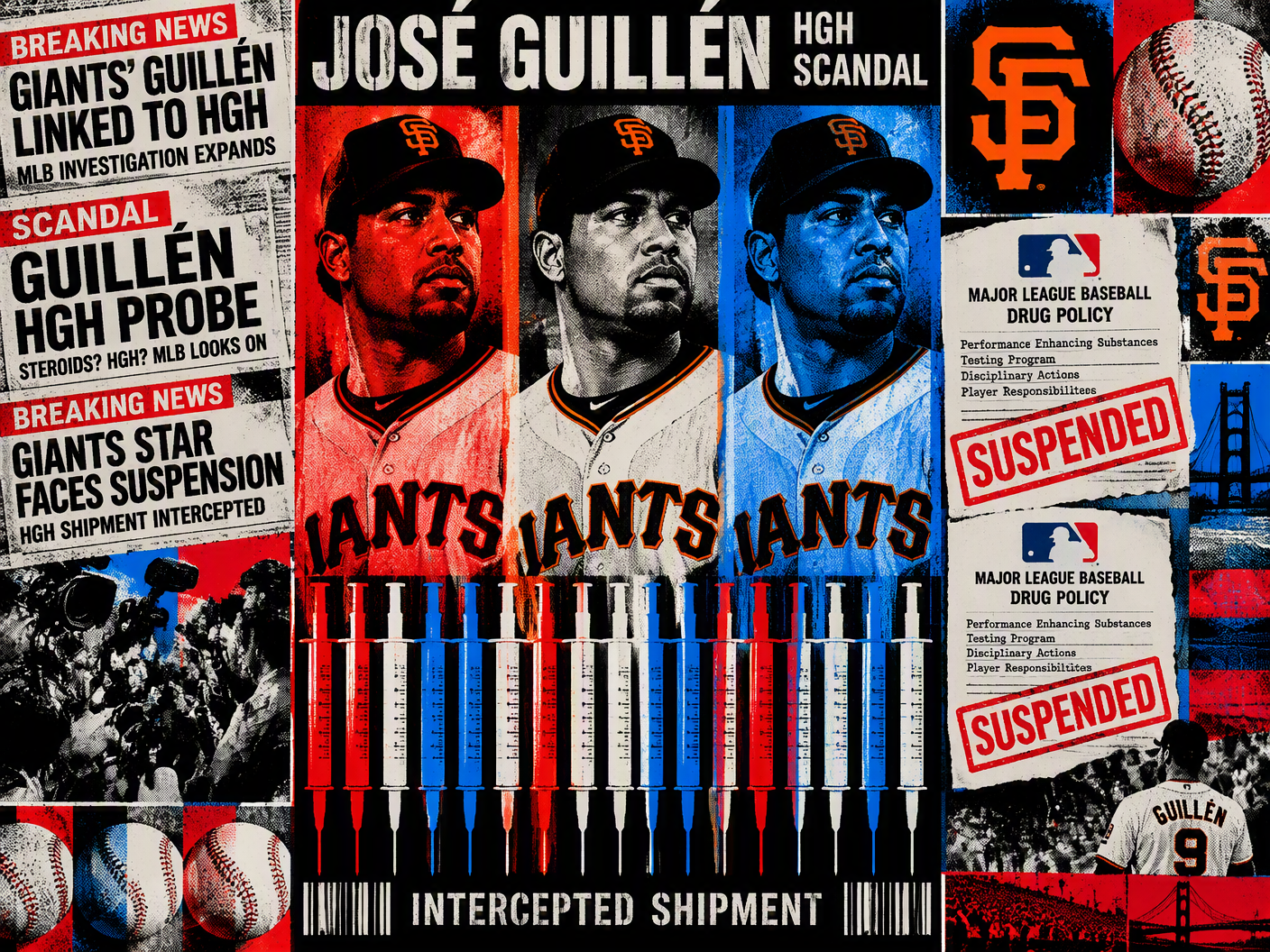
On November 14, 2010, the Drug Enforcement Administration intercepted a package containing fifty human growth hormone syringes while it was en route to José Guillén’s house. The seizure immediately gave physical form to an inquiry Major League Baseball had already opened into HGH shipments received by the outfielder. MLB responded through its own authority: the San Francisco Giants were directed to keep Guillén off their postseason roster. The package did not arrive. His eligibility did not survive the league’s intervention.
The interception was the latest step in a six-year sequence of discipline, association, and institutional scrutiny. Guillén had already lost games and postseason eligibility under the Los Angeles Angels, then received a formal MLB suspension under the league’s Drug Prevention and Treatment Program. In 2007, his name entered the Mitchell Report’s account of performance-enhancing drugs in baseball. By 2010, the question had moved beyond a club’s internal punishment and into a federal interception that MLB treated as sufficient reason to control a championship roster.
The first documented rupture came in 2004, when the Angels suspended Guillén for the final two weeks of the regular season and the postseason. The club identified the punishment as a response to inappropriate conduct. That decision carried a direct competitive cost: Guillén was removed from the team during the period when the regular season ended and the postseason began. The suspension was imposed by Anaheim, not by the Commissioner’s Office, and it established an early division between club discipline and later league action.
Three years later, the governing authority changed. On December 6, 2007, Major League Baseball suspended Guillén for fifteen days under the Drug Prevention and Treatment Program, with the penalty taking effect at the start of the 2008 season. This was not the Angels’ conduct-based suspension repeated under another name. It was a league-administered sanction tied to baseball’s drug rules. The distinction matters because it shows two separate institutions exercising different powers over the same player: the club over conduct, and MLB over a formal program violation.
The Mitchell Report placed Guillén inside the wider performance-enhancing-drug investigation that had begun to reshape baseball’s public accounting. Its 2007 findings linked him to performance-enhancing drugs. The linkage altered the meaning attached to his earlier suspension and to the league’s later penalty, even though the documents involved different procedures and standards. A name in the report was not the same thing as a criminal conviction. It was, however, a permanent addition to the public record surrounding Guillén’s career.
In 2009, Guillén addressed one of the relationships that had become part of that public record. He said he had worked for many years with Angel Presinal, a personal trainer, but had not worked with him since 2004. The statement supplied Guillén’s own timeline: a long professional association, followed by a claimed separation that coincided with the year of the Angels suspension. It did not erase the association. It placed the relationship inside the chronology Guillén was trying to explain.
The next inquiry concerned shipments rather than a single disciplinary episode. In 2010, MLB began examining HGH shipments received by Guillén. The league did not wait for a final criminal judgment before acting on the roster question. It directed the Giants to keep him off their postseason roster while the inquiry proceeded. That decision transferred the immediate consequence from a later hearing to the club’s competitive plans: regardless of how the investigation ended, Guillén would not appear for San Francisco in the postseason.
The DEA interception intensified the matter because it involved a specific object, a specific quantity, and a specific destination. Fifty HGH syringes were stopped while traveling toward Guillén’s house. The seizure connected federal law enforcement to an inquiry that MLB had been handling through league channels. It also created an evidentiary fact that could be stated precisely without resolving every question around it. The package was intercepted. The syringes were not delivered through the documented route.
That boundary shaped the consequences. MLB had authority to suspend a player under its drug program and to direct a club’s roster decision. The DEA had authority to intercept the shipment. Neither action, standing alone, established that Guillén personally possessed or used HGH, trafficked it, or had been criminally convicted for a steroid- or HGH-related offense. The documented sequence therefore contains different kinds of official action: club punishment, league discipline, an investigative report, an internal inquiry, and a federal seizure.
José Guillén’s case became consequential because those actions accumulated without becoming one identical finding. The Angels’ 2004 suspension removed him from the season’s final games and postseason. MLB’s fifteen-day suspension followed under a named drug-prevention rule. The Mitchell Report linked him to performance-enhancing drugs. His 2009 account separated him from Angel Presinal after 2004. Then MLB investigated HGH shipments, the Giants withheld a postseason roster place, and the DEA stopped fifty syringes bound for his home.
The lasting exposure was institutional as much as personal. Baseball possessed several ways to act before a criminal court entered the picture: a club could suspend, the Commissioner’s Office could impose a drug-program penalty, and MLB could control postseason eligibility while investigating a shipment. Federal agents could intercept the material itself. By November 14, 2010, those authorities had produced suspensions, a public linkage, an active inquiry, and a roster exclusion. The package stopped at the border of Guillén’s house; the questions surrounding it remained with baseball.
Investigative Dossier & Evidence
Read the companion investigation notes, verified source claims, and primary documents.
Read the Companion Notes & Evidence Record →