
Point Shaving & Fixes · 1919
The Black Sox Acquittal, Landis’s Ban, and Jackson’s 2025 Removal
A Cook County jury acquitted eight Chicago White Sox players in 1921 after their trial on charges connected to the fixing of the 1919 World Series. Commissioner Kenesaw Mountain Landis then barred them from organized professional baseball; in 2025, MLB removed deceased players including Shoeless Joe Jackson from its permanently ineligible list, while the surviving record continues to leave Jackson’s precise role disputed.
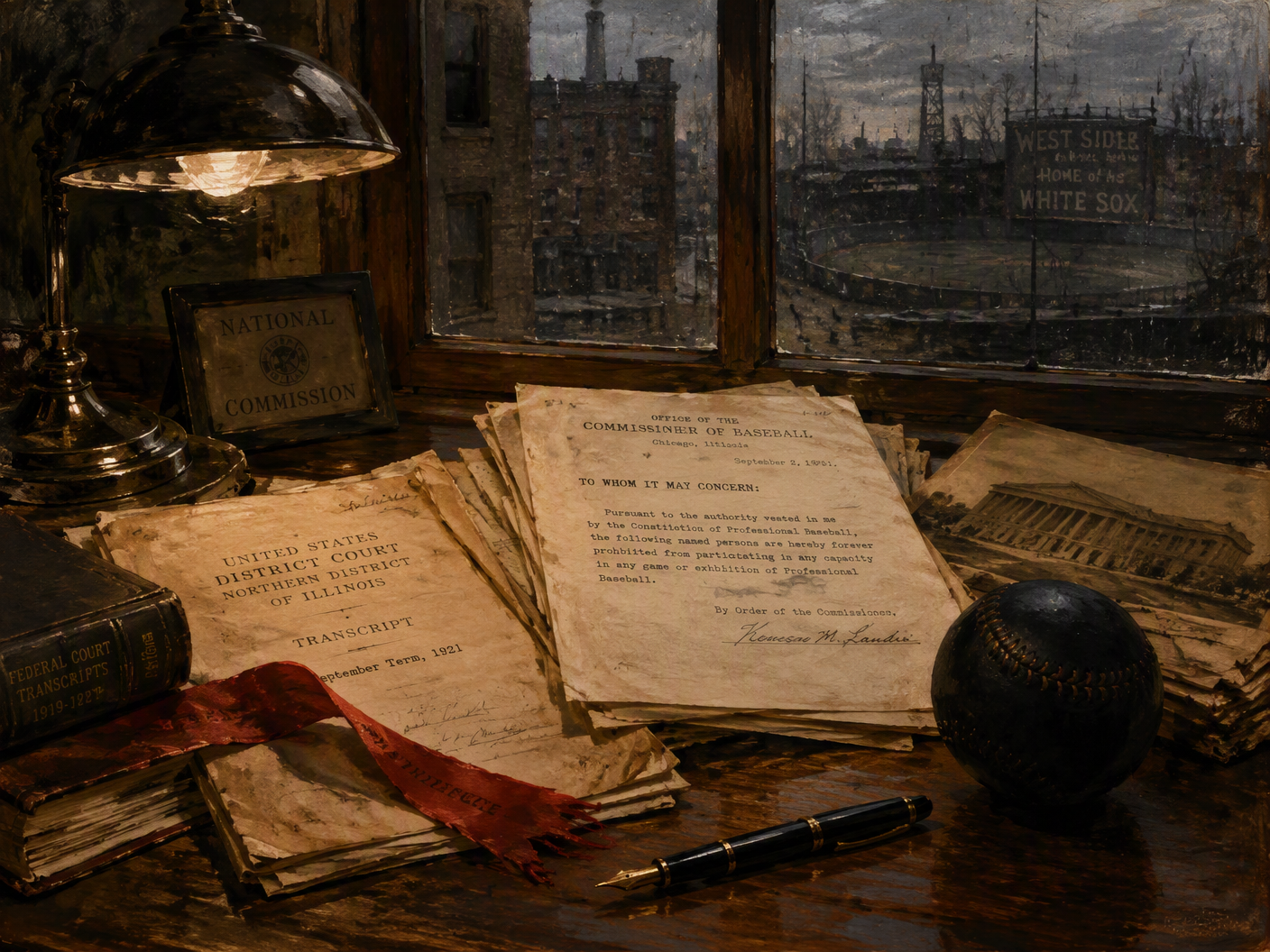
In July 1921, a Cook County jury acquitted all eight Chicago White Sox players accused of conspiring to throw the 1919 World Series. The verdict ended the criminal trial without convictions or prison sentences for the men charged. It did not end the baseball case. Commissioner Kenesaw Mountain Landis imposed a separate judgment after the acquittals, barring all eight players from organized professional baseball. The two decisions entered the historical record together: the criminal jury returned acquittals on the charges before it, while baseball imposed its own eligibility ruling on the players at the center of the scandal.
The accusation had begun with the 1919 World Series between the Chicago White Sox and the Cincinnati Reds. Chicago’s roster was powerful enough to command fear and admiration. The Series became the subject of an investigation involving White Sox players and gamblers, with the games unfolding in public while investigators examined whether money and promises had shaped what happened on the field. The question was not merely whether Cincinnati had won. It was whether the contest itself had been sold.
At the center of the later inquiry stood Joe Jackson, a poor South Carolina mill worker’s son who had become one of baseball’s most gifted hitters. He was illiterate, unable to navigate the machinery of contracts, newspapers, and courtroom language with the ease of the men who controlled his career. On the field, however, he had been fluent. His recorded major-league career ended with 1,772 hits and a .356 batting average, numbers that placed extraordinary ability beside a life increasingly defined by one series and one accusation.
On September 28, 1920, Jackson entered the grand-jury room and testified under oath. He said Chick Gandil had promised him $20,000. He said Lefty Williams delivered $5,000. The money was not a rumor repeated years later in a barroom; it was part of Jackson’s own account of what had passed between the players involved in the proposed fix. His testimony placed cash in his hands and connected him to the conspiracy’s promised rewards, even as he tried to draw a line between accepting money and helping lose games.
Jackson also denied being at the player meeting in New York’s Ansonia Hotel, the gathering associated with the plan to throw the Series. He told the grand jury he had not been present at that conference. The denial mattered because it offered him distance from the room where the agreement was said to have taken shape. But distance from a meeting was not the same as distance from the money. Jackson’s testimony preserved both facts at once: he acknowledged receiving $5,000 and denied attending the meeting central to the accusation.
He went further. Jackson testified that he had not intentionally made errors or misplays during the World Series. He said he played to win and did nothing to throw any game. That was the sworn defense he gave in the grand-jury record. The same record contains his account of the payment promised by Gandil and delivered by Williams. Jackson’s statistics remained part of his baseball history, but they did not settle the testimony about money, meetings, or intent. The payment and the denial remained side by side in the surviving account.
By the time the players stood trial in July 1921, the case had moved from the investigation of the 1919 Series into a criminal proceeding against eight members of the White Sox. The jury acquitted all eight players on the charges before it. That verdict provided the result available from a criminal court in that proceeding: the prosecution did not obtain convictions. The acquittal did not determine every question raised by the baseball scandal, including what the players knew, what agreements had been made, or how the sport should treat conduct connected to the Series.
Landis had been appointed commissioner as baseball confronted the aftermath of the scandal. His authority operated differently from that of the jurors who had heard the criminal case. The jury decided whether the prosecution had proved the charges in court. Landis decided who remained eligible to work in organized professional baseball. After the acquittals, he barred all eight accused players. The sequence made the sport’s judgment separate from the criminal verdict, even though both decisions concerned the same players and the same disputed World Series.
The order was absolute in its practical effect. Jackson and the other seven men did not return to the major leagues. The acquittal could not lift them back onto a professional roster. Landis’s decree converted a disputed criminal episode into a permanent baseball sentence. No judge had convicted Jackson of intentionally throwing a game. No jury had established that the eight men were innocent of every baseball violation. The commissioner’s authority occupied the space between those conclusions and closed it.
Jackson’s testimony remains divided into facts he acknowledged and claims he denied. He said he received money connected to the proposed fix. He denied attending the Ansonia meeting. He denied intentional errors and said he played to win. Those statements did not produce a single settled account of his role. The surviving historical accounts continue to dispute how those elements should be understood: whether the payment reflected a willing conspiracy, participation without intentional on-field wrongdoing, or some other involvement. The record preserves the disagreement without resolving it.
The jury’s acquittal remains part of the record, as do Jackson’s sworn admission and his denials. So do the numbers: 1,772 hits and a .356 lifetime average. Landis’s ban kept Jackson from a sanctioned return to major-league baseball during his lifetime, and MLB’s 2025 removal of deceased players from the permanently ineligible list altered the formal status of the case without changing that history. Jackson’s career therefore survives in two separate ledgers: the statistical record of an exceptional hitter and the unresolved account of money, meetings, intent, and institutional discipline.
Companion notes
What the Acquittal Could Not Settle
The surviving record establishes the sequence from the 1919 fixing investigation to Jackson’s 1920 sworn testimony, the players’ 1921 acquittal, and Landis’s subsequent ban. It does not provide a single adjudicated answer to Jackson’s precise knowledge, intent, or responsibility on the field, and MLB’s 2025 removal of deceased players changed the formal status of the ban.
The Fixing Inquiry
The account of the 1919 World Series as a game-fixing scandal rests principally on the historical treatment assembled by David Pietrusza and on the transcript-based material published by Baseball Almanac. Pietrusza’s account presents a player conspiracy to lose the Series to Cincinnati as established historical fact. The Baseball Almanac material supplies Jackson’s sworn account of payments and an agreement to help throw the Series. Together, the sources support the existence of an investigation involving players and gamblers, while Jackson’s testimony remains testimony rather than independent proof of every element. [S4], [S5]
Jackson Under Oath
The September 28, 1920 grand-jury testimony is the decisive record for Jackson’s own account. The transcript records him saying that Chick Gandil promised $20,000 and that Lefty Williams delivered $5,000. It also records his answers that he was absent from the player conference at New York’s Ansonia Hotel and that he made no intentional errors, misplays, or efforts to throw a game. These statements establish what Jackson said under oath; they do not independently verify his version or resolve whether he knew more than he admitted. [S5], [S4]
The Criminal Verdict
The historical account by David Pietrusza records that the eight players stood trial in July 1921 and were acquitted. The Black Sox scandal reference page on Wikipedia reports the same result, but it functions only as corroborating triage rather than the sole foundation for the claim. An acquittal establishes that the prosecution did not secure criminal convictions in that proceeding. It does not establish that no baseball rules were violated, nor does it resolve the conflicting accounts surrounding Jackson’s payment and conduct. [S4], [S1]
Landis’s Separate Machinery
The same historical account records that Commissioner Kenesaw Mountain Landis barred the eight accused players after the acquittals, and the transcript-based Baseball Almanac material identifies the players subject to the commissioner’s ban. The sequence is clear: criminal acquittal first, baseball exclusion afterward. The sources establish that Landis treated eligibility as separate from the jury’s verdict. They do not, however, supply a complete legal analysis of the commissioner’s authority or define the precise procedural form of his action. [S4], [S5]
The Statistical and Historical Afterlife
Baseball-Reference’s institutional statistical record lists Jackson with 1,772 major-league hits and a .356 career batting average; a Wikipedia biography supplies corroborating context but is not used as the sole statistical authority. Gene Carney’s archival volume is relevant to the continuing dispute over Jackson’s culpability. The combined record supports a contradiction rather than a final verdict: Jackson acknowledged receiving money while denying intentional on-field wrongdoing and attendance at the key meeting. It cannot determine whether those denials were true or whether he deserved different treatment from the other banned players. [S6], [S2], [S3], [S5]
Source key
The associated evidence packet contains visible source URLs, source roles and the complete claim ledger.