
Scandals & Feuds · 2010s
The Weight, the Low Blows, and Salido’s Split Decision
On March 1, 2014, Orlando Salido missed the featherweight limit before facing Vasiliy Lomachenko for the vacant WBO title in San Antonio. Salido won by split decision, and the fight’s aftermath turned on repeated low-blow criticism and questions about referee Laurence Cole’s control of the ring.
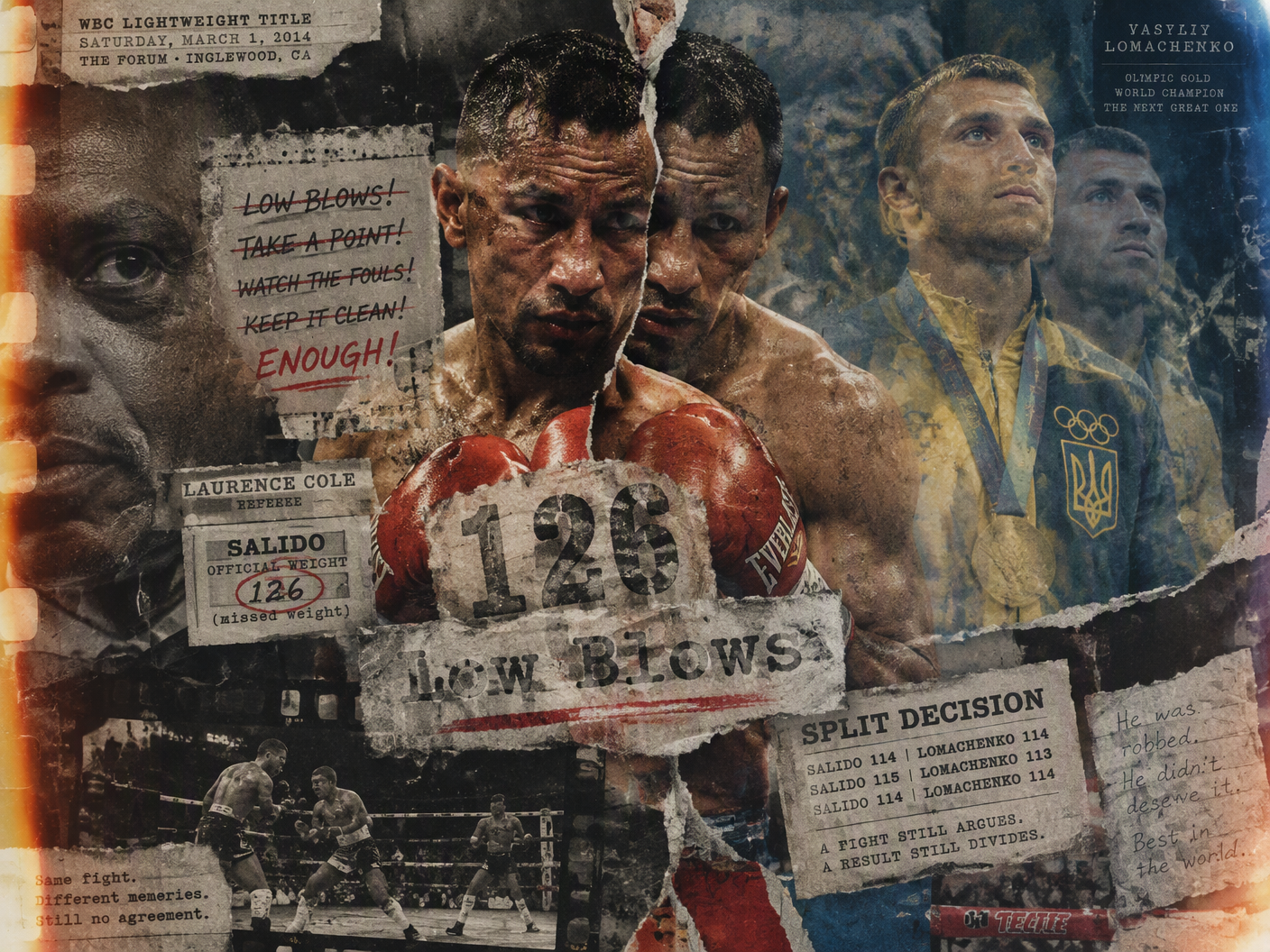
The title was already gone before Orlando Salido and Vasiliy Lomachenko entered the Alamodome. Salido had failed to make the 126-pound featherweight limit, leaving the WBO championship vacant for the March 1, 2014 fight in San Antonio. The belt still waited at ringside. The weight did not. Lomachenko had come for a title in only his second professional bout. Salido came in over the limit and fought for the win.
Lomachenko was not an ordinary newcomer. Before the professional gloves, he had won Olympic gold at the 2008 Beijing Games and again at the 2012 London Games. On October 13, 2013, he made his professional debut against Jose Ramirez and stopped him in four rounds. Five months later, the Ukrainian stood in a championship fight, facing a veteran opponent whose first obligation to the scale had already failed.
The arrangement had its own hard arithmetic. Lomachenko could win the vacant WBO featherweight title. Salido could win the fight, but the belt would not change hands because he had missed weight. That distinction followed them into the ring. A championship contest had become two contests at once: one for the scorecards and one for the authority attached to a belt no fighter carried into the night.
Laurence Cole refereed. His job was plain enough: keep the men inside the rules while they worked at close range, where a punch could travel below the legal target and a clinch could become a method of delay. Cole later said he warned Salido twice for low blows. He also said he warned Lomachenko twice for holding. Those warnings placed both fighters inside the referee’s notebook, but the complaints that lasted belonged mostly to the blows Salido landed low.
The fight went twelve rounds. When it ended, the judges split. Salido took the decision, winning the bout on two cards while Lomachenko received the third. The official result was not a draw, a rematch order, or a belt ceremony for the man who had missed weight. It was a twelve-round split decision for Salido, with the vacant WBO title still defined by the scale before the first bell.
The argument began as soon as the arithmetic was finished. Salido had won, but the low blows became the subject people carried away from the ring. A foul in boxing is not an abstract defect. It changes where a man protects himself, how he stands, and what he expects from the official between them. The criticism directed at Salido said he had been allowed to work below the legal line too often. The criticism directed at Cole asked why the warnings had not produced firmer control.
Bob Arum, Top Rank’s chief executive and the promoter connected to the event, criticized the officiating. He said Salido had been allowed to throw many low blows. Arum was not speaking from a neutral corner; promoters have money, matchmaking, and reputations tied to what happens under the lights. But his complaint entered the public dispute because it named the same problem that had already become attached to the result: the referee’s handling of Salido’s work downstairs.
Cole answered several days later in a March 6 RingTV interview. He said he had warned Salido twice for low blows and Lomachenko twice for holding. Then he offered a less polished assessment of his own night: his performance might not have been his “A-game.” The sentence did not change the cards. It did change the shape of the argument. The referee had acknowledged an imperfect performance while defending the fact that both fighters had been warned.
That left the fight in an uncomfortable place. Salido’s failure at the scale was fixed before the contest began. His split-decision victory was fixed after twelve rounds. Between those points sat the disputed low blows, the warnings, Lomachenko’s holding, and Cole’s admission that he had not operated at his best. The pieces could be placed beside one another. They could not be reduced to one clean explanation for the scorecards.
Lomachenko lost the championship opportunity in his second professional fight. The result did not erase the Olympic medals or the four-round debut stoppage, but it placed a professional defeat beside them before his career had properly acquired a routine. Salido left San Antonio with the victory, though not with a belt earned at the required weight. The official language was spare: split decision. The public language was not.
Cole’s warnings became part of the bout’s permanent furniture, along with the empty title slot and the scorecards that divided the judges. Salido had been warned twice for low blows. Lomachenko had been warned twice for holding. Arum had condemned the officiating. Cole had conceded that the night might not have been his best. None of it moved the result from the ledger. Salido won the fight. Lomachenko left without the belt, and the number 126 remained the first fact attached to the contest.
Investigative Dossier & Evidence
Read the companion investigation notes, verified source claims, and primary documents.
Read the Companion Notes & Evidence Record →