
Violence & Brawls · 1970s
Patriots–Jets Rivalry Games: Arrests, a Locker-Room Scuffle, and Sign-Stealing Discipline
The documented rivalry runs from mass arrests and improvised crowd restraint at Schaefer Stadium to a postgame confrontation, a coaching-rights lawsuit, and NFL sanctions tied to a sign-stealing dispute. Later meetings supplied severe scorelines and turnover totals, but no comparable disciplinary episode.
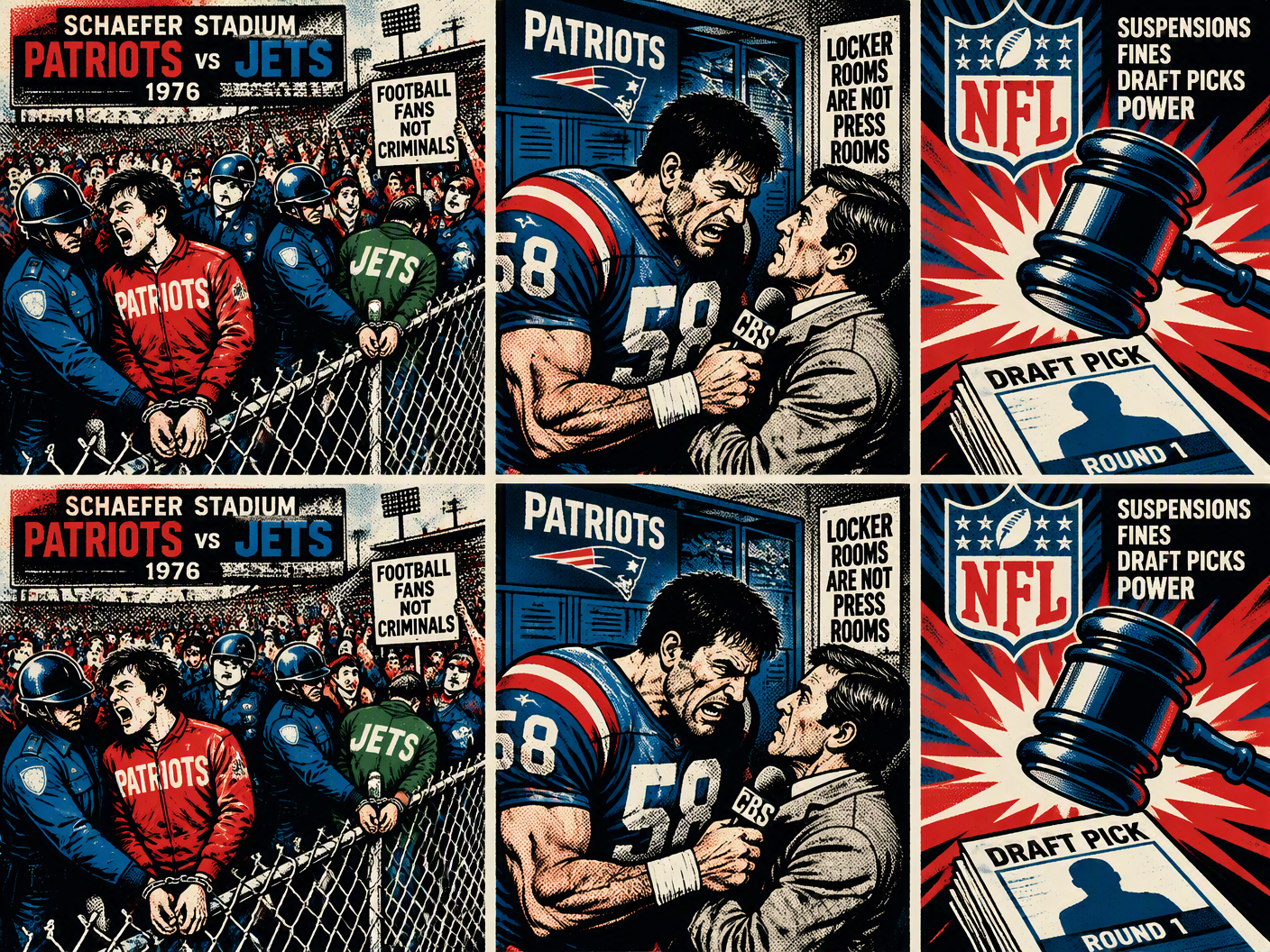
On October 18, 1976, local police made mass arrests during the Patriots-Jets Monday Night Football game at Schaefer Stadium in Foxborough. The crowd disorder created a custody problem that outlasted the available holding space. Officers cuffed some fans to a chain-link fence because no other space remained. A rivalry game had produced a police operation large enough to turn part of the stadium perimeter into temporary detention. The defining facts were physical and administrative: spectators were arrested, holding capacity failed, and the fence became the place where officers kept people in custody.
The operation turned spectator disorder into a question of control. Police were no longer dealing only with conduct in the stands; they had to manage the people already taken into custody and find a place to secure them. The chain-link fence was part of that solution. It marked an early form of rivalry escalation in which the consequences reached beyond the field and into the public infrastructure surrounding it. There was no league fine or disputed coaching decision attached to this episode. Its immediate authority belonged to local police, and its immediate cost was imposed on the fans they arrested.
On September 9, 1979, the conflict moved inside the Patriots’ working space. After New England won at Schaefer Stadium, Raymond Clayborn, a Patriots cornerback, and Will McDonough, a Boston Globe writer, became involved in a scuffle in a crowded locker room. The setting mattered. This was not a confrontation among anonymous spectators at the edge of the stadium; it involved a player and a journalist in the compressed area where athletes and media met after the game. The result had been decided, but the rivalry’s pressure continued into the room where access, reporting, and player authority intersected.
The 1976 episode had been managed through arrests and improvised restraint. The 1979 incident placed the confrontation among the people who carried the game into public view: an athlete and a reporter. Together, the episodes showed two different points of failure around the same contest. One required police intervention among spectators. The other produced a physical altercation after the players had left the field. Neither event depended on the final score to become consequential. The authority surrounding the game—police custody in one case, locker-room access in the other—became the site where the rivalry continued.
After the 1996 season, Bill Parcells resigned as Patriots head coach and later became the Jets’ head coach under an agreement brokered by the NFL. The league did not simply observe the transfer between its two franchises. It arranged compensation for Parcells’ move, turning a coaching departure into a negotiated transaction between New England and New York. The rivalry had entered a different jurisdiction. The decisive actors were no longer police officers or reporters but a head coach, two clubs, and the league office that controlled the terms under which one franchise could claim a prominent employee from the other.
Bill Belichick’s dispute with the Jets carried that struggle over control into federal court. After the Jets denied him permission to speak with other teams, Belichick filed an antitrust lawsuit against the NFL. The lawsuit made employment mobility part of the rivalry’s history. A coach’s next conversation could be treated as an issue governed by league power rather than ordinary hiring. The dispute did not arise from a tackle or a sideline exchange. It concerned who could authorize access to a coach and whether the league’s restrictions on that access could survive a challenge under federal antitrust law.
By January 2007, the contest over control had moved to information on the field. In a playoff meeting between the teams, the Jets accused the Patriots of filming defensive signals from an on-field location. League rules treated that conduct as a violation. The dispute centered on how one team observed and used the other team’s signals, not on a disputed collision or an ordinary tactical advantage. It placed the Patriots’ competitive methods under the authority of the league office, which had the power to convert an accusation into an administrative case and impose consequences on both the coach and the club.
After the Patriots-Jets game on September 9, 2007, the NFL imposed those consequences. The league fined Bill Belichick $500,000 and fined the Patriots $250,000. It also took away New England’s first-round pick in the 2008 draft. The penalty reached beyond the individual who had been fined. A draft choice represented a future player, a future contract, and a future season, so the sanction transferred the cost of the dispute into the club’s competitive planning. The league’s response was formal, measurable, and larger than the crowd-control incidents that had marked the rivalry’s earlier history.
On December 30, 2018, the Patriots defeated the Jets 38–3 at Gillette Stadium. The documented consequence of that regular-season finale was a scoreline rather than an arrest operation, a locker-room scuffle, or a league sanction. The game still belonged to the same rivalry, but the institutional conflict around it had changed shape. In 1976, police used a fence when custody space ran out. In 2007, the NFL removed a draft choice. In 2018, the contest was reduced to the arithmetic of a 35-point margin.
On October 21, 2019, the Jets lost another Monday-night game to New England, 33–0. Sam Darnold threw four interceptions and lost a fumble. Those turnovers supplied the game’s central measurable facts and exposed the quarterback to the full consequence of a one-sided contest, but they did not produce a new disciplinary finding. The rivalry’s documented sequence ended with the most basic form of football evidence: possession lost, points denied, and a final score that required no police response, courtroom filing, or league punishment to explain the result.
Investigative Dossier & Evidence
Read the companion investigation notes, verified source claims, and primary documents.
Read the Companion Notes & Evidence Record →