
Scandals & Feuds · 1970s
The Stamford Bridge Replay That Cost Alan Mullery £100
On 6 December 1976, Crystal Palace defeated Brighton & Hove Albion 1–0 in the second replay of an FA Cup tie that had already required two previous matches. The decisive penalty sequence was followed by Alan Mullery’s removal from the pitch by police and a Football Association fine for bringing the game into disrepute.
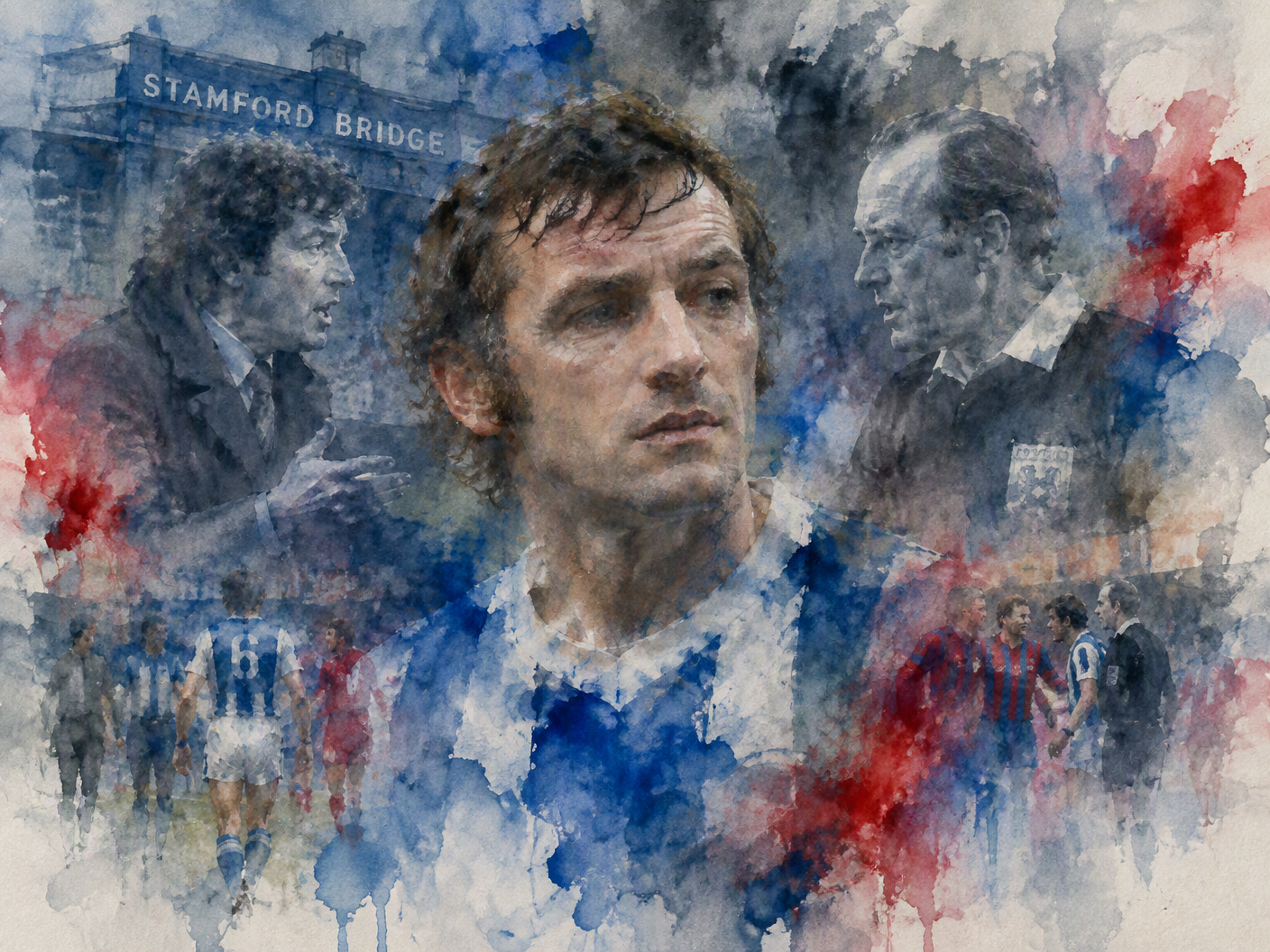
On 6 December 1976, at Stamford Bridge in London, the FA Cup tie between Brighton & Hove Albion and Crystal Palace ended with Alan Mullery being escorted from the pitch by police. Crystal Palace had won 1–0. Before the evening was over, the Brighton manager had addressed the referee after the final whistle and had also addressed Palace manager Terry Venables. The Football Association would fine Mullery £100 for bringing the game into disrepute. The match had been decided by a single goal, but its lasting consequence came after the score had stopped changing.
The tie had already resisted resolution twice. On 20 November, Brighton and Palace drew 2–2 at the Goldstone Ground. Three days later, at Selhurst Park, the first replay ended 1–1 after extra time. The competition required another match, and the clubs moved to Stamford Bridge for the second replay. In the rules and customs of the period, a cup tie could continue through repeated fixtures until one side prevailed. There was no aggregate score to settle the matter and no penalty shootout waiting at the end of an additional stalemate.
Mullery brought to the contest a history with both clubs. He managed Brighton in the tie after a playing career that had included England and Tottenham, and he had previously managed Crystal Palace. Venables stood in the opposite technical area as Palace’s manager. Their roles gave the replay a personal dimension, but the match itself was governed by the decisions made on the field: the referee’s whistle, the players’ actions, and the score that followed. The later legend of the fixture would attach itself to the managers. The immediate contest belonged to the two teams.
Palace took control of the scoreboard in the 18th minute. Phil Holder scored the opening goal, giving Crystal Palace a 1–0 lead that survived the remainder of the match. For Brighton, the deficit created the ordinary pressure of a knockout tie: one goal would restore equality, but every attack would also expose the side to the possibility of a second Palace goal. The match had reached its decisive phase without yet acquiring the disciplinary meaning that would follow it beyond the ground.
Brighton appeared to find that equalizer through Brian Horton’s penalty. The goal did not stand. Ron Challis, the referee, disallowed the kick for encroachment and ordered Horton to take it again. The ruling transformed one scoring opportunity into two separate acts governed by the same decision: first the apparent conversion, then the retake demanded by the official. The penalty had not been erased from the evening; it had been placed under a different condition, one that required Horton and Brighton to repeat the attempt.
Paul Hammond, Palace’s goalkeeper, saved the retaken penalty. Palace kept its lead, and the possibility that had opened for Brighton closed without a goal. The final score remained 1–0 to Crystal Palace. Challis’s decision on encroachment and Hammond’s save therefore occupied the narrow space between an apparent Brighton equalizer and Palace’s advancement. The match was not decided by a broad tactical pattern preserved in the scoreline. It turned on a goal by Holder, a penalty ruling, and the goalkeeper’s response when the penalty was taken again.
The final whistle ended the contest but not Mullery’s involvement in it. He addressed Challis after the match and was escorted off the pitch by police. He also addressed Venables. The documented sequence does not require an invented speech or a private explanation: Mullery’s conduct after the whistle became the subject of disciplinary action, and the police escort marked the point at which the football authorities’ concern moved from the result to the behavior surrounding it.
The Football Association fined Mullery £100 for bringing the game into disrepute. The sanction belonged to football’s administrative order rather than the criminal courts. It did not alter the result at Stamford Bridge: Crystal Palace remained the 1–0 winner, and the penalty sequence remained the match’s central sporting reversal. But the fine attached a formal consequence to the manager’s postmatch conduct, preserving the incident as something the governing body considered serious enough to punish after the players had left the field.
The careers of the two managers continued along paths that crossed the same rivalry. From 1982 to 1984, Mullery managed Crystal Palace. In the 1986–87 season, he returned as Brighton’s manager. Those appointments placed him in charge of each club at different points, turning the old opposition into part of his professional geography rather than a single night at Stamford Bridge. The later positions did not cancel the fine or remove the police escort from the account. They showed instead how football careers could carry a disputed episode forward while continuing to offer new institutional roles.
By 2005, Mullery was working at Crawley Town in a consultancy capacity. His duties included attending matches, attending training, and performing scouting work. The position belonged to a different stage of football administration from the one that had placed him on the Stamford Bridge touchline in 1976. The former England and Tottenham midfielder, former Palace manager, and returning Brighton manager had become an experienced football adviser. The later work did not reopen the replay; it situated the fined manager within a career that continued after the association’s punishment.
What endured from the second replay was a compact sequence with no need for embellishment. The first tie had ended 2–2; the first replay had ended 1–1 after extra time; the second replay ended 1–0 to Palace after Holder’s goal, Horton’s disallowed penalty, Challis’s retake, and Hammond’s save. Then Mullery was escorted away, and the FA imposed its £100 fine. Stamford Bridge preserved the result in its competition record. The disciplinary ruling preserved the boundary the governing body had drawn around conduct after the whistle.
Investigative Dossier & Evidence
Read the companion investigation notes, verified source claims, and primary documents.
Read the Companion Notes & Evidence Record →