
Violence & Brawls · 1820s
George Wombwell’s 1825 Warwick Lion-Baiting Exhibitions
In July 1825, George Wombwell staged two organized lion-baiting exhibitions at Warwick, first presenting Nero and then Wallace against six dogs. The named animals, the structure of the bouts, and the public outrage that followed survive in later historical accounts, though the exact sequence of attacks remains uncertain.
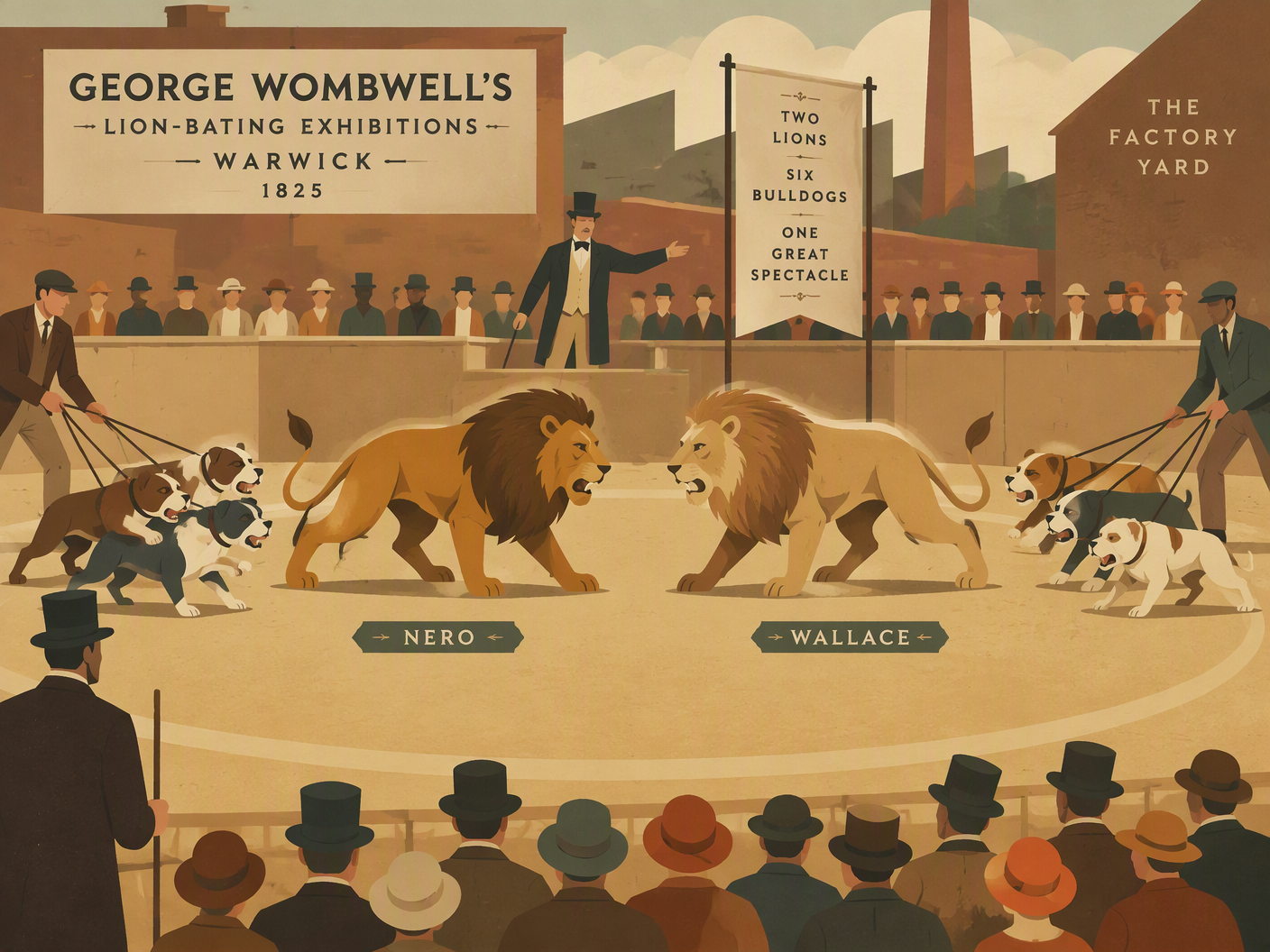
In July 1825, George Wombwell brought two lions into the Factory Yard at Warwick and presented them against dogs. The first was Nero. After that exhibition, Wombwell arranged another match with a second lion, Wallace. Six dogs were used in each spectacle. The events were organized demonstrations, not spontaneous encounters: animals were selected, handlers supplied them, and the public was given a sequence of contests in which a captive predator became the central object of entertainment.
Wombwell was a traveling menagerie promoter whose business depended on turning rare animals into public attractions. At Warwick, the lions were not displayed only behind barriers or in cages. They were placed in an arena of controlled violence, where dogs were sent toward them in arranged groups. Sam Wedgbury supplied dogs for the matches, while Bill George, known for handling and breeding bulldogs, attended the contests. Ben White also appears among the people associated with the exhibitions.
Nero came first. The Warwick exhibition placed six dogs against him in two groups, a structure that gave the encounter a measured progression rather than the disorder of an uncontrolled attack. The descriptions preserve the arrangement more clearly than every movement inside it. Nero did not continue fighting after the attacks described in the surviving accounts, and Wombwell then turned to Wallace for the second presentation.
Wallace was matched against six dogs. Later descriptions name the animals as Tinker, Ball, Billy, Sweep, Turpin, and Tiger, and place them within staged attacks at the Factory Yard. Their names survived because the exhibition was treated as an event with performers, not merely as the feeding or killing of animals. Each dog became part of the attraction’s vocabulary, while Wallace became its principal subject.
Wallace carried a biography that made him unusually valuable to a menagerie promoter. The accounts place his birth in Edinburgh in 1812 and identify him as the first African lion bred in England. Those details transformed him from an anonymous captive into a named animal with a history that could be displayed, repeated, and sold to an audience. At Warwick, that history ended in a public contest designed to make his body itself the attraction.
The use of named dogs and named lions also exposed the commercial structure beneath the spectacle. Wombwell supplied the venue and the lions. Wedgbury supplied dogs. George brought expertise associated with bulldogs, and the men around the exhibition helped convert animal handling into a public performance. The division of roles mattered: the contest required promoters, keepers, animals, and an audience willing to pay for controlled danger.
The precise choreography of the fights is less stable than the broad sequence. The sources overlap on the essential points: Nero appeared first, Wallace followed, and six dogs were used against Wallace. They vary in the order of individual attacks and in the finer disposition of the animals. That uncertainty does not erase the event. It identifies the boundary between what the Warwick exhibitions establish and what later retellings have supplied.
What changed after Warwick was not the existence of animal entertainment but the public meaning attached to it. Outrage followed the spectacles and reached Parliament. The exhibitions became associated with the closing phase of lion-baiting in the United Kingdom, as legislators and reformers confronted practices that had been presented as ordinary amusement. The reaction moved the event beyond Wombwell’s yard and into a national argument over what public entertainment could legally permit.
Later accounts connect the Warwick controversy to the closure of White’s establishment and to legislation that forbade animal fighting. They do not reduce the entire reform process to one bout or one promoter. The political response developed within a broader campaign against baiting, and the surviving descriptions preserve outrage more firmly than a single legal order linking every consequence directly to Warwick. Wombwell’s exhibitions nevertheless occupied a clear place in that transition.
Wallace outlived the July exhibition as a historical object. Later biographical treatment followed him beyond the Factory Yard, preserving his reported Edinburgh birth, his status as an English-bred African lion, and his eventual taxidermy display. The living animal was converted into a specimen that could be examined after the spectacle had ended. His second life in preservation extended the exhibition’s reach, carrying the name Wallace from a baiting yard into institutional memory.
The Warwick events therefore survive in two forms. They were July 1825 exhibitions in which Wombwell presented Nero and Wallace against six dogs, with handlers and promoters turning violence into a scheduled attraction. They were also a point at which public reaction entered political debate. The bouts’ exact movements have blurred, but their structure has not: a first lion, a second lion, repeated attacks, and an audience whose outrage helped make the practice harder to defend.
Investigative Dossier & Evidence
Read the companion investigation notes, verified source claims, and primary documents.
Read the Companion Notes & Evidence Record →