
Doping & Drugs · 2000s
The Failed Tests and Team Withdrawals That Broke the 2007 Tour de France
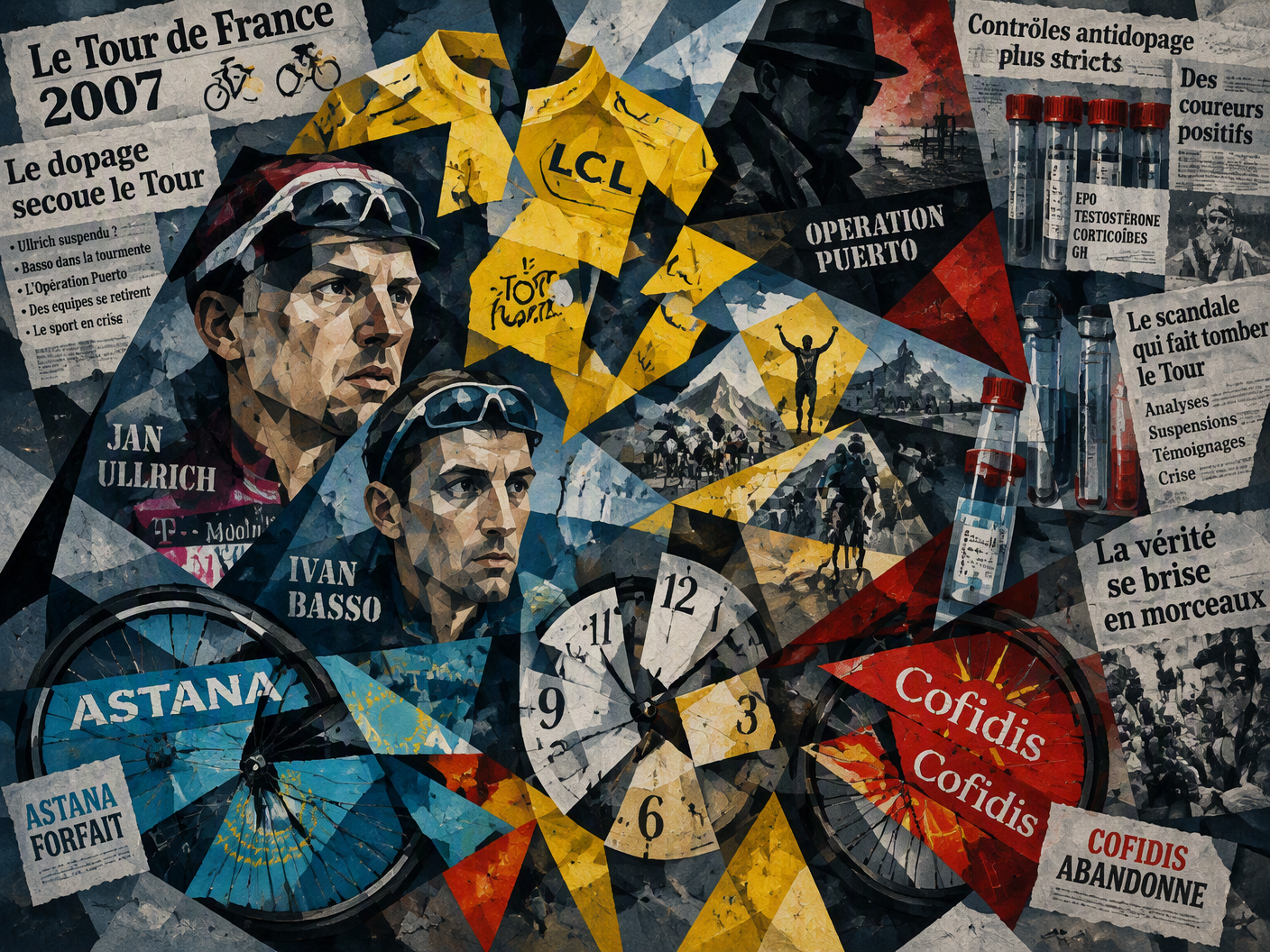
In July 2007, adverse doping tests forced Astana and Cofidis out of the Tour while Rabobank removed its yellow-jersey leader for whereabouts violations. The sequence exposed how quickly a race could be destabilized by laboratory findings, team discipline, and the loss of public trust.
Alexander Vinokourov won the time trial in Albi on July 21, 2007. Then his post-stage sample produced evidence of blood doping through transfusion. Vinokourov had entered the Tour as one of its leading favorites, and his victory appeared to restore his position after a difficult opening week. The test changed the meaning of the result. Astana suspended its leader and withdrew the entire team from the race. A laboratory finding had become a team-wide consequence before the Tour reached its final mountain stages.
Astana’s departure did not follow a court hearing or a criminal charge. It followed the team’s response to an adverse analytical result. The distinction shaped the public crisis. Cycling’s anti-doping system could remove a rider through testing and disciplinary procedures, while the team that employed him faced a choice about whether to remain in the event. Astana chose to leave. Its withdrawal erased every rider in the team from the Tour and made Vinokourov’s sample the central institutional event of the race.
The warning had arrived before the peloton reached Albi. On May 23, Alessandro Petacchi failed a salbutamol test at the Giro d’Italia. Team Milram suspended him, and the sprint specialist did not start the Tour de France. In June, Patrik Sinkewitz tested positive for elevated testosterone at a pre-Tour training camp in the Pyrenees. He later admitted using testosterone gel. By the time the Tour began, the enforcement system had already produced one prominent absence and one positive result inside a leading team.
Those earlier cases altered the terms of every later announcement. A failed test was no longer an isolated problem that a rider and team could contain privately. Petacchi’s absence removed a major sprint contender before the first Tour stage. Sinkewitz’s result placed T-Mobile under scrutiny before its riders had completed the opening week. The race carried its own prehistory: samples collected away from the finish line could still reach the event, its teams, and its television audience.
On July 25, Cristian Moreni failed a testosterone test after Stage 11. The Cofidis rider was led away by police after the stage. The response followed quickly. Cofidis withdrew from the Tour rather than continue with the team surrounding a rider whose result had become public. As with Astana, the consequence extended beyond the individual cyclist. One sample removed an entire organization from the competition and gave the race a second team withdrawal within four days.
Moreni’s case unfolded on the same day that Michael Rasmussen won Stage 16 while wearing the yellow jersey. Rasmussen’s victory should have strengthened his control of the race. Instead, Rabobank removed him after the team said he had lied about his whereabouts and missed required doping controls. His expulsion was not tied to a reported positive doping test. It came through a different route: team discipline applied to location information and control obligations.
The removal carried a specific visual and administrative consequence. Rasmussen did not defend the yellow jersey at the next stage because Rabobank had taken him out of the Tour. On July 26, the race began without a yellow-jersey wearer. The absence was not caused by a crash, a time penalty, or a rival’s attack. The leader had been removed by his own team after violations connected to the anti-doping whereabouts system.
Rasmussen’s case therefore sat beside the positive tests without being identical to them. Vinokourov and Moreni were linked to adverse test results that prompted their teams to leave the race. Rasmussen was pulled for lying about his location and missing controls. The difference mattered because the Tour’s crisis was assembled from several forms of enforcement: laboratory findings, team withdrawals, and an internal decision against the rider in yellow. They produced the same practical result—riders disappeared from the race—but through separate procedures.
The teams’ decisions transferred the immediate cost of doping enforcement from individual riders to the event itself. Astana lost its leader and every remaining competitor. Cofidis surrendered its place after Moreni’s result. Rabobank lost the rider leading the Tour and accepted the consequences of removing him at the point when his jersey carried the greatest sporting value. The rules did not merely punish conduct after the finish. They changed the composition of the race while it was still being contested.
The institutional damage reached beyond the start and finish areas. Two German television broadcasters stopped covering the Tour after the doping scandals broke. Their decision converted the crisis from a cycling disciplinary story into a broadcasting and commercial problem. The race had depended on the public accepting the results as credible. When teams withdrew, a leader vanished, and television partners abandoned coverage, the consequences were measured not only in suspensions and missing jerseys but in lost access to the audience that made the event valuable.
By July 26, the Tour’s central question was no longer only who would win. It was which riders and teams would still be present when the race reached its next stage. The sequence had begun with a salbutamol failure that kept Petacchi away, continued through Sinkewitz’s testosterone result, and accelerated after Vinokourov’s transfusion finding and Moreni’s testosterone test. Rasmussen’s removal added a separate breach of the whereabouts rules. Each decision narrowed the field and widened the institutional exposure.
The 2007 Tour did not collapse through one ruling. It was stripped piece by piece: a favored rider suspended, a team withdrawn, another rider taken into police custody after a stage, a second team removed, and the yellow jersey left vacant at the next start. Television broadcasters then cut away. The lasting consequence was visible in the race’s altered structure. Anti-doping enforcement had become impossible to separate from the event itself, because every test or disciplinary decision could determine who was allowed to continue.
Investigative Dossier & Evidence
Read the companion investigation notes, verified source claims, and primary documents.
Read the Companion Notes & Evidence Record →