
Tragedy · 2010s
Perro Aguayo Jr.’s In-Ring Death and the Ten-Bell Tribute
Perro Aguayo Jr. died after a freak accident during a tag team match for The Crash in Tijuana on March 20, 2015. The following night, Lucha Underground answered with a ten-bell salute, turning an in-ring death into an immediate public memorial.
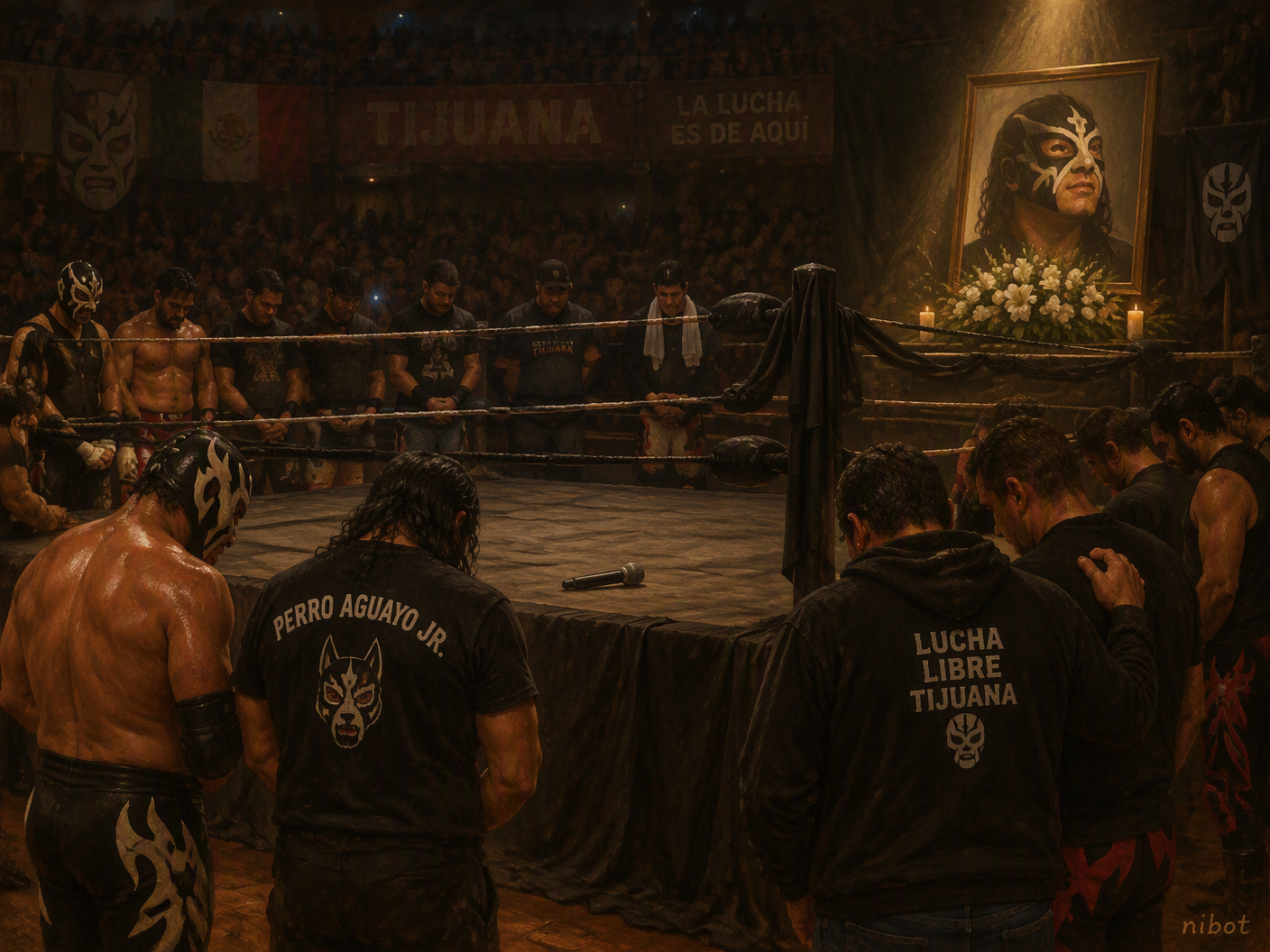
Perro Aguayo Jr. Died during a tag team match for The Crash in Tijuana on March 20, 2015. The event was described as a freak accident. Aguayo Jr. Collapsed during the bout, and the match became the setting of his death rather than the conclusion of a performance. Professional wrestling had no distance to place between the spectacle and the loss. The ring was both the workplace and the site of the fatal event. By the next night, another promotion had already chosen how to acknowledge what had happened.
On March 21, 2015, Lucha Underground opened its program with a ten-bell salute for Aguayo Jr. The tribute came immediately after his death, not months later when memory had settled into retrospective language. The promotion’s roster used a formal wrestling custom to mark the absence of a wrestler who had died in the ring. Ten bells gave the broadcast a fixed beginning and a public act of recognition. The ceremony did not reconstruct the accident. It identified the person lost and placed that loss before the audience.
That choice mattered because professional wrestling has an established vocabulary for death. A ten-bell salute is not an ordinary pause in a program; it is a ceremonial acknowledgment that a performer will not return to the ring. Its meaning depends on repetition, and on the shared understanding that the bells belong to memorial rather than competition. Lucha Underground used the form one night after Aguayo Jr.’s death. The gesture transferred the event from a local match in Tijuana into a communal statement across a separate wrestling production.
The sequence also exposed the narrow distance between wrestling’s commercial format and its human obligations. A program designed to continue week after week had to begin by stopping for someone who had died while performing. The roster did not answer with a storyline or a fictional explanation. It answered with a ritual whose purpose was direct: identify the dead, suspend the ordinary program, and allow the profession to acknowledge its own loss. The response was public, immediate, and controlled.
The record fixes the central event without supplying a complete medical reconstruction. Aguayo Jr. Died after a freak accident during the tag team match, but the public account does not provide a full cause-of-death analysis or a definitive ringside mechanism. That boundary matters when an in-ring collapse can invite speculation about responsibility. The documented facts support the fatal outcome and the description of the accident. They do not turn the episode into a detailed forensic explanation.
The legal response is equally limited in the documented sequence. No criminal charge, police finding, or court ruling appears in connection with Aguayo Jr.’s death. The immediate institutional response was therefore ceremonial rather than prosecutorial: a promotion acknowledged the death, while the captured public account contains no adjudicated finding assigning criminal responsibility. That absence does not explain the accident. It defines what followed in public view. The memorial was visible; a criminal case was not.
Later wrestling tributes show that the ten-bell salute remained an active professional custom. On January 15, 2018, WWE opened Raw with a ten-bell salute honoring Dr. Martin Luther King Jr. WWE described the ceremony as a traditional salute in his honor. The example placed the ritual beyond a single promotion or one kind of loss. It showed how a wrestling broadcast could use the bells to establish respect before returning to its scheduled business.
The custom continued after another wrestler’s death. On June 21, 2020, Stardom opened its program at Shin-Kiba 1st Ring in Tokyo with a ten-bell salute for Hana Kimura. Kimura’s death and Aguayo Jr.’s death were separated by more than five years and by different wrestling markets, yet the same ceremonial form connected their memorials. The practice gave promotions a recognizable public language for grief. It also allowed a roster to register a death collectively, without pretending that ordinary programming could proceed unchanged.
Aguayo Jr.’s tribute remains anchored to the unusual proximity between event and memorial. He died on March 20 during a match in Tijuana. Lucha Underground held its ten-bell salute on March 21. The interval was one night. That timing made the tribute an immediate institutional decision, not a later anniversary observance or a historical embellishment. The promotion had to decide how to begin its next program, and it began by naming the dead through a ritual the wrestling industry already understood.
The final documented consequence is therefore not a finding about culpability but a record of recognition. Aguayo Jr.’s death occurred inside a tag team match for The Crash, after a freak accident, and the next night Lucha Underground marked him with ten bells. The later ceremonies for Martin Luther King Jr. And Hana Kimura confirm the salute’s continuing use, but they do not alter the facts of Tijuana. What remains is a fatal in-ring event followed almost immediately by a formal public memorial.
Investigative Dossier & Evidence
Read the companion investigation notes, verified source claims, and primary documents.
Read the Companion Notes & Evidence Record →