
Doping & Drugs · 1980s
Petra Schneider’s Olympic Gold and the Records She Asked to Erase
Petra Schneider won Olympic gold, silver, and five world records inside East Germany’s state-sponsored doping system. In 2005, after admitting her participation, she called for her remaining 400-meter individual medley record to be expunged.
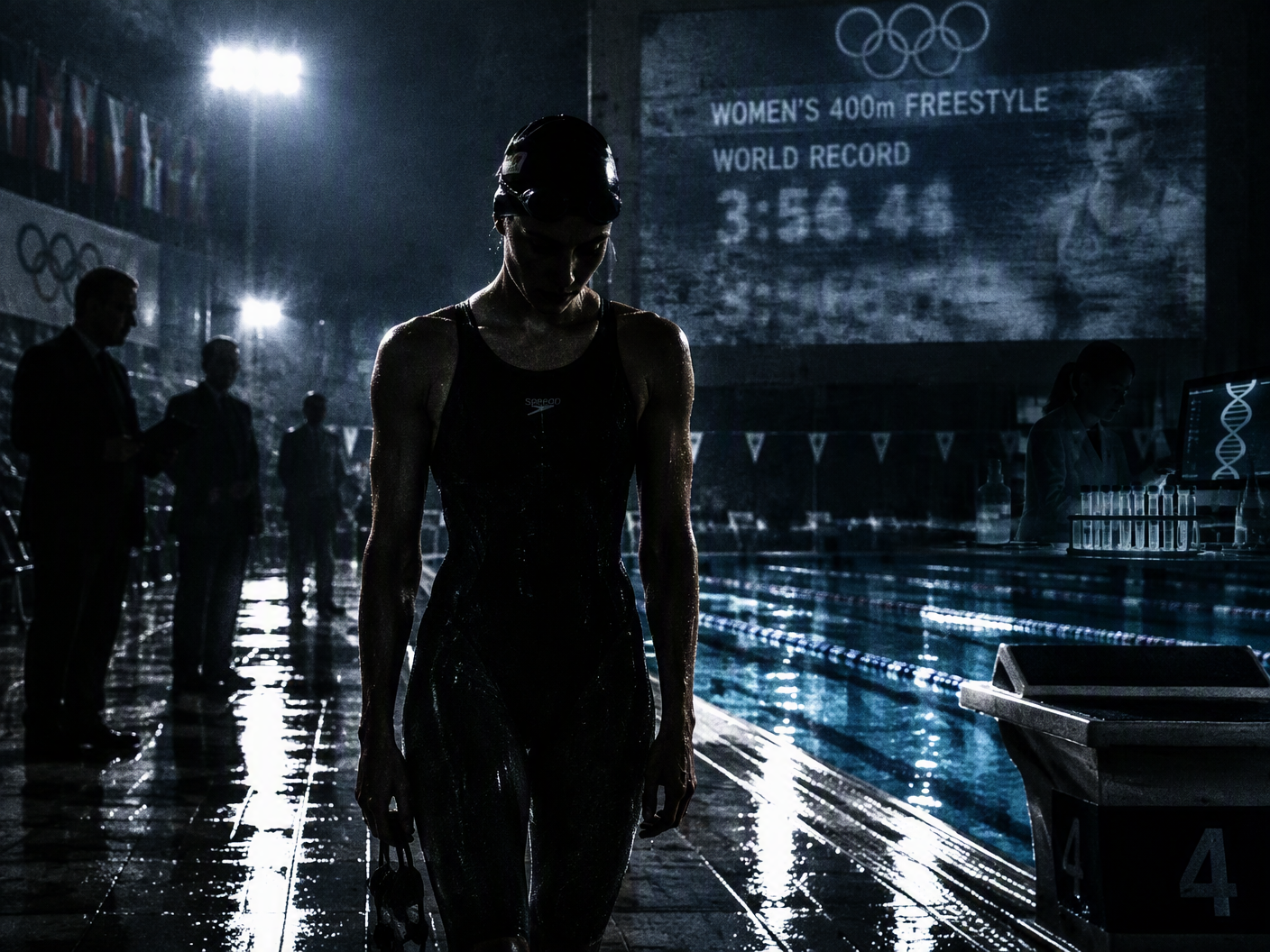
East Germany presented athletic excellence as a civic virtue, a national duty, and presumably a matter best managed by men in gray suits with access to laboratories. On July 26, 1980, Petra Schneider won the women’s 400-meter individual medley at the Moscow Olympics, collecting gold for a country that treated the medal table as a quarterly performance review. She also won silver at those Games. Across her career, Schneider became one of swimming’s prominent figures, setting five world records while the state’s sporting machinery polished its public image with the efficiency of a ministry issuing stationery.
The Moscow pool offered a clean stage for a dirty arrangement. The United States had boycotted the 1980 Olympics, altering the competitive landscape in the events Schneider entered. The missing American swimmers were not a footnote in the water; their absence changed who stood on the blocks, who faced the stopwatch, and who left with medals. Schneider still had to swim the races, and she did so with the disciplined violence demanded by elite competition. But the field had been rearranged before the first official took his seat and before the first stopwatch began its small bureaucratic sermon.
East Germany’s sporting system did not rely on inspiration alone. Its authorities built a systematic doping program into the country’s athletic structure, binding medals to research, training, pharmaceuticals, and the political prestige of the state. The arrangement converted young bodies into national instruments and then displayed the results beneath flags, anthems, and carefully laundered language about scientific preparation. The athlete supplied the lungs, muscles, discipline, and risk. The government supplied the machinery. The public received triumph, while the costs were carried inside competitors whose bodies had become another state asset.
Schneider participated in that program. Her later admission stripped away the pleasant fiction that the records had emerged from swimming talent untouched by institutional chemistry. She had been a champion, but she had also been placed inside a system in which performance enhancement was not an individual midnight experiment conducted behind a gymnasium; it was part of the organized athletic apparatus. The distinction mattered to the people who had built the program, because responsibility could be diluted across coaches, doctors, laboratories, officials, and patriotic slogans until the only visible culprit appeared to be the athlete standing beside the pool.
The numbers, naturally, behaved better than the people. Schneider set five world records during her career, each one offering the sort of clean, glittering evidence that administrators adore: a time, a ranking, a line in a program, a cheap commemorative trophy waiting somewhere under a layer of dust. Records are useful because they do not ask who supplied the tablets, who signed the forms, or which authority decided that an adolescent swimmer’s health was an acceptable expense. They simply announce that one body moved faster than other bodies, and leave the paperwork to the less photogenic department.
For the swimmers who lost to Schneider, the arrangement was not an abstraction about national systems. Sharron Davies, an Olympic competitor, later described the effect Schneider’s doping had on her own medal chances. A silver medal can be held in one hand, weighed, polished, and placed in a display case; the missing opportunity attached to it has no official shape. It does not receive a ribbon. It does not appear in the opening ceremony footage. The machinery could manufacture medals with great precision, but it could not manufacture an honest account of whom those medals displaced.
Schneider’s Olympic success and world records therefore acquired a second life after the political machinery around them had begun to look less indestructible. The athlete once presented as proof of national superiority became evidence of how thoroughly a government could absorb sport into its own administrative appetite. The pool remained the same in principle: lanes, water, officials, time. What changed was the meaning of the stopwatch. It no longer measured only training and talent. It also measured the reach of a system willing to turn pharmacology into policy and policy into medals.
In 2005, Schneider publicly stated that her last remaining record, set in the 400-meter individual medley, should be expunged because doping had aided it. This was an unusual form of athletic housekeeping: the record holder asking the institution to remove her own name from the wall. The gesture did not restore every race altered by the program, nor could it return an unentered competitor to a podium. It did something narrower and more exact. Schneider refused to preserve a performance whose official dignity depended on pretending that its chemical assistance had never existed.
That request also exposed the peculiar afterlife of records. A world-best time is treated as permanent property, even when the conditions that produced it have been discredited. Officials can repaint a pool, revise a rulebook, or install a newer electronic board, but the old number continues to circulate because institutions prefer durable figures to uncomfortable explanations. Schneider’s admission made the record less convenient. Her call for expungement made it more inconvenient still. The stopwatch had delivered its verdict decades earlier; in 2005, the swimmer asked that the court reopen the file.
The Schneider case remains part of the modern argument over doping because the central question has outlived the Cold War machinery that produced it: what does athlete integrity mean when a competitor’s choices are shaped by coaches, physicians, officials, and a state that rewards results while distributing the danger downward? Modern sport has supplied newer substances, newer laboratories, and newer public-relations vocabulary. The basic bargain remains recognizable. Institutions praise clean competition in polished conference rooms, then discover that enforcement is expensive, reputations are valuable, and a chemically improved stopwatch is wonderfully silent.
Schneider’s story does not require a cartoon villain in a tracksuit. The system was more efficient than that. It needed ambitious officials, obedient structures, scientific expertise, medals, and athletes trained to understand national success as personal obligation. It also needed audiences willing to admire the result before asking about the process. Schneider won gold and silver at Moscow, set five world records, admitted her participation in state-sponsored doping, and later asked that her final record be removed. Those facts leave behind no clean podium, only a polished one—and the fingerprints beneath it.
Investigative Dossier & Evidence
Read the companion investigation notes, verified source claims, and primary documents.
Read the Companion Notes & Evidence Record →