
Scandals & Feuds · 1890s
The Professionalism Dispute That Suspended the Andover-Exeter Rivalry
On November 11, 1893, Exeter defeated Andover 26-10 with the 27-year-old professional athlete William F. “Pooch” Donovan on its side. The ensuing vote by Andover’s student body suspended future competition and interrupted one of the schools’ defining football rivalries until 1896.
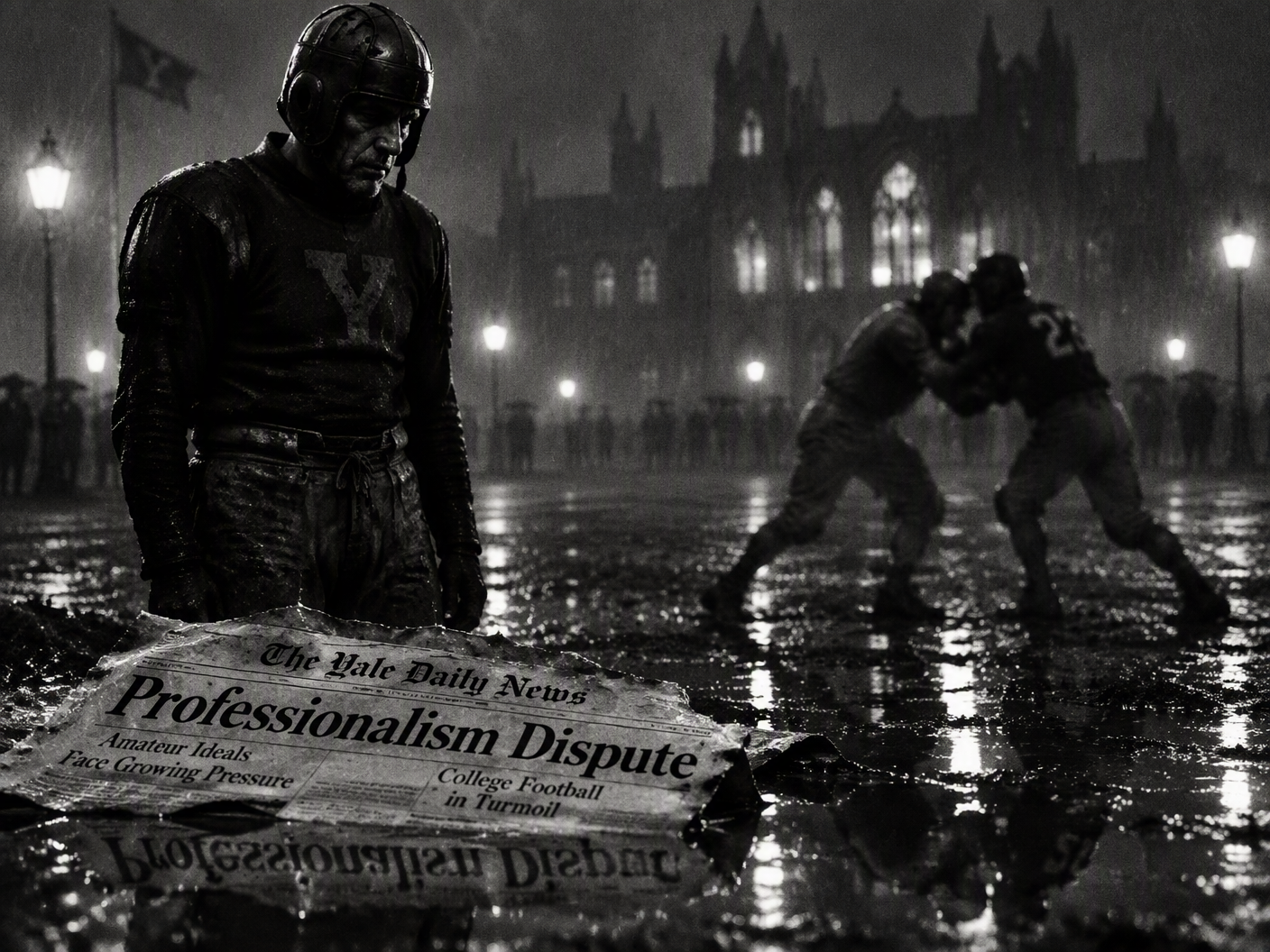
The vote came after the game, but the decision began on Exeter’s home gridiron. On November 11, 1893, Phillips Exeter Academy defeated Phillips Academy of Andover, 26-10, in a contest that placed William F. “Pooch” Donovan at the center of an eligibility dispute. Andover’s student body responded by suspending future athletic competitions with Exeter. The punishment was not a fine, a lawsuit, or an order from an outside authority. It was a campus decision that removed the rivalry from the schedule.
Donovan’s presence supplied the disputed fact. He was not presented simply as another schoolboy on an adolescent football team. He was 27 years old when he played for Exeter, and he had recently been coaching track at Worcester Academy. The age and professional background transformed the question from ordinary eligibility friction into a direct challenge to the amateur status the schools claimed to protect. Exeter had won the game. Andover’s students then judged the conditions under which that victory had been secured.
The score fixed the immediate sporting result, but it did not settle the question that followed. Exeter had beaten Andover by sixteen points, and Donovan had taken part in the winning side. The controversy concerned whether a professional athlete belonged in a contest between two preparatory schools. In that setting, the identity of the player mattered as much as the result. A game governed by amateur expectations could be altered by one participant whose age, employment, and coaching experience placed him outside the ordinary student category.
The dispute also had a prior history. In 1889, an Andover-Exeter football game was canceled after accusations involving paid athletes and eligibility. The earlier conflict established the terms of the later one: who could play, what counted as compensation, and whether a school could claim the advantages of professionalism while presenting the contest as school athletics. By 1893, the rivalry was not encountering amateurism for the first time. It was returning to a question that had already interrupted competition once.
Edward Coy, serving as Andover’s acting principal, had already drawn a formal boundary after the 1889 incident. He wrote to Walter Scott, the principal at Exeter, and declared athletic contests between the schools at an end. That letter gave the earlier dispute an institutional form. It was no longer only an argument among players, coaches, or students. A school official had used his office to terminate the relationship, placing eligibility and professionalism above the continuation of the schedule.
The 1893 episode reopened that boundary through Donovan. His recent work coaching track at Worcester Academy made him legible as a professional athlete, while his age made the mismatch impossible to overlook. The issue was not merely whether he had scored, blocked, or influenced a particular play. It was whether Exeter could field him against Andover and still treat the game as a contest between student bodies. The documented response at Andover treated the answer as unacceptable.
Andover’s students supplied the decisive authority. After the revelations surrounding Donovan, they voted to suspend future competitions with Exeter. That choice converted an eligibility controversy into a policy. The students did not seek to preserve the rivalry while isolating one disputed participant; they halted the future contests themselves. The consequence reached beyond Donovan’s appearance on November 11. It assigned the cost of the disagreement to the entire athletic relationship between the two academies.
The form of the response mattered. The suspension did not emerge from a criminal proceeding or a court judgment. It came through the student body, the constituency that gave the rivalry its immediate social force. A vote could not determine every question about Donovan’s status, but it could determine whether Andover would continue sending teams to play Exeter. The students possessed the authority to stop the fixture, and they used it after the 1893 game rather than allowing the result to close the dispute.
The break lasted three years. Andover and Exeter did not resume football competition in 1894 or 1895. The suspension remained in place until 1896, turning a single player’s disputed eligibility into a measurable interruption of the rivalry. That interval distinguished the episode from a routine protest or a temporary argument over scheduling. Competition between the schools stopped, and the absence itself became the consequence attached to the professionalism controversy.
When football returned in 1896, the rivalry resumed on the Andover gridiron. The restoration of play ended the suspension, but it did not erase the sequence that had produced it: the canceled 1889 game, the earlier dispute over paid athletes, Donovan’s participation in Exeter’s 1893 victory, and the student vote that followed. Resumption showed that the separation was temporary. It did not turn the earlier argument into a settled rule or produce a formal ruling assigning exclusive blame.
The controversy survives because the schools’ athletic relationship exposed a conflict that football could not resolve on its own. Exeter’s 26-10 victory was final on the field. Donovan’s age and professional background made the conditions of that victory contestable beyond it. Andover answered through institutional withdrawal, first in 1889 through its acting principal and again in 1893 through its student body. By 1896, the teams were playing once more, but the three-year absence remained the clearest measure of what the dispute had cost.
Investigative Dossier & Evidence
Read the companion investigation notes, verified source claims, and primary documents.
Read the Companion Notes & Evidence Record →