
Bizarre & Myths · 2025
The Penalty Save That Sent Queen’s Park Past Rangers at Ibrox
On 9 February 2025, Queen’s Park defeated Rangers 1-0 in the Scottish Cup fifth round at Ibrox. Seb Drozd scored in the 69th minute, and goalkeeper Calum Ferrie preserved the result by saving James Tavernier’s stoppage-time penalty.
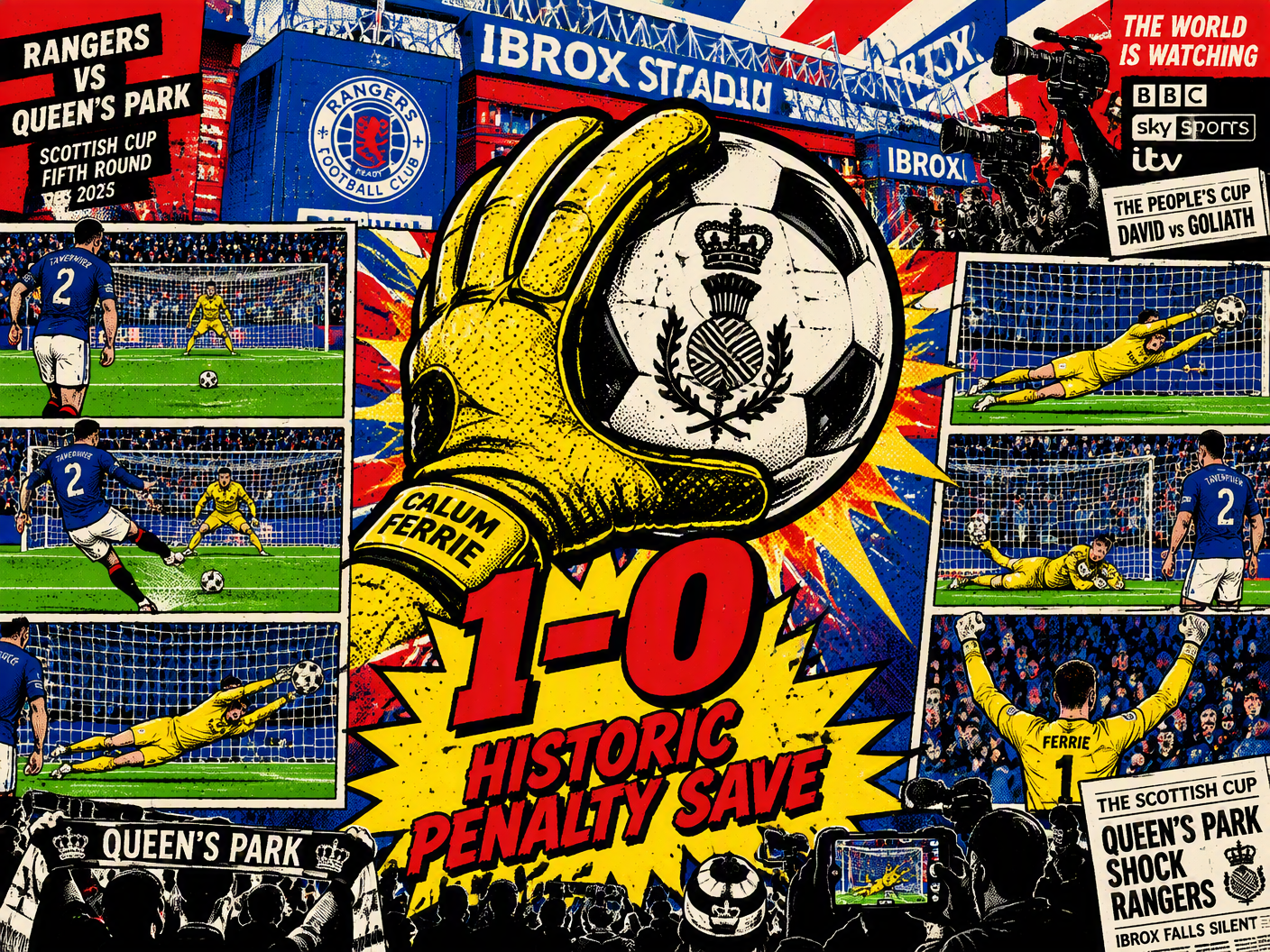
On 9 February 2025 at Ibrox Stadium in Glasgow, Calum Ferrie stood between Rangers and the equalizer that could have rescued their Scottish Cup campaign. James Tavernier, Rangers’ captain, took the stoppage-time penalty. Ferrie saved it. Queen’s Park kept its 1-0 lead, and the fifth-round tie ended with the lower-league club moving into the quarter-final draw while Rangers left the competition. The decisive passage lasted only moments, but it gave the match its permanent shape: one substitute’s goal, one goalkeeper’s save, and no reply from the club expected to control the occasion.
The fixture had been arranged as a meeting between Rangers, one of Scotland’s most powerful football institutions, and Queen’s Park, the lower-league visitors. Ibrox was the venue, and the Scottish Cup supplied the particular pressure: a single defeat ended the campaign. Queen’s Park manager Callum Davidson watched from the main stand while serving a suspension, separated from the technical area where a manager normally directs substitutions and defensive instructions. The club therefore entered the tie with its manager removed from the touchline, though not from the contest.
The imbalance was measured not only in league status but in expectation. Rangers were supposed to advance at home; Queen’s Park had to survive the afternoon without allowing that assumption to become a goal. The eventual result carried an older Scottish Cup comparison with it. Rangers had not been eliminated from the competition by lower-league opposition since the 1966–67 season. That interval placed the defeat in a long institutional sequence, connecting a single afternoon at Ibrox to a rarity that had outlasted several generations of players and managers.
For much of the tie, the score remained level. That fact mattered because the Scottish Cup does not reward control that fails to produce a goal. Each passing minute preserved Queen’s Park’s opportunity and increased the consequence of the next decisive action. Rangers could continue as the stronger club in status and resources, but the scoreboard recognized only what had entered the net. Davidson’s side remained within reach of the result it needed; Rangers remained vulnerable to the single moment that would turn pressure into a reckoning.
That moment came in the 69th minute. Seb Drozd, a substitute forward for Queen’s Park, scored the only goal of the match. His intervention altered the terms of the afternoon immediately. Queen’s Park no longer needed to find a breakthrough; it needed to protect one. Rangers, now behind at Ibrox, had to recover the tie before the final whistle. The goal was not part of a long scoring exchange or a sequence of equal responses. It stood alone, giving Drozd the match’s only entry on the scoresheet and Queen’s Park the lead that mattered.
After Drozd’s goal, the contest became a test of whether Rangers could convert urgency into an equalizer. Queen’s Park’s advantage was narrow but sufficient, and every attacking move carried the possibility of either restoration or exposure. The visitors were no longer playing for a respectable performance at a major ground. They were defending the route to the quarter-final draw. Rangers, meanwhile, were playing against the arithmetic of elimination: one goal would reopen the tie, while failure would remove them from a competition they had entered as the stronger side.
The late penalty gave Tavernier the clearest available route back. As captain, he took responsibility for the kick that could have changed the result. Ferrie saved it in stoppage time. The goalkeeper’s intervention preserved the one-goal margin and denied Rangers the equalizer at the last significant opening. Tavernier’s penalty became the match’s second defining action, but it did not erase Drozd’s contribution. The save mattered because the goal had created the possibility of victory; without Ferrie’s stop, that possibility would have ended before the final whistle.
When the match ended, Queen’s Park had defeated Rangers 1-0 at Ibrox. The scoreline was exact in the way cup results often are: one goal separated the clubs, and the saved penalty prevented the margin from disappearing. Queen’s Park advanced to the Scottish Cup quarter-final draw. Rangers were eliminated by lower-league opposition, carrying out of the stadium not a disputed score or a prolonged series of reversals, but the simple consequence of failing to score while Drozd’s goal and Ferrie’s save held.
The immediate institutional response came from Philippe Clement, Rangers’ manager. He described the result as “unacceptable” and said he did not expect to step down. His remarks placed the defeat inside the ordinary structure of football accountability: a manager questioned after a cup exit, and a club required to explain a result that its hierarchy had not planned to absorb. The statement did not alter the score or restore Rangers to the draw. It marked the boundary between the match itself and the consequences that followed inside the club.
Davidson’s position at the main stand and Clement’s post-match response framed two different forms of managerial presence. One manager had been suspended from the touchline before kickoff; the other faced questions after his team had been removed from the tournament. Between them stood a match settled by a substitute’s goal and a goalkeeper’s penalty save. The result did not require a wider theory to explain it. Queen’s Park scored once, Rangers did not score, and the decisive late opportunity was stopped.
The afterlife of the tie was therefore carried in the competition’s structure. Queen’s Park entered the quarter-final draw; Rangers’ Scottish Cup route ended at Ibrox. The club’s elimination by lower-league opposition joined the defeat to the earlier 1966–67 benchmark, when Rangers had last suffered the same kind of exit. In the public record of 9 February 2025, the enduring objects are modest and conclusive: Drozd’s goal in the 69th minute, Ferrie’s stoppage-time save, and the 1-0 result that moved Queen’s Park onward.
Investigative Dossier & Evidence
Read the companion investigation notes, verified source claims, and primary documents.
Read the Companion Notes & Evidence Record →