
Doping & Drugs · 2010s
Roger Clemens, Brian McNamee, and the Testimony That Became a Federal Case
Roger Clemens was named in the Mitchell Report, denied using steroids and human growth hormone, and faced six federal felony counts after giving sworn testimony to Congress. The case ended with his acquittal in 2012, leaving the drug allegations contested rather than judicially established.
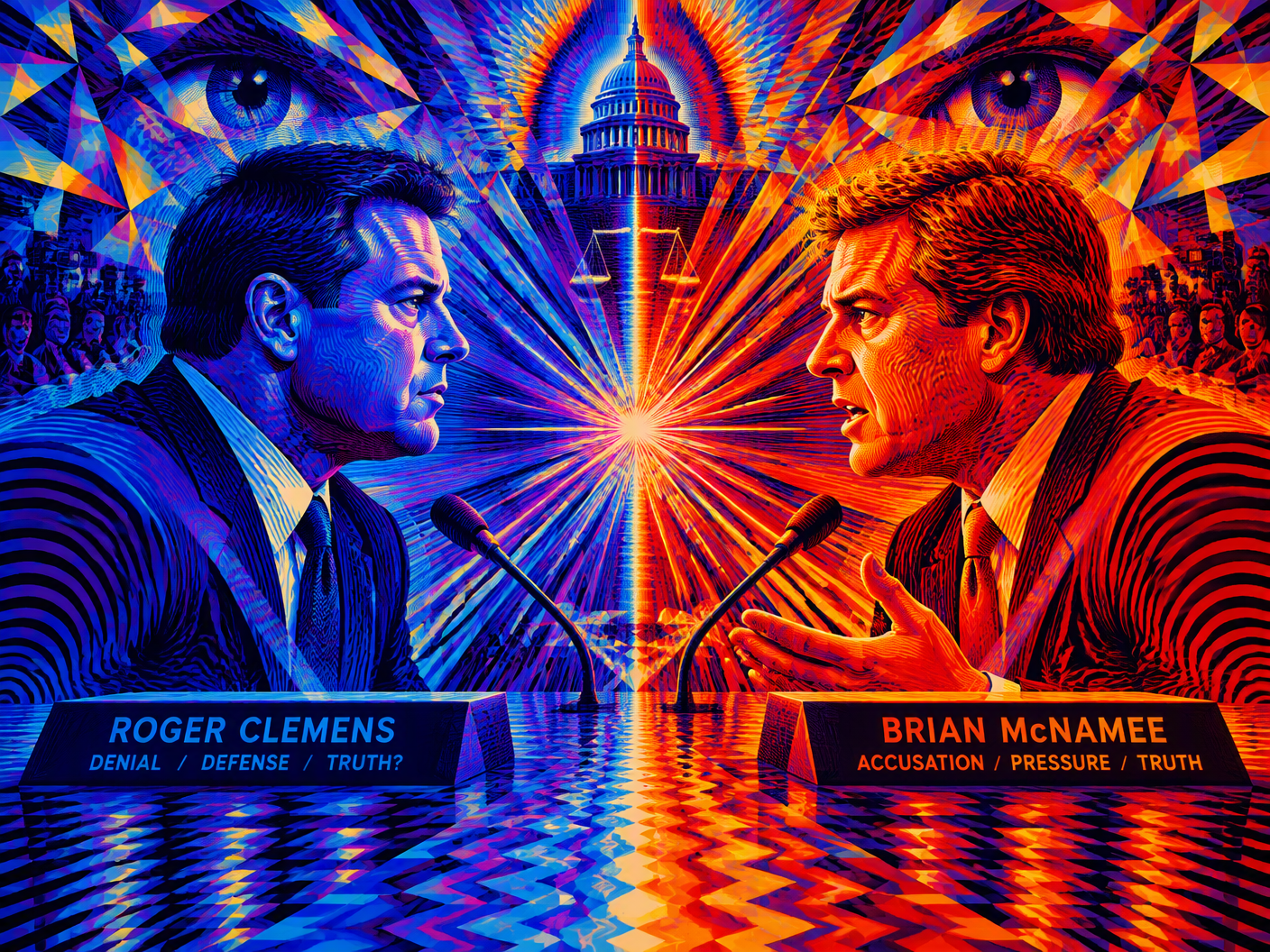
The accusation arrived in a government report and followed Roger Clemens into a hearing room. On December 13, 2007, George J. Mitchell released the product of a 20-month investigation into performance-enhancing drugs in Major League Baseball. Clemens’s name was in it. Brian McNamee, his former personal trainer and baseball strength coach, had told Mitchell’s investigators that he supplied Clemens with steroids and human growth hormone. Clemens denied using either substance. The pitcher who had built his public life around command and durability now had to answer for needles, syringes, and a trainer’s account.
McNamee was not a distant accuser. He had worked around Clemens’s training and had occupied the practical space where an athlete’s private habits meet the public body: the weight room, the treatment table, the regimen nobody in the stands can see. His account placed Clemens inside the drug story that had already spread through baseball. Clemens answered through denial and legal resistance. The dispute did not remain in the clubhouse or in the pages of baseball debate. It moved toward Congress, where the two men would give their accounts under oath.
On February 13, 2008, Clemens and McNamee appeared before the House Committee on Oversight and Government Reform. They sat under oath and gave opposing accounts of the same private relationship. McNamee said Clemens had used steroids and human growth hormone. Clemens said he had never used them. The hearing fixed the conflict in official testimony. One man described injections and drug use; the other rejected the entire account. The disagreement was no longer a matter of a trainer’s memory against a pitcher’s reputation. Each version now carried the weight and risk of sworn words before federal lawmakers.
Congress had not gathered merely to settle a quarrel between a pitcher and his trainer. Baseball’s drug scandal had become a public question, and Clemens’s testimony placed his own conduct beside the larger inquiry. The hearing gave McNamee a platform and gave Clemens a formal place to deny the allegations. It also created a second question, one that would outlast the hearing itself: whether Clemens’s statements to Congress were true. The alleged steroid use remained the subject that brought him there. His testimony became the subject prosecutors would later pursue.
For Clemens, the difference mattered. A drug allegation attacks the story built around an athlete’s body and achievement. A perjury case attacks the words used to defend that story. The first question concerned what happened in private between a pitcher and a trainer. The second concerned what Clemens said in a public room while lawmakers listened. That shift did not resolve the original dispute. It changed the arena in which the dispute would be fought, from baseball’s drug investigation to a federal criminal case over testimony.
On August 19, 2010, a federal grand jury in Washington, D.C., indicted Clemens on six felony counts. The charges included obstruction of Congress, making false statements, and perjury. The indictment did not function as a finding that Clemens had used steroids or human growth hormone. It placed his congressional testimony at the center of the prosecution. The government’s case now turned on whether he had lied, obstructed, or made false statements while answering questions about the allegations. The report had named him. The hearing had recorded the conflict. The indictment gave that conflict a criminal docket.
McNamee remained tied to the case because his testimony supplied the opposing account. His statements had helped carry the allegations from the Mitchell investigation to Congress, and from Congress toward the indictment. Clemens remained the defendant, not a convicted user of performance-enhancing drugs. The legal focus was narrower than the public argument that had surrounded him. Prosecutors had to prove criminally false testimony, not simply persuade baseball audiences that one man was more credible than the other.
The trial came in June 2012 in the United States District Court for the District of Columbia. Clemens faced all six counts. The prosecution’s theory rested on the statements he had made before the House committee and on the conflict between those statements and McNamee’s account. The courtroom therefore carried two histories at once: the long baseball argument over drugs and the precise criminal question raised by sworn testimony. The public could still debate the allegations. The jury had to decide whether the government had proved the charged offenses.
The verdict came later that month. Clemens was found not guilty on all six counts. The acquittal ended the federal perjury-related prosecution without a conviction for obstruction of Congress, false statements, or perjury. It also left the original drug allegations where they had stood after the hearing: asserted by McNamee, denied by Clemens, and not established as fact by the criminal verdict. The government had brought the case to trial. The jury did not return the result prosecutors sought.
What remained was a chain of public events with no single verdict binding them together. Mitchell’s report named Clemens. McNamee accused him of supplying and using steroids and human growth hormone. Clemens denied ever using them before Congress. The hearing became the basis for six felony charges, and the charges ended in acquittal. The pitcher’s name stayed attached to the allegations, but the courtroom did not convert them into a proven drug-use finding. In the end, the most durable object was not a conviction. It was the sworn contradiction between two men who had once worked in the same orbit.
Investigative Dossier & Evidence
Read the companion investigation notes, verified source claims, and primary documents.
Read the Companion Notes & Evidence Record →