
Violence & Brawls · 2009
The Pub Brawl, the Corner Flag, and the Bans That Followed the East Midlands Derby
Two separate episodes defined the 2009 Derby County–Nottingham Forest rivalry: a January pub clash that produced twelve criminal convictions, and an August post-match scuffle that brought Football Association charges against both clubs and Forest striker Nathan Tyson. The consequences reached from Derby Crown Court to a decade-long football banning order.
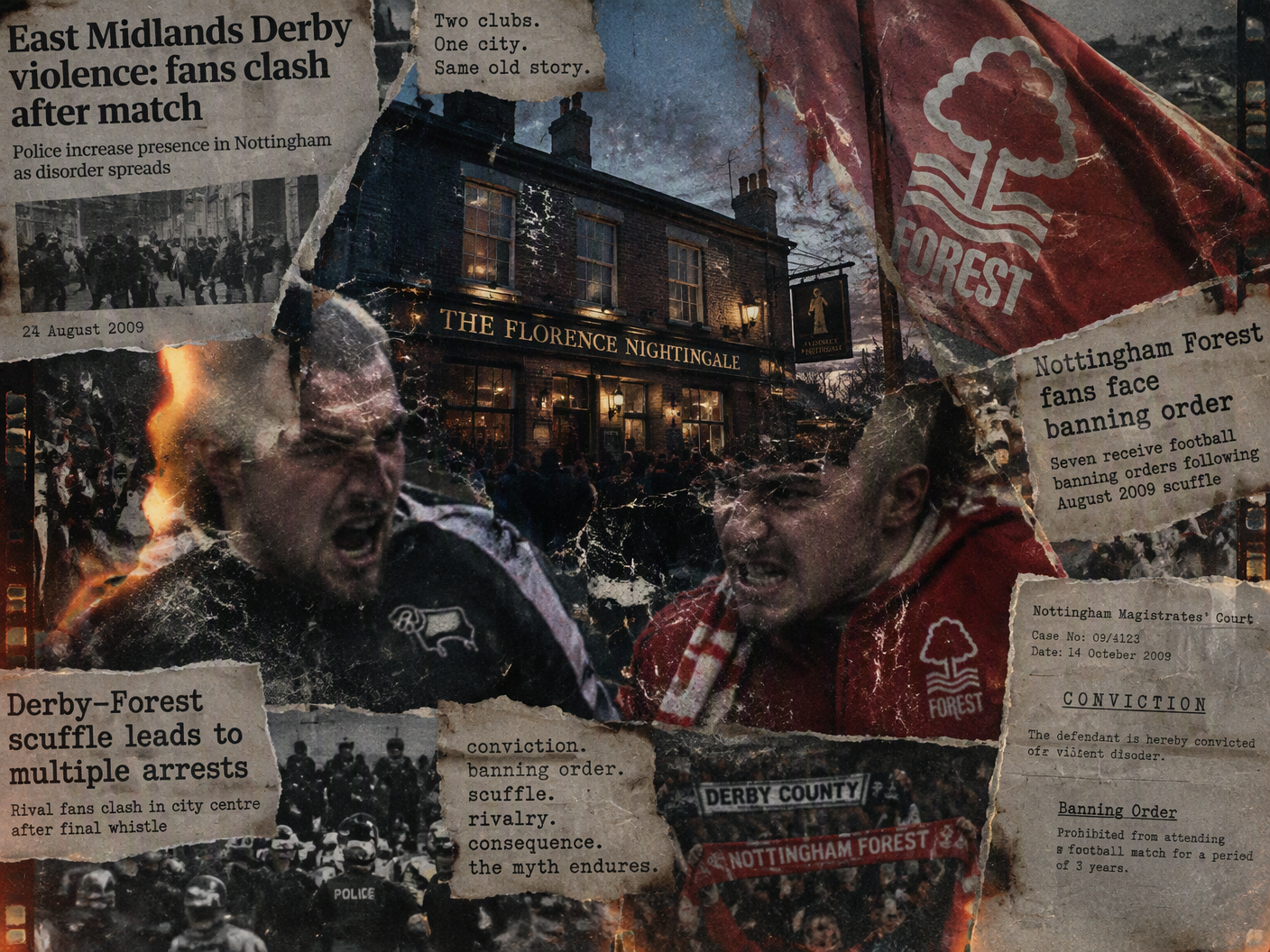
On 23 January 2009, Derby County and Nottingham Forest supporters clashed inside the Florence Nightingale public house in Derby. The violence did not remain confined to the pub. Forest fans threw two sheep’s heads at Derbyshire pubs, turning a football rivalry into a sequence of assaults and acts of intimidation that would later be tested in court. The match itself was over. The legal consequences were not.
Ian Innes emerged from the January incident as the principal defendant in the later Derby Crown Court case. He was identified as having led the attack on Forest fans. Stephen Innes, another Derby supporter, was convicted for taking part. Their cases placed individual conduct inside a wider confrontation involving supporters from both clubs, rather than reducing the violence to a single act by a single man.
The court reached its verdicts on 29 March 2010. Six Forest fans and six Derby fans were found guilty of offences linked to the pub violence. The division mattered: criminal responsibility extended across both supporter groups, while the sentences attached consequences to named defendants. The January clash had begun as a confrontation among rival fans. It ended as a twelve-person criminal case.
Ian Innes received a 20-month prison sentence and a ten-year ban from football matches in England and Wales. Stephen Innes received one year in prison and a six-year nationwide banning order. The orders did more than remove the men from a particular ground. They restricted their access to football across the country, converting a match-related conviction into a prolonged prohibition on attending the sport.
The trial judge described Ian Innes as a “thorough and utter disgrace.” The phrase accompanied a measurable punishment: prison and a decade away from football. It also fixed the court’s response to the violence in terms that could not be absorbed into rivalry folklore. The defendants were not being sanctioned for an offensive chant or an aggressive celebration. They were being sentenced for criminal offences arising from a pub attack.
Seven months before those convictions, another Derby–Forest confrontation had moved from the terraces into the disciplinary jurisdiction of the Football Association. On 29 August 2009, Forest defeated Derby 3–2 at Pride Park Stadium. After the final whistle, Forest striker Nathan Tyson waved a Forest-branded corner flag in front of Derby supporters. A post-match scuffle followed.
Tyson’s gesture became the immediate disciplinary focus. The celebration placed a club symbol directly before opposing supporters after an away victory, and the situation deteriorated into a confrontation involving players and officials. Billy Davies, Forest’s manager, later gave a post-match account denying knowledge of the incident. He was also quoted claiming that Derby manager Nigel Clough had attacked him during the melee.
The Football Association said it would investigate the scuffle with some urgency. On 3 September, it charged both Nottingham Forest and Derby County with failing to control their players and officials. Tyson was charged separately with improper conduct over the corner-flag display. The governing body therefore treated the episode as a club-level failure as well as an individual disciplinary matter.
The two cases traveled through different systems. The January violence produced arrests, a prosecution, guilty verdicts, prison terms, and football banning orders. The August incident produced FA charges directed at clubs and a player. One process operated through criminal law and imposed sentences on supporters. The other operated through football governance and examined whether clubs had controlled the conduct of people acting within the match environment.
That distinction also shaped the competing accounts. Davies’s accusation against Clough remained part of the post-match dispute, while the FA’s action focused on the conduct surrounding the scuffle and Tyson’s celebration. The charges against the clubs did not convert the confrontation into a criminal prosecution, and Tyson’s charge did not by itself determine the ultimate merits of the gesture. The disciplinary file and the criminal case answered different questions.
The rivalry continued to generate its own later reference points. On 22 March 2014, Derby defeated Forest 5–0 at Pride Park, with Craig Bryson scoring three goals. That result belonged to the sporting history of the fixture, not to the January pub case or the August disciplinary proceedings. It showed how quickly a rivalry could move from criminal court and banning orders back into the ordinary arithmetic of a league match.
Investigative Dossier & Evidence
Read the companion investigation notes, verified source claims, and primary documents.
Read the Companion Notes & Evidence Record →