
Doping & Drugs · 2010s
Sochi’s Tampered Laboratory and the IOC’s Uneven Russia Sanctions
The 2014 Sochi Olympics carried an anti-doping breach into the center of international sport, while Thomas Bach’s IOC moved between public demands for clean competition and increasingly formal restrictions on Russian institutions. A decade later, Russian participation remained a dispute over eligibility, national identity, and the authority to define accountability.
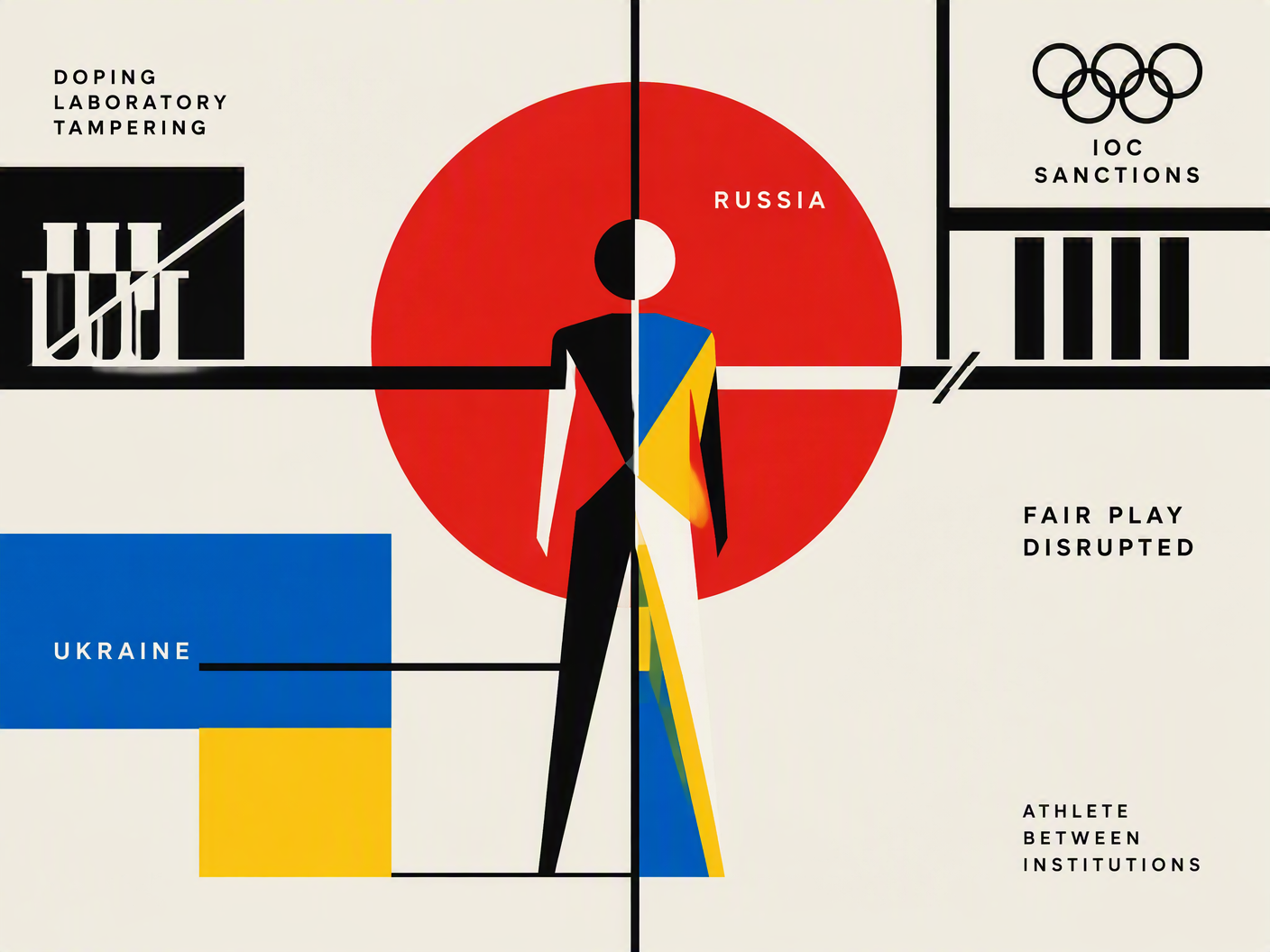
In July 2023, Ukrainian fencer Olga Kharlan was disqualified after refusing to shake the hand of a defeated Russian opponent. She offered a blade tap instead, a gesture shaped by a war that had made ordinary sporting etiquette politically charged. The decision placed one athlete’s body and judgment inside a dispute that had begun years earlier with drug testing, national flags, and the protection of sporting institutions. By then, Russia’s presence in Olympic competition no longer concerned only what athletes had taken. It concerned who could compete, under whose name, and which violations an international federation was prepared to punish.
The first decisive breach had occurred in February 2014 at the Winter Olympics in Sochi. The Games were staged in Russia, where the anti-doping laboratory responsible for testing athletes was tampered with. The laboratory was supposed to represent the boundary between performance and fraud: a controlled public facility where samples could be examined after the private labor of training, travel, dieting, injury management, and competition. Instead, the testing system itself became part of the scandal. Later findings connected the tampering to a broader Russian state-doping program, turning the host nation’s showcase into a question about whether national power had entered the sample room.
The cost of that breach did not fall evenly. Athletes who had trained for years under the assumption that rules applied across borders faced suspicion they had not individually earned, while competitors from other countries had to measure medals against a system whose controls had been compromised. The distinction between an athlete and the state claiming to represent that athlete became central. An Olympic medal is won by a person, but it is counted through flags, committees, laboratories, uniforms, and ceremonies. When those institutions are implicated, the athlete is left carrying both the value of the result and the doubt attached to the institution behind it.
Thomas Bach had become president of the International Olympic Committee in 2013, before the Sochi scandal fully reshaped the politics of Russian participation. Shortly after his election, Vladimir Putin congratulated him by telephone. The call placed Bach’s new presidency within a network of Olympic diplomacy that included heads of state, host governments, national committees, and the vast public investment required to stage the Games. Its existence establishes contact and political context. It does not, by itself, explain how Bach voted, what he knew, or why any IOC decision was made. The connection became part of the public meaning surrounding his later dealings with Russia.
By the 2018 Winter Olympics in Pyeongchang, the IOC had chosen a compromise that separated Russian athletes from the Russian national presentation. They competed as Olympic Athletes from Russia rather than under Russia’s flag. The arrangement preserved a path to participation while withholding the ordinary signs of national recognition. For athletes, that meant entering the largest stage in sport without the uniform political identity that usually accompanies the Olympic experience. The sanction was visible in every ceremony and scoreboard, but it also transferred the burden of a state-linked scandal onto individual competitors whose own conduct was not treated as identical.
At the opening ceremony, Bach told athletes to respect the rules and stay clean. The words were directed at the entire field, but they carried the weight of Sochi and the damaged confidence in anti-doping oversight. A clean-sport appeal can establish a public standard; it cannot repair a compromised laboratory or determine individual responsibility. Bach’s message placed the IOC on the side of rules in language designed for a global audience, while the Olympic program itself showed how difficult enforcement became when the alleged wrongdoing was associated with a state, a national committee, and a large population of athletes.
The dispute then moved beyond prohibited substances. In July 2023, Kharlan’s disqualification made a fencing piste into another site of Russia’s unresolved Olympic status. Her blade tap followed a defeated Russian opponent instead of a handshake, and the governing authority treated the omission as a disciplinary violation. The episode joined the formal language of sporting etiquette to the lived reality of war and political exclusion. Kharlan was not adjudicated for doping, and the incident did not settle the broader scandal. It showed instead how national conflict could reach into the smallest rituals of competition, where athletes were expected to perform respect under conditions that had changed around them.
In October 2023, the IOC suspended the Russian Olympic Committee for violations of the Olympic Charter. The action concerned the committee’s incorporation of Ukrainian sporting bodies from territory annexed by Russia. This was a governance sanction, not an individualized finding that every Russian athlete had doped. It marked a further change in the IOC’s response: from restricting the appearance of Russian competitors to suspending the national institution that organized and represented them. The difference mattered to athletes waiting for decisions about entry, eligibility, and recognition. Their careers were governed through an institution now excluded from the Olympic system it had been built to serve.
Russia appealed the suspension, but the Court of Arbitration for Sport declined the appeal in February 2024. By then, the Olympic question had accumulated separate layers: the tampering of the Sochi laboratory, the later recognition of state doping, the 2018 decision to allow athletes to compete without the Russian flag, and the 2023 suspension tied to territorial governance. Those layers were often compressed into a single argument about Russia. The formal decisions did not do that. They addressed different institutions and different violations, leaving the IOC to manage a problem in which sporting eligibility, national sovereignty, and the credibility of regulation had become inseparable in practice.
Bach’s role sits inside that sequence, but the boundaries are important. He publicly urged athletes to follow rules and remain clean at Pyeongchang. He presided over IOC actions that restricted Russian presentation in 2018 and later suspended the Russian Olympic Committee. Putin’s congratulatory call after Bach’s election remains relevant to the political setting, yet the supplied record does not show that Bach directed Russian doping policy, engineered the Sochi breach, or determined IOC outcomes as a private favor. Nor does it establish that every Russian athlete was individually involved. The documented story is institutional responsibility, public messaging, and sanctions—not proven personal authorship of the scandal.
For Kharlan, the consequences were immediate and personal: a disciplinary ruling attached to a gesture made after a match against a Russian opponent. For Russian athletes, the consequences arrived through altered names, absent flags, eligibility reviews, and the suspension of their national committee. For the IOC, each decision carried a different cost. Leniency risked weakening the rules Bach invoked; collective punishment risked treating athletes as extensions of governments; political engagement risked making Olympic governance appear inseparable from state power. The people who entered the competition area had to live inside those contradictions, even when the institutions arguing over them remained at a distance.
The Sochi laboratory began as a place meant to certify fairness through technical procedure. It became the origin point for a decade in which laboratories, flags, handshakes, national committees, and arbitration rulings all carried political meaning. Bach’s presidency moved through that changing landscape with declarations of clean sport and decisions against Russian participation, while his early contact with Putin remained part of the surrounding political frame. The athletes were left with the practical residue: medals questioned, identities altered, gestures scrutinized, and careers conducted under rules whose legitimacy depended on institutions that had already shown how much power they could hold over the meaning of clean competition.
Investigative Dossier & Evidence
Read the companion investigation notes, verified source claims, and primary documents.
Read the Companion Notes & Evidence Record →