
Point Shaving & Fixes · 1980s
The Good Hand Substitution That Exposed British Racing’s Flockton Grey Scheme
On March 29, 1982, Good Hand ran at Leicester under the name Flockton Grey and won by 20 lengths, turning a routine betting coup into a police investigation. Two years later, owner Ken Richardson and trainer Stephen Wiles were convicted of conspiring to defraud bookmakers, while the Jockey Club barred Richardson from racing for 25 years.
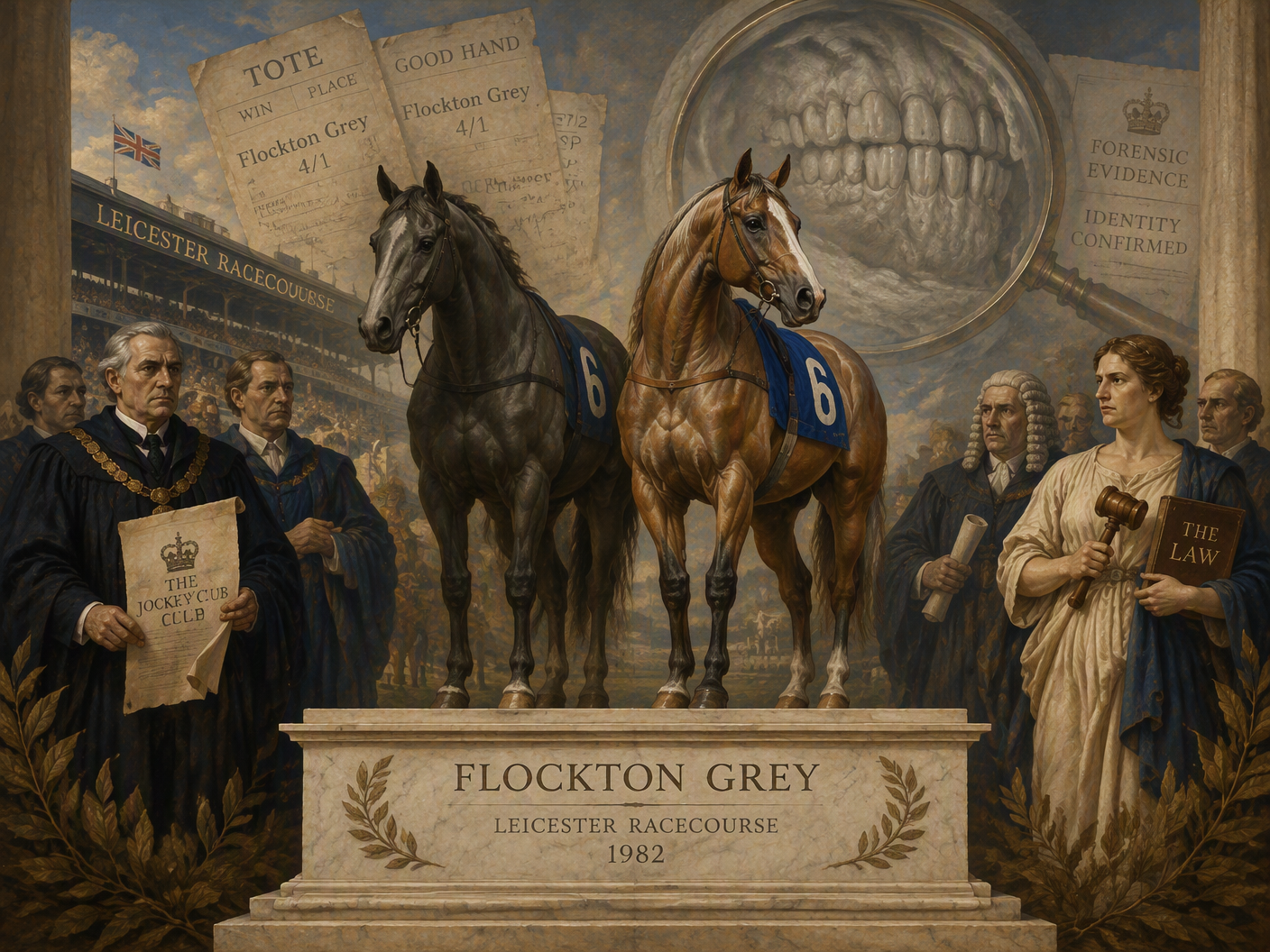
British racing liked to present itself as a pageant of bloodlines, breeding ledgers, polished saddles, and gentlemen who could pronounce “integrity” without choking on the word. At Leicester on March 29, 1982, that decorous fiction acquired four legs and a false name. Flockton Grey had been entered for the race, but Flockton Grey did not run. Good Hand did, carrying the declared horse’s identity into the racecourse and, eventually, into the bookmakers’ nightmares. The substitution was not an administrative clerical error. It was the central mechanism of a conspiracy that converted a horse race into a piece of commercial theater.
The race began under the usual machinery of British racing: horses were presented, names were read, bets were accepted, and money moved through betting shops with the solemn efficiency of a nation posting letters. The public wagered on Flockton Grey. The horse beneath that name was Good Hand. One animal had been entered; another performed. The distinction mattered chiefly to the people placing the bets, although they were granted the privilege of discovering it after the race, when the money had already begun its migration into private pockets.
Then the horse wearing Flockton Grey’s name won by 20 lengths. A narrow victory can be dressed in many respectable garments: a clever ride, a favorable pace, a sudden improvement, perhaps even the mysterious intervention of athletic excellence. Twenty lengths is less accommodating. It left the race looking less like competition than an announcement. The margin drew immediate suspicion and brought police investigators into the affair. The bookmakers, who had been invited to finance the performance, were suddenly expected to admire the choreography.
The first useful witness was not a bookmaker, detective, or informant. It was the horse’s mouth. Official record photographs showed that the winner had developed teeth inconsistent with a two-year-old. The animal presented as a young racehorse possessed dental evidence suggesting a different age, and therefore a different identity. In an industry built on pedigrees, registration papers, and minute distinctions in breeding, the teeth supplied a plainer language than the printed forms. Good Hand had brought its own biography to Leicester, and it was visible whenever anyone looked closely enough.
The substitution gave the betting operation its essential advantage. A horse’s public form belonged to Flockton Grey; the physical animal’s abilities belonged to Good Hand. The bettors were not merely choosing a likely winner. They were choosing a name attached to one horse while another horse supplied the performance. The scheme exploited the distance between the racecourse and the betting counter, between what officials announced and what bookmakers believed they were pricing. A small gap, properly cultivated, could become worth a great deal of money.
Ken Richardson stood at the center of the affair as owner and principal figure. Stephen Wiles, the trainer associated with Flockton Grey, was involved in the substitution and later convicted alongside him. Around them, associates used multiple betting shops to distribute wagers rather than place one conspicuous fortune at a single counter. The bets reached £20,000, a sum large enough to make the supposedly private sport of knowing something in advance resemble a modest banking operation conducted beneath fluorescent lights and beside stale newspapers.
The betting shops supplied the scheme with its camouflage. A single enormous wager might have invited questions; money divided among several premises could pass as the ordinary appetite of racing enthusiasts, provided nobody examined the pattern too closely. The arrangement relied on bookmakers accepting the names presented to them and on the racecourse treating identity as paperwork rather than anatomy. That was the bargain: the institution supplied forms, the conspirators supplied a substitute horse, and everyone hoped the teeth would remain out of the conversation.
The 20-length victory spoiled the quiet ending. Suspicion prompted a police investigation, and the race was reconstructed through the practical debris of the operation: the declared runner, the horse that actually appeared, the betting activity, and the photographs. Flockton Grey’s name had won the race, but Good Hand had supplied the legs. The distinction was no longer a private advantage among men who knew the animals. It became the fact around which the prosecution could organize its case.
At York Crown Court in June 1984, Richardson and Wiles were found guilty of conspiracy to defraud bookmakers by substituting Good Hand for Flockton Grey. Richardson had been charged with conspiracy to defraud and received a suspended sentence. Wiles was convicted for his role in the ringer scheme. The court therefore supplied the part that racing’s own paperwork had failed to provide: a formal account of responsibility. The horse could not be sentenced, which was fortunate, since its only contribution had been to run very well under somebody else’s name.
The Jockey Club answered in its own institutional dialect. After the scandal, Richardson received a warning from the governing body and was barred from racing for 25 years. The prohibition was longer than the useful life of many horses and nearly theatrical in its duration, but racing’s disciplinary machinery had discovered that time could be used as a substitute for explanation. The sport had permitted a horse’s identity to be traded for betting advantage; it now protected its reputation with a calendar.
The scandal’s mechanics were neither mystical nor sophisticated. A declared horse was replaced. A different animal won by an extraordinary margin. Bets were spread across multiple shops, reaching £20,000. Photographs exposed teeth that did not fit the supposed age of the winner. Police investigated, and a court convicted the owner and trainer. The operation depended on ordinary people accepting official names at face value, which is perhaps the most reliable technology ever invented for separating bookmakers from their money.
Flockton Grey became the name attached to the scandal, though Flockton Grey never ran the Leicester race that made the name notorious. Good Hand performed the winning act; Richardson and Wiles carried the legal consequences; bookmakers absorbed the intended loss; and the Jockey Club attempted to seal the breach with a 25-year ban. The grand language of racing—honor, breeding, tradition—ended in a simpler arrangement: one horse substituted for another, several betting shops used as cover, and a set of teeth that refused to cooperate with the paperwork.
Investigative Dossier & Evidence
Read the companion investigation notes, verified source claims, and primary documents.
Read the Companion Notes & Evidence Record →