
Tragedy · 1980s
The 14th-Round Knockout That Changed Championship Boxing
On November 13, 1982, Ray Mancini stopped Kim Duk-koo in the 14th round of a scheduled 15-round WBA lightweight title fight at Caesars Palace. Kim’s collapse, emergency brain surgery, and death five days later preceded a staggered move by boxing’s major sanctioning bodies to 12-round championship contests.
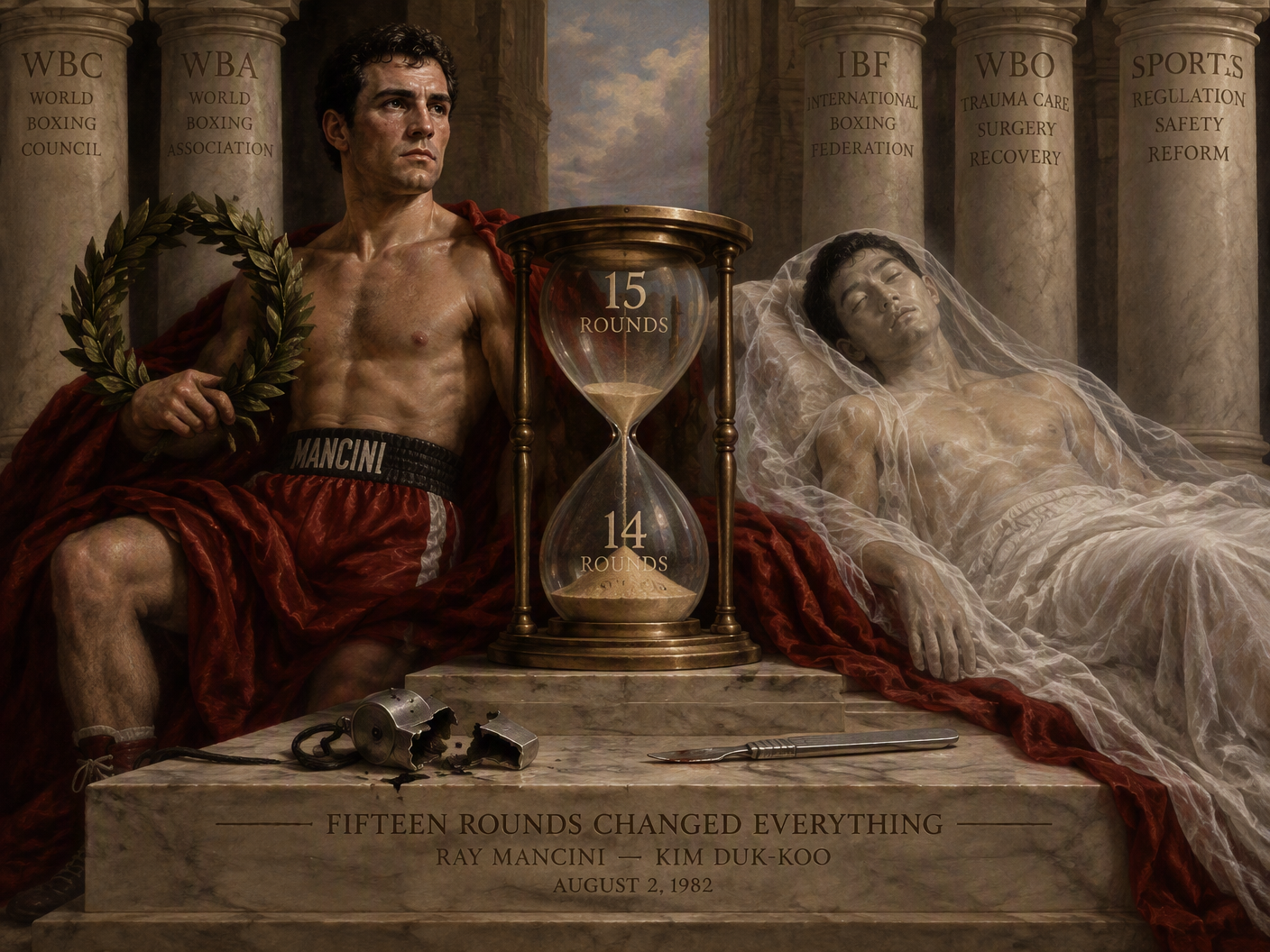
On November 13, 1982, at Caesars Palace in Paradise, Nevada, Ray Mancini and Kim Duk-koo entered a ring built for fifteen rounds. Mancini held the WBA lightweight championship. Kim was the challenger, fighting for the title across a distance that had defined championship boxing for generations. The contest ended before the scheduled final bell. In the 14th round, referee Richard Green stopped the fight after Mancini knocked Kim down and Kim could not continue effectively. Mancini retained the championship by knockout.
The result initially belonged to the ordinary order of prizefighting: a champion had defended his belt, a challenger had been stopped, and the officials had recorded the outcome. The fight’s significance changed after Kim left the ring. He collapsed and was taken to Desert Springs Hospital for emergency treatment. The sequence moved quickly from the regulated violence of a title contest to the procedures of a hospital, where physicians examined an injury that could not be settled by a referee’s decision or a championship ledger.
A scan showed a subdural hematoma, a collection of blood pressing inside Kim’s skull. Surgeon Lonnie Hammargren performed emergency brain surgery. The operation placed the fight inside a different institutional system, one governed by scans, operating rooms, and the narrow decisions of physicians rather than by rounds, judges, or the authority of the Nevada officials. Kim had been knocked down in the 14th round; now doctors were attempting to relieve the consequences of what had happened before the scheduled 15th could ever arrive.
Kim remained under treatment for five days. On November 18, 1982, he was pronounced dead in Nevada. His death fixed the bout in public memory, but the immediate facts were more exact than the myths that gathered around them: a title fight had been scheduled for fifteen rounds; Mancini had won by a 14th-round knockout; Kim had collapsed afterward, undergone emergency surgery, and died five days later. Those facts supplied the chronology from which boxing’s subsequent debate over championship distance began.
Mancini’s role in the event was the role assigned to him by the contest’s rules: he fought the challenger until the referee stopped the bout. The fight was not fixed, and the documented sequence does not support turning the outcome into a concealed arrangement. Nor does a rumored handwritten note attributed to Kim establish a particular intention beyond the circumstances in which it was discussed. What could be stated plainly was the physical and institutional sequence: fourteen rounds were completed, the challenger was knocked out, and the challenger died after the fight.
The first major regulatory response came from the World Boxing Council. Between December 1, 1982, and January 1, 1983, the organization announced that its title fights would be reduced to twelve rounds, with the new distance effective January 1. The change shortened the maximum duration of a championship contest by three rounds. It did not erase the traditions that had made fifteen-round fights a measure of endurance, but it altered the formal boundary within which future champions and challengers would be required to compete.
The WBC decision did not instantly establish one rule for every championship in the sport. Boxing’s sanctioning bodies operated separately, awarding their own titles and setting their own procedures. The WBA, the organization that had sanctioned Mancini and Kim, retained the fifteen-round championship distance until October 1987, when it reduced title fights to twelve rounds. The delay mattered. It showed that the post-fight response was not a single order issued across boxing, but a series of institutional decisions made on different schedules.
The International Boxing Federation followed in June 1988, when it voted to switch its championship fights to twelve rounds. By then, the three principal sanctioning bodies had moved away from fifteen-round title contests, though they had reached that position at different times. The change was linked in time to Kim’s death and to the safety questions that followed it. The chronology supports that connection without reducing every decision to one official explanation or assigning the entire reform to one person.
The altered distance also changed what a championship fight demanded from the people inside it. A boxer preparing for fifteen rounds had been trained to preserve strength, absorb punishment, and remain capable of fighting deep into a contest. A twelve-round limit removed three rounds from that design. It did not make boxing safe, and it did not transform the sport’s basic act of striking another person. It established a different maximum for the contests that carried the sanctioning bodies’ titles.
For Mancini, the November fight remained both a victory and the event through which his name became inseparable from Kim’s death. For Kim, the bout ended not with the bell that would have completed fifteen rounds, but with a knockout, a hospital transfer, surgery, and death on November 18. For boxing’s governing organizations, the afterlife was written into rulebooks over the next six years. The twelve-round championship became the durable institutional answer to a fourteen-round fight that no longer ended at the ring.
Investigative Dossier & Evidence
Read the companion investigation notes, verified source claims, and primary documents.
Read the Companion Notes & Evidence Record →