
Tragedy · 1840s
The Wakefield Orangery Bear Escape and the Death of Hannah Haselgrave
In 1844, a bear escaped from its pit at the Orangery in Wakefield, killed Hannah Haselgrave, and badly injured another person before a butcher shot the animal. The calamity grew from a decision made three years earlier, when the Orangery bought the bear and confined it on grounds used by the public.
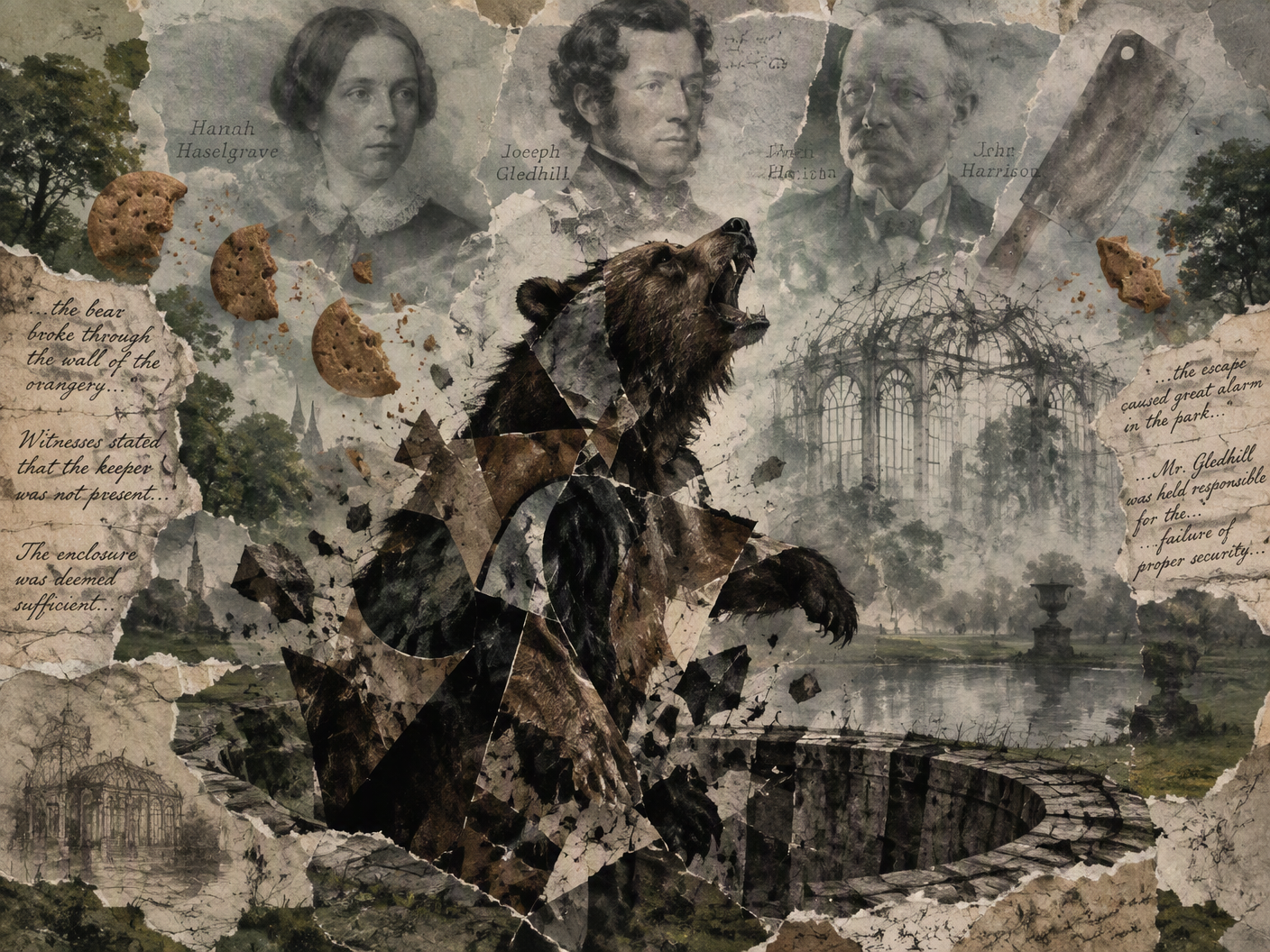
In 1844, a bear leaped from its pit at the Orangery in Wakefield. The boundary between captive animal and public grounds disappeared in that instant. Joseph Gledhill, a biscuit hawker, encountered the bear outside its enclosure and gave it a biscuit. He then went for help. Before the emergency ended, Hannah Haselgrave had been killed, another person had been badly injured, and the bear itself had been shot dead. What began as an escape became a fatal attack within the same grounds where the animal had been kept for three years.
The Orangery had bought the bear three years before the escape. Its pit imposed the arrangement on which such captivity depended: the animal remained inside, while people occupied the space beyond it. Ownership had converted a powerful animal into an attraction under human control, but it had also placed responsibility for that control on the institution that kept it. For three years, the separation held. In 1844, it failed at its essential purpose, and the danger once contained below the edge of the pit moved among people in the grounds.
Gledhill’s place in the sequence was preserved because he later testified at the inquest. He said the bear leaped out of the pit. His decision to offer it a biscuit belonged to the first moments of the escape, before the encounter had acquired its fatal meaning. As a biscuit hawker, he carried the very thing he placed before the animal. The gesture was small and immediate. It neither restored the bear to confinement nor ended the danger. Gledhill left to obtain assistance while the escaped animal remained loose.
The episode then changed from an institutional failure into an attack on human beings. The bear encountered people in the Orangery grounds and inflicted grave injuries. One person survived after being badly hurt. Hannah Haselgrave did not. Her death gave the escape its enduring human consequence and brought the conduct of the bear, its confinement, and the response after it broke free into the formal work of an inquest. The public calamity could no longer be remembered merely as an animal loose from a pit.
Haselgrave’s name is central because the loss was hers. Later retellings could make the bear the spectacle: an exotic captive, an impossible leap, a pursuit across public ground. The inquest preserved a different center. A woman had been killed at the site where the animal was confined, and another person had suffered serious injury. The bear’s escape supplied the extraordinary circumstance, but Haselgrave’s death supplied the legal and human reason for reconstructing the order of events and taking testimony from the people who had seen them.
The immediate danger ended through lethal force. John Harrison, a butcher, fired the shot that killed the bear after the attack. His intervention closed the physical emergency but could not reverse what had happened in the grounds. The captive animal purchased three years earlier was dead; Hannah Haselgrave was dead; another injured person remained among the consequences. The sequence was compressed, without a prolonged search or distant capture. The bear escaped, encountered people near the place of its confinement, attacked them, and was shot.
At the inquest, Gledhill’s testimony fixed the crucial first movement: the bear had leaped out of the pit. That detail placed the origin of the calamity at the enclosure itself. Gledhill also became inseparable from the unusual fact that preceded the violence—his gift of a biscuit to the escaped animal. In another setting, the exchange might have survived as local amusement. After Haselgrave’s death, it became part of a formal chronology, the last ordinary action in the encounter before help was sought and the full danger became apparent.
The institutional decision lay three years behind the fatal day. The Orangery had acquired the bear and kept it in a pit, concentrating both possession and risk on one site. Once the animal cleared the enclosure, that risk passed immediately to the people in the surrounding grounds. Haselgrave bore its final cost. The other injured person bore it physically. Gledhill became a witness required to explain how the bear had emerged, and Harrison became the man who ended the threat with a firearm. Each role followed from the failed separation at the pit.
Bear-pit stories later accumulated embellishments beyond Wakefield, including tales of captive bears eating children and a boy killed after falling into a pit at Sheffield Botanical Gardens. Those stories persisted as rumor. The Wakefield incident retained a narrower and more exact form because named people were attached to successive acts: Gledhill saw the leap and offered the biscuit; Haselgrave was killed; another person was badly injured; Harrison fired the fatal shot. The specificity prevented the event from dissolving entirely into folklore about dangerous animals and Victorian public amusements.
Much later, artist Rebecca Chesney returned to the Orangery incident through portraiture. She completed portraits for a Wakefield project drawn from a series of thirteen characters connected to the accidental death on the site in 1844. The project gave individual form to an episode often compressed into the image of an escaped bear. Its enduring subjects were the people drawn into the sequence by work, proximity, injury, responsibility, or death. The Orangery’s bear survived only as history; Haselgrave, Gledhill, Harrison, and the others remained attached to the place by name.
Investigative Dossier & Evidence
Read the companion investigation notes, verified source claims, and primary documents.
Read the Companion Notes & Evidence Record →