
Tragedy · 1902
The West Tribune Collapse at Ibrox and the Match That Continued
On 5 April 1902, part of the West Tribune Stand failed during Scotland–England, killing 25 spectators and injuring more than 500. Officials resumed the match before the football authorities voided its result, while the prosecution and rebuilding that followed exposed the limits of the wooden stand.
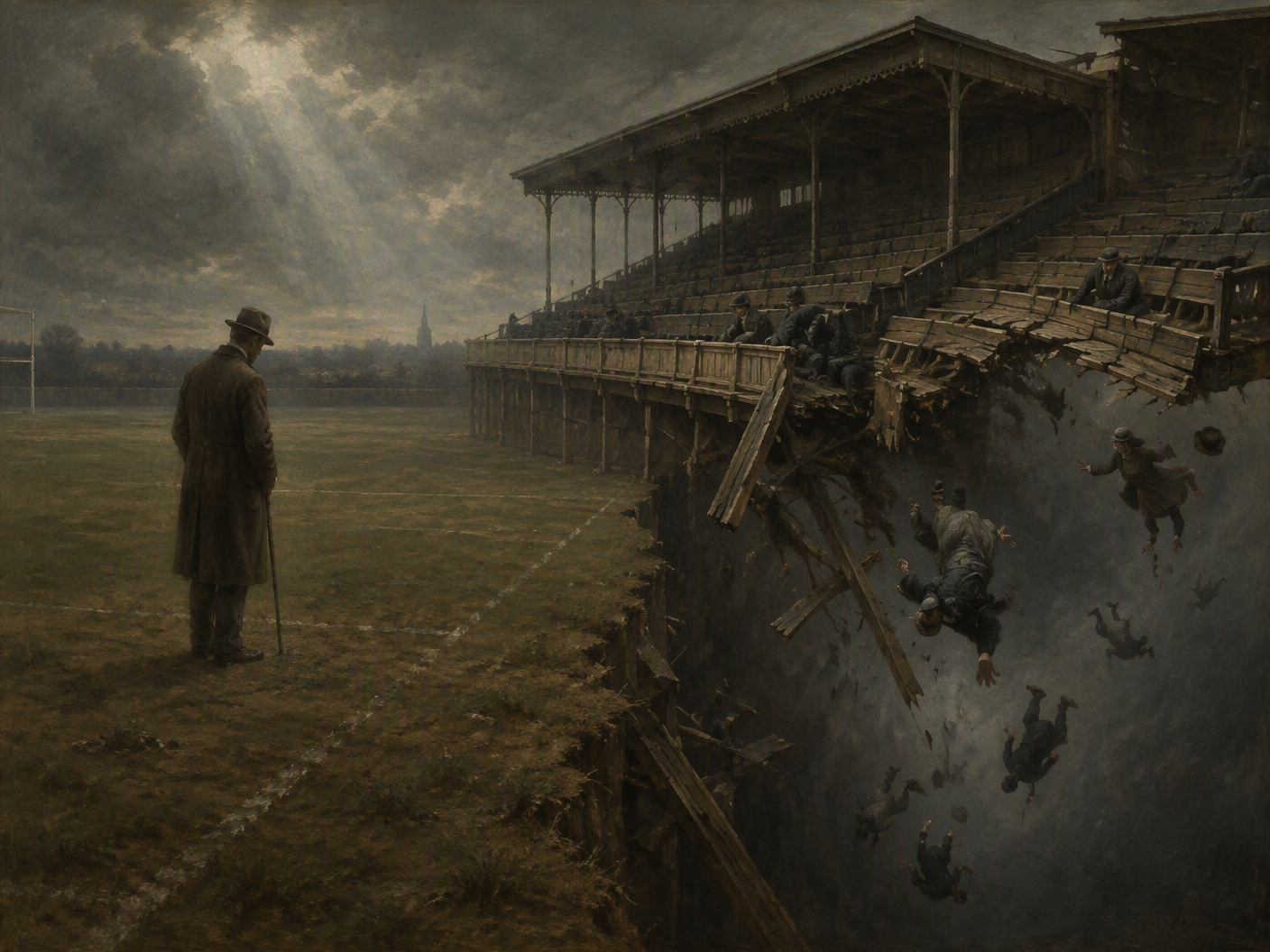
On 5 April 1902, during the Scotland–England match at Ibrox Park in Govan, a section of the West Tribune Stand gave way beneath the spectators. People fell through the broken structure as timber and bodies descended into the space below. On the field, Scotland’s Bobby Templeton had been carrying the ball moments earlier. His position in the sequence later supplied an easy fragment for retellings, but no player and no single passage of play caused the stand to fail. The decisive event was structural: part of a crowded wooden terrace could no longer bear its load.
The scale of the disaster emerged through the work of removal, treatment and identification. Twenty-five people died. More than 500 were injured, though early totals varied as casualties moved through hospitals and families sought relatives. The numbers placed the collapse beyond the boundaries of a sporting mishap. Spectators had entered a football ground and become victims of a mass-casualty event created by the place built to hold them. The risk had been transferred from the match organizers and the structure’s suppliers to people who had purchased admission and stood together on the West Tribune.
The players understood only fragments at first. Scotland’s Alex Raisbeck later recalled that the movement in the crowd appeared to them like a pitch invasion. From field level, the structural failure did not immediately present itself as a complete disaster. What had happened beyond the touchline had to be recognized amid the interruption and confusion. The officials stopped play, but the suspension was temporary. The same afternoon, while casualties were still being dealt with, the teams returned to the match. The decision joined two incompatible realities at Ibrox: emergency operations around the broken stand and organized football continuing on the field.
The resumed game ended 1–1. That score entered the afternoon’s first administrative account, but it could not settle what the football authorities were to do with a fixture conducted across the dividing line of the collapse. In 1902, the associations governed the international match through their councils and agreements; there was no standing modern protocol designed for a disaster of this scale. Resumption had been the decision made inside the ground. Once officials had time to consider the deaths, injuries and interruption, they faced a second question: whether a match completed under those conditions could remain an official contest.
On 19 April, the Football Association Council declared the original match unfinished. The English and Scottish associations agreed to void the 1–1 result, establish relief arrangements and stage the fixture again. The reversal did not undo the decision to resume play; it separated the official competition from the afternoon on which 25 people had died. The first score ceased to count, but the match itself remained inseparable from the disaster because the continuation had shown how quickly sporting procedure could reassert itself before the dimensions of an emergency were understood.
The replay took place at Villa Park in Birmingham on 3 May 1902. Scotland and England drew 2–2. It supplied the associations with a valid result and provided a practical means of raising relief money, but it could not function as a replacement for what had happened at Ibrox. The voiding of the first score concerned football administration, not the consequences carried by the dead, the injured and their families. One match had been removed from the official competition. The collapse that interrupted it remained the event requiring explanation.
Attention turned to the West Tribune itself. Archibald Leitch, the stadium architect who had designed the stand, expressed anguish over the accident. The structure belonged to a period when large football crowds were being accommodated through ambitious combinations of timber and steel, while the institutions governing the game were still developing standards equal to the numbers entering the grounds. The failure raised questions extending from design to materials and construction. Yet the criminal case that followed did not proceed against Rangers, the Scottish Football Association or Leitch. It focused on Alexander McDougall, the timber merchant whose wood had been used in the stand.
In June 1902, McDougall was charged with culpable homicide. The prosecution placed the quality and supply of the timber at the center of a criminal proceeding arising from 25 deaths. A charge of that gravity offered the prospect of locating responsibility in one commercial actor, but the courtroom did not produce a conviction. McDougall was acquitted. The verdict closed the case against the timber supplier without converting the disaster into a simple account of one guilty man. The stand had collapsed; the casualties were established; criminal blame was not assigned to McDougall by the court.
The acquittal left engineering and institutional consequences to carry what the prosecution had not resolved. Ibrox required redevelopment, and Rangers again employed Leitch to oversee it. His return was one of the episode’s most revealing reversals: the architect connected to the failed stand was not permanently excluded from stadium work but entrusted with helping redesign the ground. Leitch would remain an important figure in British football architecture. The response to Ibrox therefore developed through altered construction practice rather than through the removal of every person associated with the original structure.
The broader change was material. Stadium construction moved away from vulnerable wooden frameworks carried on steel supports and toward terracing formed from earth embankments or reinforced concrete. The transition was neither an abstract architectural preference nor a ceremonial tribute. It addressed the conditions revealed at Ibrox: a dense public gathering placed upon a structure whose failure could turn ordinary spectator movement into a mass fall. Later grounds retained the commercial purpose of bringing large crowds close to the field, but the physical bargain began to change. Capacity could no longer be treated apart from the means by which that capacity was supported.
The lasting account of 5 April contains two institutional decisions made at different speeds. Inside Ibrox, officials resumed the game and reached a 1–1 finish. Two weeks later, the governing associations removed that result and ordered another match. Beyond the councils and score lines, the more durable answer appeared in rebuilt terraces and changed structural practice. The official fixture could be replayed at Villa Park; the West Tribune could not be restored by administrative ruling. Its afterlife remained in the construction methods that British stadium builders increasingly left behind.
Investigative Dossier & Evidence
Read the companion investigation notes, verified source claims, and primary documents.
Read the Companion Notes & Evidence Record →