
Point Shaving & Fixes · 1906
The 1906 Canton–Massillon Fix Allegations and the Fight That Followed
A split two-game series between Canton and Massillon turned into a public dispute over alleged bribery, a hotel-bar brawl, and libel litigation. The accusations damaged attendance and player pay, but no court established that either team had fixed a game.
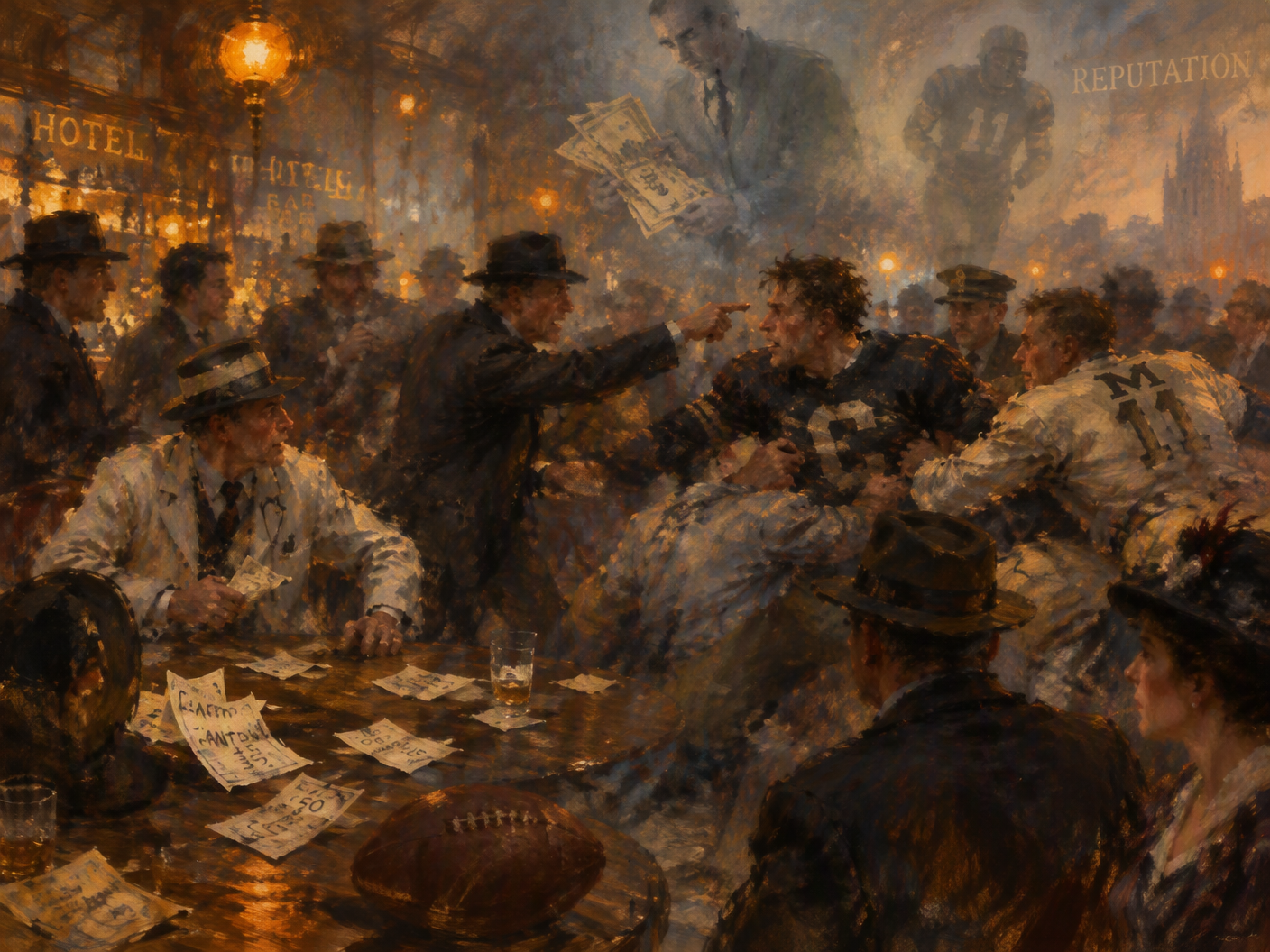
Massillon won the rematch 13–6 on November 24, 1906, and the result immediately acquired a second meaning. Ed Stewart, Massillon’s manager and a newspaper figure, publicly charged that someone had tried to bribe Massillon players to throw the game. The accusation moved through the two cities before the players had left the dispute behind. It named no settled conspiracy, but it placed money, loyalty, and the credibility of the series in the same sentence. Canton denied the charge. The rivalry became a public argument over whether the contest had been played or arranged.
The series had begun eight days earlier at Mahaffey Park in Canton. Canton defeated Massillon 10–5 on November 16, with Blondy Wallace coaching the Bulldogs and Sherburn Wightman directing Massillon. The rematch shifted to Hospital Grounds Stadium in Massillon, where the Tigers reversed the scoreline and won by seven points. Two games, two home victories, and a split record should have closed the season’s argument. Instead, the reversal supplied the fact around which suspicion could gather.
Wallace occupied a vulnerable position in the dispute. He had coached Canton through both games, and his name entered the allegations as part of a supposed effort to fix the series. Walter East, a Massillon end, was also named. The charge did not remain a private complaint between athletes or managers. It became an accusation about the control of a football team, the influence of betting, and the ability of prominent men to determine what happened on the field.
Stewart’s charge supplied the alleged mechanism: money offered to Massillon players in exchange for losing. That was more precise than saying the game had seemed irregular, but it was still an accusation rather than an established finding. Canton rejected it, while the names of Wallace and East circulated alongside claims that the series itself had been manipulated. Wightman, Massillon’s coach, appeared in the competing allegations surrounding the episode. The dispute therefore produced two opposing assignments of responsibility, each attached to people inside the teams.
The argument left the newspapers and reached the Courtland Hotel Bar in Canton. There, public allegations that the game had been fixed preceded a physical disturbance involving Canton players, fans, and Victor Kaufmann, a physician and bettor described as having suffered heavy betting losses. Kaufmann was said to have made the fix allegations loudly. The confrontation became a barroom brawl, and police were called to break it up. The controversy now had a visible consequence beyond disputed words: people had been drawn into a fight over the meaning of a football score.
The newspapers kept the dispute in circulation. Stewart’s public statements and the reporting connected to Massillon carried the bribery accusation, while Canton answered with denials. The competing claims did not produce a common account of who had approached whom, what money had changed hands, or whether any player had agreed to alter the result. Wallace and East remained attached to the allegations, but attachment was not judgment. The accusation spread faster than any formal process capable of testing it.
Wallace eventually answered through civil litigation. He filed a libel lawsuit against Stewart and the Massillon Independent, turning the newspaper conflict into a legal dispute over published accusations and reputational injury. The suit did not itself establish that the game had been fixed. It showed instead how quickly a contest between two football clubs could become a case about public speech, named individuals, and the cost of repeating an allegation in print.
The financial consequences appeared at the next major fixture. On Thanksgiving Day, Canton played the Latrobe Athletic Association before a very small crowd. Gate receipts were insufficient to pay the Canton players, leaving the team without compensation for the game. The attendance collapse followed the accusations and the public disorder closely enough to become part of the controversy’s practical aftermath. Whatever the truth of the bribery charge, the dispute had already imposed a measurable cost on the people whose labor produced the spectacle.
The episode also exposed the weak boundary between football administration and commercial pressure in 1906. Betting losses could intensify a public accusation; newspaper ownership could amplify it; team officials could answer through denials or litigation; and players could absorb the financial damage when spectators stayed away. No league inquiry or disciplinary ruling converted the claims into a proven fixing scheme. The series remained a split result: Canton’s 10–5 victory at Mahaffey Park, followed by Massillon’s 13–6 win at Hospital Grounds Stadium.
What endured was not a demonstrated conspiracy but the sequence of consequences attached to the allegation. Stewart accused unnamed parties of attempting to bribe Massillon players. Wallace and East were named in claims of collusion. Canton denied the charges. Kaufmann’s betting losses and the Courtland Hotel brawl gave the dispute a physical edge, while Wallace’s libel suit carried it into court. The Thanksgiving crowd then supplied the balance sheet: fewer spectators, and Canton players left unpaid.
The court never established that Canton or Massillon had thrown a game, and no criminal conviction or formal football sanction followed from the allegations. But the absence of an adjudicated fix did not erase what the dispute accomplished in public life. A two-game series became a fight over bribery, a newspaper battle, a police matter, and a financial loss. In late 1906, the score was settled on the field. The consequences were not.
Investigative Dossier & Evidence
Read the companion investigation notes, verified source claims, and primary documents.
Read the Companion Notes & Evidence Record →